
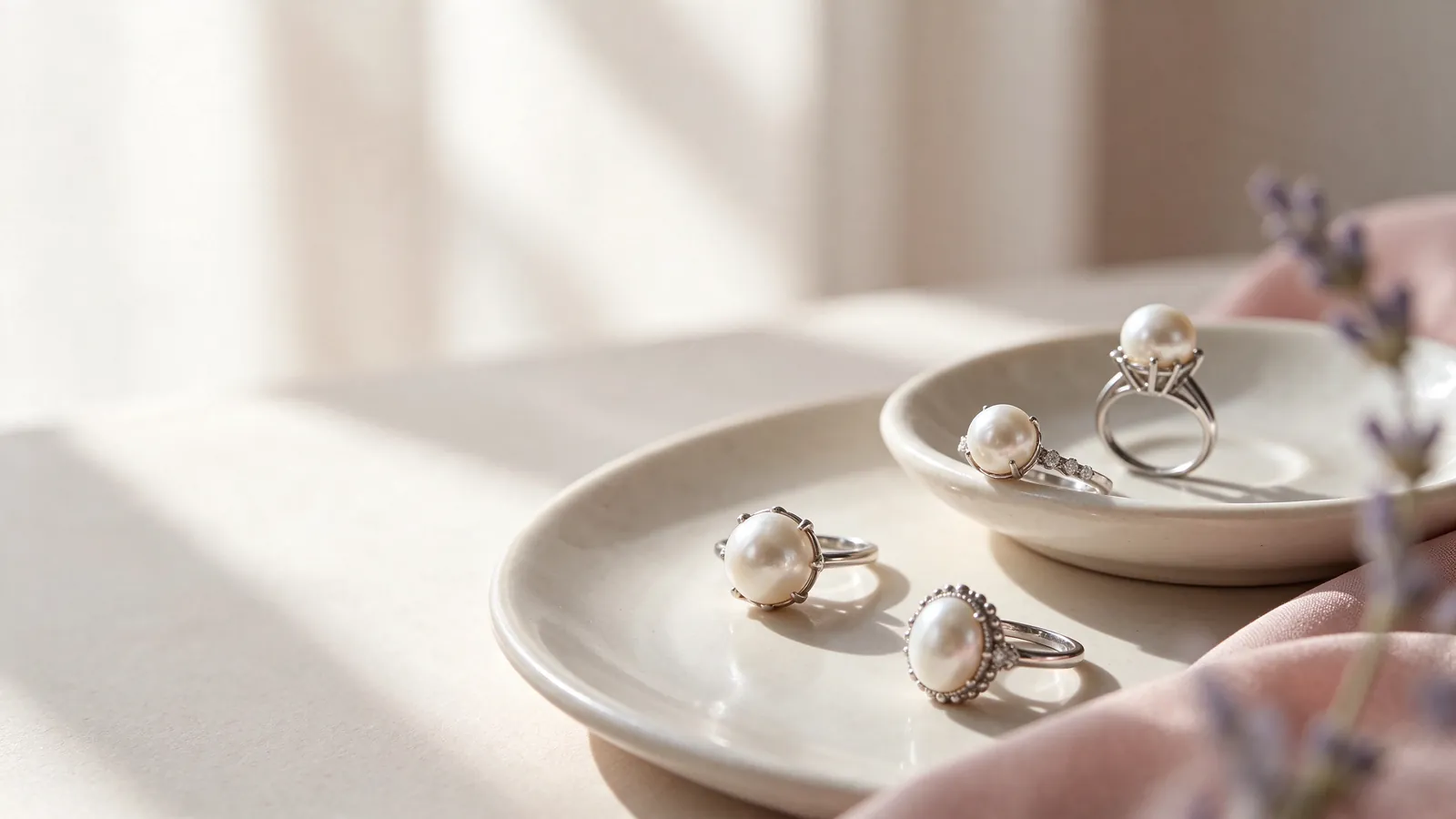
How do pearl and band proportions shape the look of a pavé pearl ring, a diamond pave pearl ring or a pave setting pearl ring?
Think first about where you want attention to land. If the pearl should be the clear center, compare how much space remains around it and whether the band supports rather than competes with its outline. If you want a broader sparkling impression, notice how the diamonds extend towards the shoulders and how much of the finger the whole design occupies visually. A narrow band is not automatically subtle, and a broad band is not automatically too much; the relationship between the elements decides the effect.
Photographs can exaggerate these differences when the camera distance or angle changes. While comparing pearl rings, look for a relaxed whole-hand view as well as close details, and keep the hand position consistent during a try-on. Examine the visible metal border and the transition below the pearl, not just the brightest stones. The best balance for your taste may be a distinct soft center, a continuous sparkling frame or something between them. Naming that preference makes later comparisons much more focused.
How can a side view and try-on help you compare fit in a pavé pearl ring, a diamond pave pearl ring or a pave setting pearl ring?
A side view shows how the pearl setting rises above the band and where nearby jewelry might touch it. During a try-on, open and bend the fingers gently, then relax the hand. Notice pressure at the sides, the passage over the knuckle and any repeated turning of the center instead of judging fit from a posed picture.
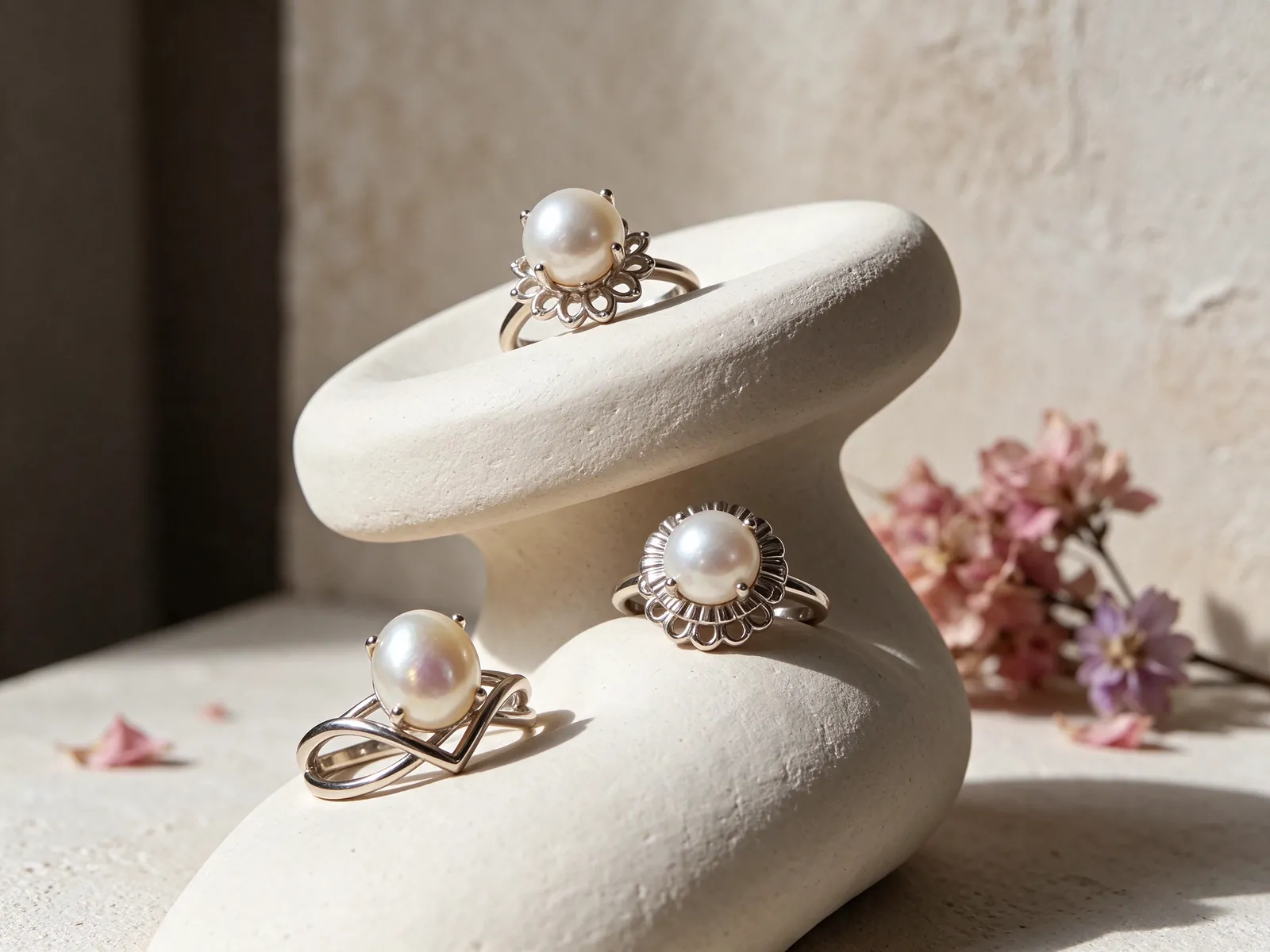
Ask what the diamonds do, not just what the style is called
Pavé commonly refers to closely arranged small diamonds producing a paved-looking surface. That description tells you about an effect, but it does not mean every design with small diamonds has identical construction. Micro-setting relates to fine setting work, and a cluster can gather stones into a recognizable motif rather than a continuous band. Before choosing a pave setting pearl ring by its name, ask where the diamonds sit, how their pattern develops and what visible metal surrounds them. Those details are the foundation of a useful comparison.
A pearl halo ring directs the eye around the center pearl. Diamonds set along the shoulders instead draw bright lines outward towards the finger. Some designs combine these elements, so the distinction is about placement rather than a rule that only one can appear. Exploring a pearl and diamond ring more broadly helps you compare individual accents, patterned groups and close-set bands. If you dislike a crowded center, study the gap between the pearl and its surroundings; if you enjoy a strong border, follow its complete outline.
Read the close-up together with the profile
A close-up can show the route of the diamonds and the metal edges beside them. A profile adds the transition into the pearl setting and areas hidden from above. Keep both views, but do not infer smoothness against fabric from either one; that is something to explore carefully during a try-on.
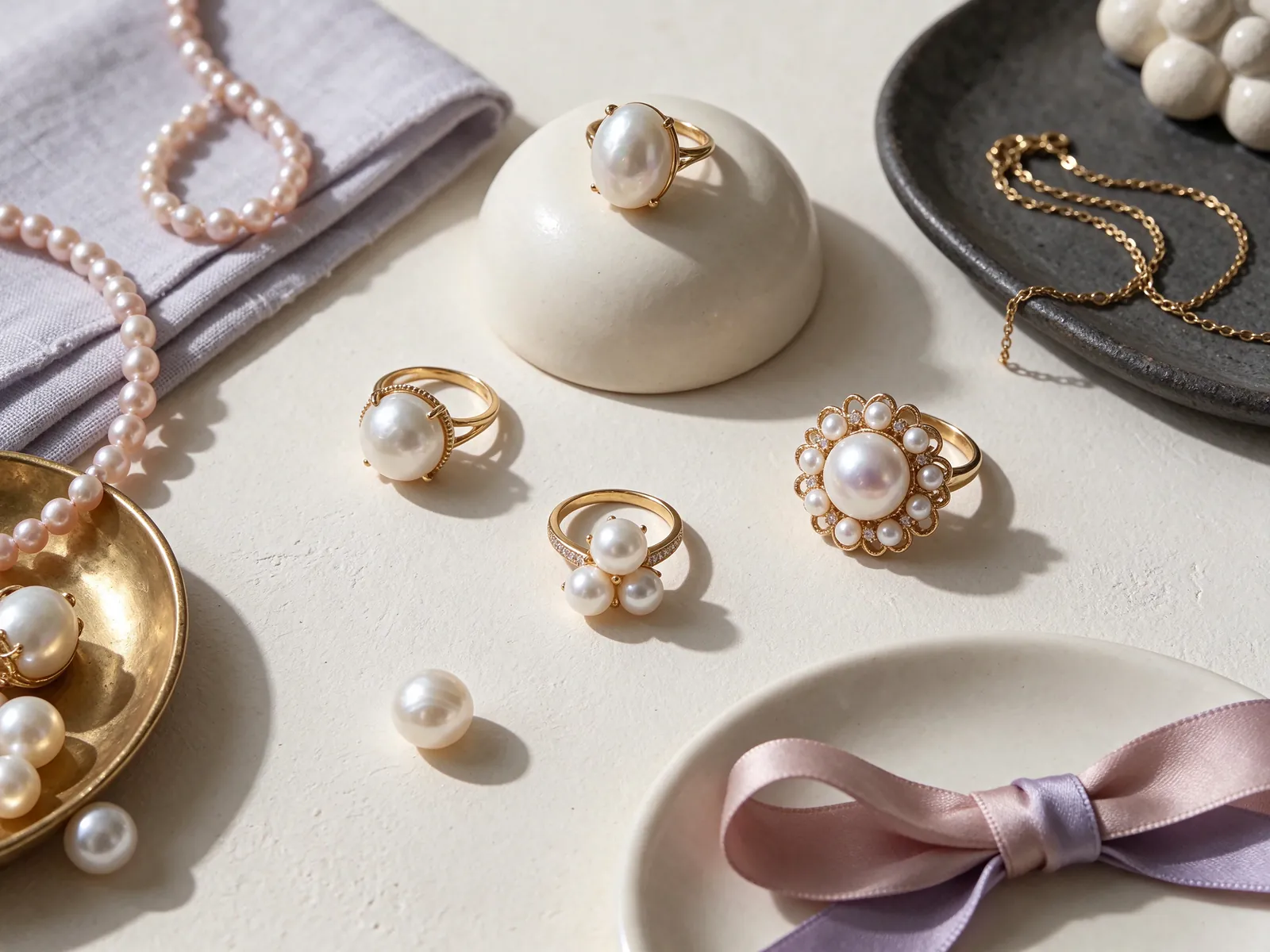
Evaluate the pearl without letting the diamonds answer for it
Take a second look away from concentrated spot lighting. In softer, more even light, observe the pearl's reflections, surface appearance and color against your hand. GIA identifies seven pearl quality factors: size, shape, color, luster, surface quality, nacre quality and, for jewelry with multiple pearls, matching. The list helps explain why a bright picture or a pleasing round outline is only part of the discussion. Diamonds can change the ring's visual energy, but their presence does not establish the pearl's quality, identity or accompanying documentation.
If your search includes an Akoya pearl ring or a Tahitian pearl ring, separate questions about pearl identity from questions about pavé placement. The pearl category and the diamond layout describe different things. Color and shape alone cannot confirm origin, natural-versus-cultured identity or certification, even when the ring looks distinctive. Read the actual description of the pearl being discussed, and use consistent lighting for visual comparison. Background color and exposure can influence your impression, so avoid treating differences between unrelated photographs as reliable differences between pearls.
Keep color preference separate from identity
GIA distinguishes bodycolor, overtone and orient; not every pearl shows all three. Rotate the ring to see whether a nearby warm or cool reflection moves with the metal. You can decide that a tone looks good on your skin without making an unsupported conclusion about what kind of pearl it is.
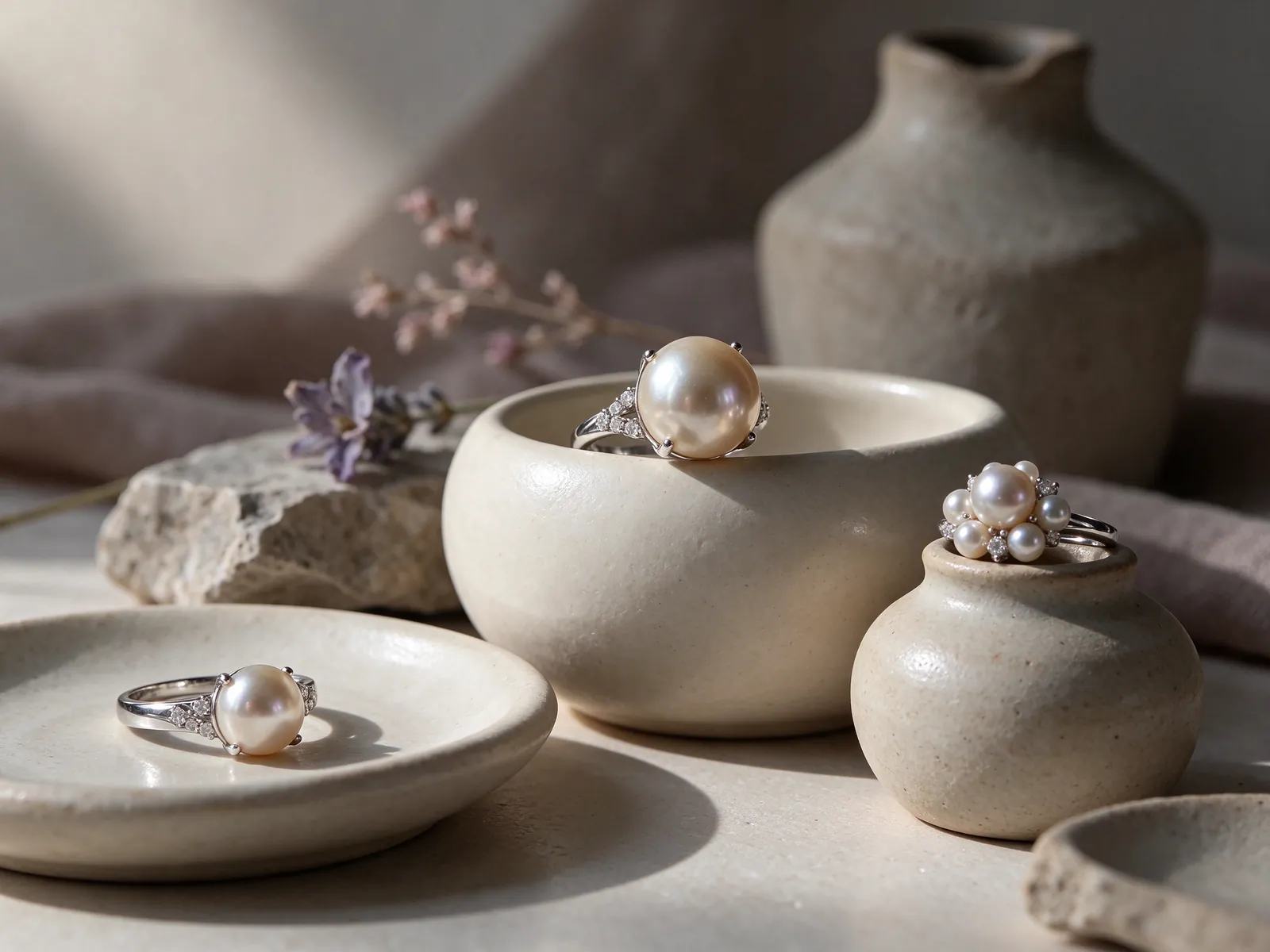
Consider how the ring behaves on your working hand
A ring's feel is shaped by band width, the inside contour and the location of its edges, not just the nominal size. Close your fingers gently to discover whether the diamond-set sides meet neighboring fingers. Then think about the raised center when reaching into a pocket, putting on a jacket or holding a bag. Using your usual phone grip or writing posture can make the comparison more realistic. A comfortable-looking front view cannot show all the places where a ring may meet your daily routine.
If the pearl repeatedly turns to one side, describe that behavior during the fitting discussion. It may involve the fit, the distribution of the upper structure and your finger shape; tightening should not be treated as an automatic answer. Explain whether you plan frequent wear or occasional wear and whether the ring will sit next to another band. If a size change is being considered, ask how far the diamonds continue around the shank and how that arrangement affects the method. Different constructions cannot be assumed to accept the same adjustment.
Try a short sequence of natural movements
With the ring in a safe try-on setting, relax the hand, bend the fingers slowly and gently open them again. Compare the height with a familiar sleeve without deliberately snagging fabric. When trying an adjacent band, inspect both pieces from the side and notice whether they touch the pearl as your hand moves.
Choose a styling role before adding more sparkle
A pavé pearl ring can be the main detail on the hand without making every other piece of jewelry equally bright. A plain sleeve gives the pearl and band a clear background; a heavily patterned or textured sleeve may change which element catches attention first. Instead of matching the exact sparkle elsewhere, try repeating a curve or a metal color. The design does not have to be reserved for formal events. Its scale, open space and relationship to the outfit can create a quieter or more pronounced impression.
If you are drawn to a pearl cocktail ring, decide whether the hand should carry the strongest statement or share that role with earrings. Under evening lighting, individual diamond flashes may become more noticeable, so view the outfit as a whole rather than adding pieces one by one without reassessing. For stacking, start with physical clearance instead of color harmony. Another band can look perfect from above while rubbing against the pearl or setting from the side. Separate fingers may offer a better way to keep the intended visual combination.
Match the silhouette to what you actually wear
Consider your most common cuffs, outerwear and bag handles. A raised center meets a fitted cuff differently from a loose sleeve. Ask whether the combination lets you dress and handle belongings naturally. This practical check adds something that a styled photograph, however attractive, cannot tell you.
Let the pearl set the limits of the cleaning routine
The sparkle of the band should not suggest that the entire ring has the same resistance to scratches. GIA lists pearl at 2.5 on the Mohs hardness scale. That is a useful reason to protect the pearl from rubbing against harder objects, not a measure of how much impact a ring can withstand. Remove it for housework, cleaning products and activities likely to knock the center. Store the piece with the pearl separated from other metal or gemstones instead of leaving jewelry surfaces to rub together.
Although small spaces between diamonds can look difficult to clean, GIA says pearls should never go into ultrasonic or steam cleaners. Use a very soft, clean cloth after wearing, and avoid acids, perfume, hair spray and excessive heat around the pearl. If you notice a catching edge, a visibly loose part or a change in the diamond arrangement, do not probe between stones or attempt to secure the setting with household glue. Have the complete structure assessed before choosing a cleaning or repair approach.
Make safe handling easy to repeat
Put the ring on after perfume and hair products, and take it off before washing or using cleaners. Keep a soft cloth and a separate storage spot ready where you normally remove jewelry. A consistent routine is easier to maintain than searching for somewhere safe after the ring is already in your hand.
Prepare a preference brief for a focused conversation
A conversation with Flint Jewelry can start with the effect you want: a pearl-led center, a sparkling band or a more framed silhouette. Identify the specific details you like in a few images, such as the width of a shoulder or the space below the pearl. Equally, explain what feels too broad, too busy or too raised for your taste. This is more helpful than asking for a ring to be simply luxurious, and it avoids borrowing an entire branded design when only one visual feature interests you.
Material preferences and setting preferences belong on separate lines of that brief. The material directions for discussion are 18K 750 white gold, 18K 750 yellow gold, 18K 750 rose gold, PT950 platinum and PT900 platinum. Diamond placement, the pearl setting and sizing are distinct considerations. For a particular ring under discussion, rely on its actual pearl description and diamond layout rather than interpreting image brightness as a specification. Include your usual wearing occasions, working hand, nearby rings and care routine so the discussion addresses appearance and use together.
To talk about your pearl ring preferences with Flint Jewelry, contact +85260106207 on WhatsApp and share your preferred band proportions, side profile and wearing occasions.
Write down what a try-on taught you
Note the preferred focal point, band presence and profile, then add any specific contact or pressure you noticed. Include whether the ring will be worn alone and which sleeves you wear most. These observations give you a practical basis for comparison without assuming that all the details of a favorite photograph suit your own hand.
| Feature | What to compare from above | What the profile or try-on adds | Question to discuss | Practical consequence |
|---|---|---|---|---|
| Overall balance | Pearl-led center or a broader bright silhouette | How the shoulders appear as the hand turns | Which element should lead visually? | A quiet sleeve helps show the outline |
| Diamond arrangement | Band, shoulders or border around the pearl | Position of edges beside neighboring fingers | Pavé, halo or both in this layout? | Consider contact with cuffs |
| Pearl appearance | Reflections, surface and color in even light | Changing reflections at different angles | What does the actual pearl description say? | Do not equate diamond brightness with pearl quality |
| Fit and raised center | Direction of the ring on a relaxed hand | Finger movement and clearance beside other rings | How do width and structure affect the fit? | Check stacking for direct pearl contact |
| Care needs | Visible changes in the band or setting | A catching or loose element needs assessment | How should the complete ring be cleaned? | Soft cloth, without ultrasonic or steam equipment |
Pearl knowledge and authoritative references
GIA gives pearl a Mohs hardness of 2.5. The diamond-set band does not change the pearl's need for scratch protection, and pearl care rules exclude ultrasonic and steam cleaning for the complete ring.
Read the reference for this factFrequently asked questions
Does adding more pavé always make the pearl look larger?
No. A broader sparkling area changes the overall visual footprint, but it may also share attention with the pearl. Look at the whole-hand view and the space around the center. Decide whether you want a clear pearl focal point or a combined pearl-and-diamond impression rather than expecting more stones to create one fixed result.
Can a ring have a halo and a pavé band at the same time?
Yes, the descriptions concern different parts of a layout. A halo outlines the pearl, while pavé may extend along the shoulders or band. Assess how the elements work together and ask about their actual construction; the presence of one does not automatically exclude the other.
Will choosing a tighter size stop a raised pearl ring from turning?
Not necessarily. Turning can involve the fit, the upper structure and finger shape, so the behavior should be assessed during a try-on. Check how the ring passes the knuckle and how the sides feel during movement. A tighter fit should not be assumed to solve every balance issue.
Is diamond-cleaning equipment appropriate for a pavé pearl ring?
The complete ring includes a pearl, so a diamond-only routine is not appropriate. GIA states that pearls should never be cleaned with ultrasonic or steam cleaners. Routine care uses a very soft, clean cloth; any more involved method should account for the pearl and its setting as well as the diamonds.
What should I bring to a pearl ring preference discussion?
Bring a few images with specific features identified, your usual wearing occasions and observations about fit or sleeve contact. Say whether another ring will be worn beside it and whether you prefer the pearl or band to lead. Those details help define a direction without treating a photograph as a complete specification.
Updated: