
Understanding bead-nucleated vs non-bead-nucleated freshwater pearls: how do nucleated freshwater pearls relate to ‘are non-nucleated pearls natural?’
For questions about pearl terminology and choosing jewelry, contact Flint Jewelry on WhatsApp +85260106207. When a freshwater pearl is described as having no nucleus, the important follow-up is what nucleus means in that description. On this page, non-nucleated means without a bead nucleus. It does not mean without cultivation. Comparing bead-nucleated vs non-bead-nucleated freshwater pearls therefore starts with structure, while natural vs cultured pearls addresses the separate question of formation. Neither question should be allowed to silently answer the other.
The phrase bead-nucleated cultured freshwater pearl supplies several pieces of information: freshwater type, cultivation and a bead nucleus. A shorter label may not supply all three. WSP's pearl-types overview includes freshwater pearls with and without beads. Rather than assigning one structure to every freshwater pearl, read the actual wording for the item you are considering and separate each part of the description.
Evaluating descriptions of bead-nucleated vs non-bead-nucleated freshwater pearls: do nucleated freshwater pearls answer ‘are non-nucleated pearls natural?’ just through shape?
Shape cannot settle the question. A white irregular pearl may catch your eye, but the image does not establish its internal bead structure or formation history. Treat white as color and an irregular outline as appearance. If the description does not discuss cultivation or a bead, those details remain separate questions instead of becoming conclusions drawn from the photograph.
Read natural, genuine and cultured with care
For shoppers asking are non-nucleated pearls natural, the essential answer is that a pearl with no bead can still be cultured. Absence of a bead does not rule out human involvement. That is why a structure label is insufficient evidence of natural formation. It can be an informative detail, but it does not provide the pearl's complete identity or explain every aspect of how it formed. GIA research describes freshwater cultivation in which mantle tissue is inserted without an implanted bead. That tissue insertion is still human intervention. No bead therefore does not mean no cultivation or an interior without growth features or cavities. GIA has also examined bead-cultured freshwater pearls, confirming that freshwater cultivation cannot be reduced to a single bead-structure category.
Natural sometimes appears in casual language to distinguish a pearl from an imitation. That everyday use is different from a specific natural-versus-cultured classification. If a description says genuine or natural freshwater pearl, ask whether it is explicitly describing non-cultured formation or simply contrasting the material with imitation pearls. A precise explanation is more useful than a reassuring word whose meaning changes between speakers.
Keep origin and treatment information in their own fields
A description can state that a pearl is cultured without stating geographic origin or treatment information. These are independent fields. If a document accompanies the jewelry, identify the pearl or group it covers and read the findings it actually gives. Do not use a country name to infer bead structure, or a bead description to add an unstated geographic origin.

A nucleus category is not a quality grade
Choosing between structures is not the same as choosing between quality levels. GIA's seven pearl value factors are size, shape, color, luster, surface quality, nacre quality and matching. These provide a more complete comparison than the presence or absence of a bead. A name alone cannot tell you how sharp reflections will look, what surface features are visible or how well a pair works together.
For photographs, compare similar lighting and angles whenever possible. For an in-person view, look at both the overall appearance and the surface from different directions. Stronger illumination can make a picture brighter without demonstrating better luster. Consider where surface features appear in the design: a feature near the main viewing face may matter differently from one that is less prominent when worn.
Understand color before treating it as a clue to identity
GIA distinguishes bodycolor, overtone and orient; a pearl need not show all three. These are color observations, not proof of natural formation or a particular bead structure. The pearl types guide can help you organize the terminology. Then compare the actual color effect against a favorite shirt or dress instead of assuming that a white pearl must belong to one type or structure.

Separate shape labels from formation labels
Baroque describes shape, particularly an irregular outline. It does not, by itself, establish freshwater origin, absence of a bead or natural formation. An expressive silhouette can be a good reason to prefer a design without turning that preference into an identity claim. Keeping those questions separate allows you to appreciate the appearance while still reading the pearl description accurately.
Keshi is connected with cultured-pearl formation, rather than being a general synonym for small, irregular or non-bead-nucleated. GemGuide discusses differences between pearl standards over formation and the pearl-producing species covered by the term. Do not automatically call every non-bead-nucleated freshwater cultured pearl Keshi. Seed describes size and Baroque describes shape. When several terms appear together, ask what each contributes instead of assigning formation labels from an attractive photograph.
Use visual language for visual preferences
If you prefer an irregular contour, describe the contour rather than calling it naturally formed. If you want earrings to look balanced, describe the overall proportions and color relationship rather than requesting identical nucleus labels. This approach keeps a styling discussion concrete. It also makes room for an intentional difference in outline without implying that the pearls have a particular formation history.
Compare pearl types using equivalent information
A comparison with Akoya can become confusing if one side is a type name and the other is only a structure label. Begin with what are Akoya pearls to understand that type before setting it alongside a freshwater description. Whether a freshwater pearl is bead-nucleated does not independently decide whether the pearl is Akoya. Type, cultivation and structure should remain separate parts of your comparison.
Geographic language also has a different role from type language. Japanese pearls vs Akoya pearls explores that naming distinction rather than answering a nucleus question. Make the comparison fair by listing what each description actually states about type, natural or cultured identity, bead structure and visible quality. A geographic term can add information, but it should not be used to fill unrelated gaps.
Do not complete a description from a photograph
If a description is silent about a bead, avoid completing it from roundness, apparent size or color. Ask the structure question directly while comparing the appearance you can actually see. You can decide whether you want a single focal pearl or a coordinated group before every identity field is answered; the important point is not to present an unanswered question as a confirmed fact.

Match the comparison to how the jewelry will be worn
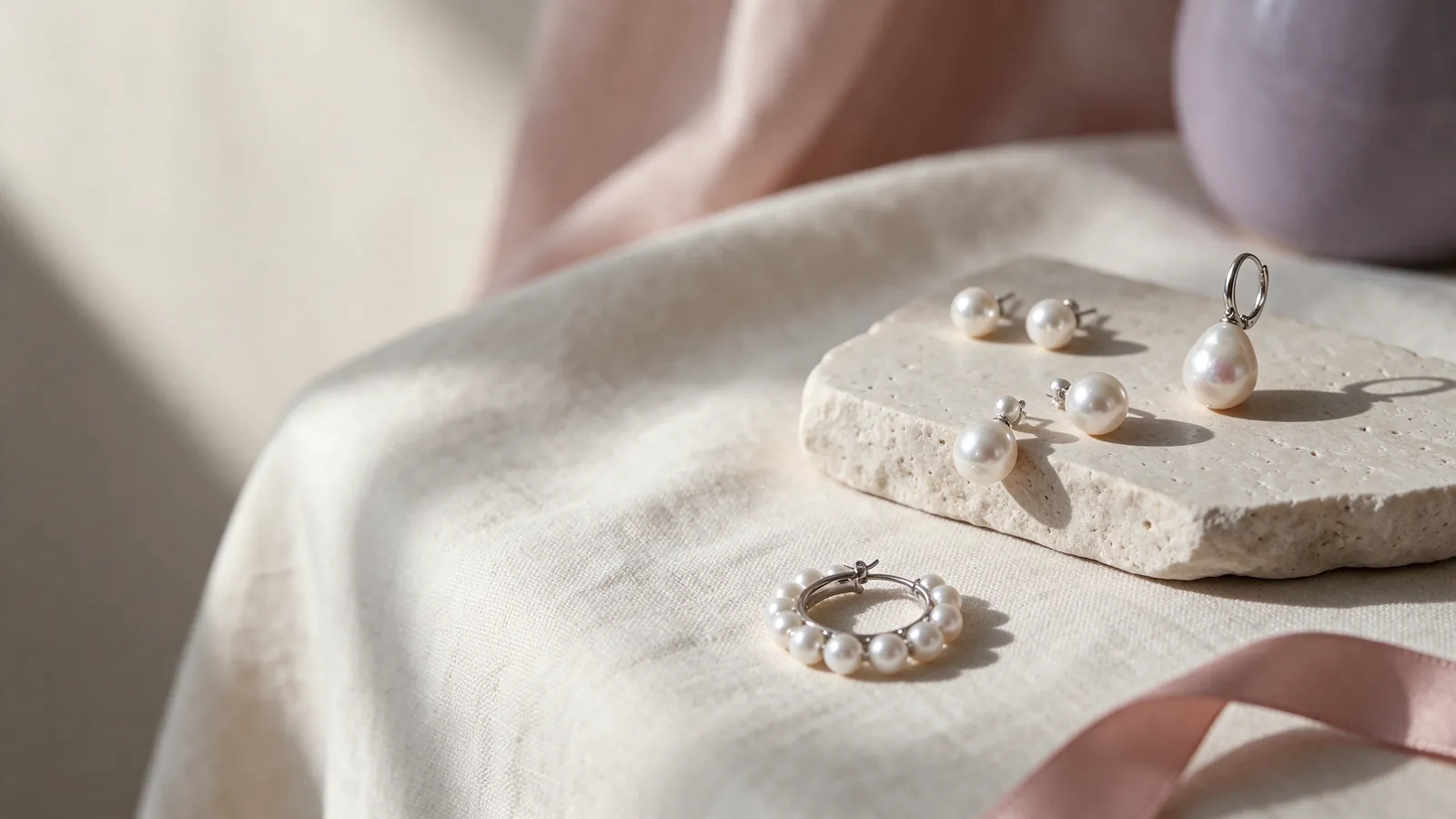
Earrings bring two pearls into the same view, making coordination especially relevant. Compare their outline, apparent size, color and luster together. The same nucleus label does not guarantee a well-matched pair. If the design is intentionally asymmetric, continuity can come from a related color or proportion rather than identical silhouettes. Decide what kind of balance you want instead of assuming every pair must look the same.
For a pendant, a single pearl's front-facing outline and position against the neckline may guide your choice. A strand involves the visual rhythm of the whole arrangement, not just its most striking individual pearl. Consider Pearl Jewelry in relation to your clothes and preferred focal point. These wearing decisions are more specific than choosing a nucleus category and applying it to every jewelry form.
Turn your preferences into a useful design conversation
For a customization discussion, explain whether you want crisp reflections, a closely coordinated pair or a distinctive irregular outline. Discuss the jewelry form and visual proportions, then address the pearl's identity and structure wording separately. This gives the conversation clear goals without asking a bead label to predict the entire result. A structural detail is meaningful, but it cannot replace your personal wearing preferences.

Ask precise questions and protect the pearl surface
A practical buying checklist begins with whether cultured identity is explicitly stated and whether non-nucleated refers specifically to no bead. Next, consider whether geographic origin is separately described and what any accompanying document identifies. Finally, return to the actual appearance and your intended use. This order avoids treating no bead as automatically more natural or treating a bead as a fixed signal of quality or price.
Care cannot be reduced to bead structure either. GIA ranks pearl at 2.5 on the Mohs hardness scale and says pearls should never be cleaned with ultrasonic or steam cleaners. Wipe them with a very soft, clean cloth after wearing and avoid acids, perfume, hair spray and excessive heat. Neither nucleus category makes the surface immune to scratching or suitable for harsh cleaning.
Dry the string fully before wearing cleaned strung pearls
If strung pearls are cleaned with water, GIA advises that the string must be completely dry before they are worn again. Keep pearls away from other jewelry that could scratch them during storage. Understanding the nucleus terminology helps you read a description, while accurate identity information, a design-specific appearance comparison and careful handling make that knowledge useful over time. To discuss pearl descriptions and the appearance you prefer for your jewelry, contact Flint Jewelry on WhatsApp +85260106207.
| Comparison point | Bead-nucleated cultured freshwater pearl | Non-bead-nucleated cultured freshwater pearl | Practical next step |
|---|---|---|---|
| Internal bead | Describes a bead nucleus | Describes no bead nucleus | Read this as structure information |
| Formation | Cultured wording states cultivation | Can be cultured despite having no bead | Do not translate no bead into non-cultured |
| Visible appearance | Shape and color require their own description | Shape and color require their own description | Do not infer a bead or origin from a photograph |
| Quality comparison | Evaluate individual qualities | Evaluate individual qualities | Consider GIA's seven value factors |
| Wearing and care | Compare matching and protect the surface | Compare matching and protect the surface | Avoid steam and ultrasonic cleaning; let cleaned strings dry |
Pearl knowledge and authoritative references
GIA identifies seven pearl value factors: size, shape, color, luster, surface quality, nacre quality and matching. Presence or absence of a bead is not a substitute for comparing these factors.
Read the reference for this factFrequently asked questions
What should I ask when a description says no nucleus?
Ask whether it means no bead nucleus and whether the pearl is explicitly described as cultured. On this page, no bead is a structure description; it does not establish absence of human involvement.
Does white color identify a non-bead-nucleated freshwater pearl?
No. White describes appearance and does not establish internal structure, freshwater type or natural formation. Those questions need their own descriptions rather than conclusions based on color.
Is a small Baroque pearl automatically a seed pearl or Keshi?
No. Baroque describes shape and seed describes size. Keshi concerns cultured-pearl formation, and definitions differ between pearl standards. A small irregular appearance does not establish Keshi identity, and not every non-bead-nucleated freshwater cultured pearl is Keshi.
Which matters more for a pendant: a bead label or the visible outline?
Understand the bead label as part of the description, then compare the outline, color and viewing position for the pendant you want. Structure alone cannot predict the visual effect against your neckline.
Does a bead nucleus make steam cleaning acceptable?
No. GIA advises against steam and ultrasonic cleaning for pearls. Bead structure is not a durability guarantee and should not override care advice for the pearl surface.
Updated: