

Choosing a pearl necklace enhancer: will a pearl clicker pendant or clip-on pearl pendant fit your necklace?
Start by identifying the connection. A pearl necklace enhancer uses a clasp that opens so it can attach at an appropriate space between pearls. A fixed bail instead provides a passage for a chain and should not be assumed to open. When exploring a pearl pendant, establish this distinction before choosing the decorative outline or planning how to combine it with a necklace you already own.
The necklace itself is the best fitting reference. Similar-looking strands can have different knots, pearl shapes and spacing, so the same attachment may not sit the same way on both. Assess the opening and the enclosed space together. The names pearl clicker pendant and clip-on pearl pendant describe a useful idea, but neither name alone tells you whether a particular strand is compatible.
Before wearing a pearl necklace enhancer, does the clasp on a pearl clicker pendant or clip-on pearl pendant close properly?
Support the necklace while you examine the closed attachment. Check that the moving part returns to its intended position and that the string is not caught at the joint. Look from the side as well as the front to see whether adjacent pearls are being pushed together. A clasp that needs pressure against the pearls to close is a reason to stop, not to press harder.

Evaluate a chain pairing independently of a strand pairing
Metal chain links introduce a different fit problem. Some links are flat, some turn as they move, and their joints may be thicker than their visible width suggests. Choosing a chain for pearl pendant wear means considering these profiles alongside the pendant's attachment and weight. A clear front view is useful for style, but a side view often reveals where the chain might catch.
If you want to reuse a favorite chain, separate the pendant decision from the necklace decision. A pearl pendant top can be considered on its own, but compatibility still depends on the connection. For a fixed bail, assess the passage needed by the chain and its end fitting. For an opening attachment, examine the chain's position and movement after the clasp is completely closed.
Test the hanging position, not only the insertion
A chain may enter an attachment at one angle yet become pinched when the pendant turns. Let the piece settle naturally and inspect the joint without twisting or pulling. Notice whether it faces forward, flips toward the back or presses a chain link against the closure. Being able to place a chain inside the opening is only the beginning of assessing the finished pairing.

Build the composition around a stable focal point
A centered pendant gives the eye a clear destination and can complement the symmetry of a pearl strand. First make sure that the intended central space can accept the clasp without crowding the neighboring pearls. Then inspect the necklace's curve on both sides. A balanced photograph is not the entire test: sit down and turn gently to observe whether the pendant keeps its intended direction.
An asymmetrical arrangement can add interest to a plain top, particularly when its position relates to the collar or shoulder line. However, a strand can slide, and the pendant's weight may move the focal point. If the piece keeps returning toward the middle, consider a centered arrangement instead. Avoid trying to preserve an off-center look by tightening the attachment against pearls or pulling the string.
Choose a clear point or a fuller pendant silhouette
Compare a single pearl pendant when you want a concise focal point, and a multi pearl pendant when you prefer more visual layers. Evaluate both against the strand's existing presence and your earrings. More detail is not automatically a better match. A strong pearl strand may benefit from one readable pendant shape, while a simpler neckline can leave room for a fuller arrangement.
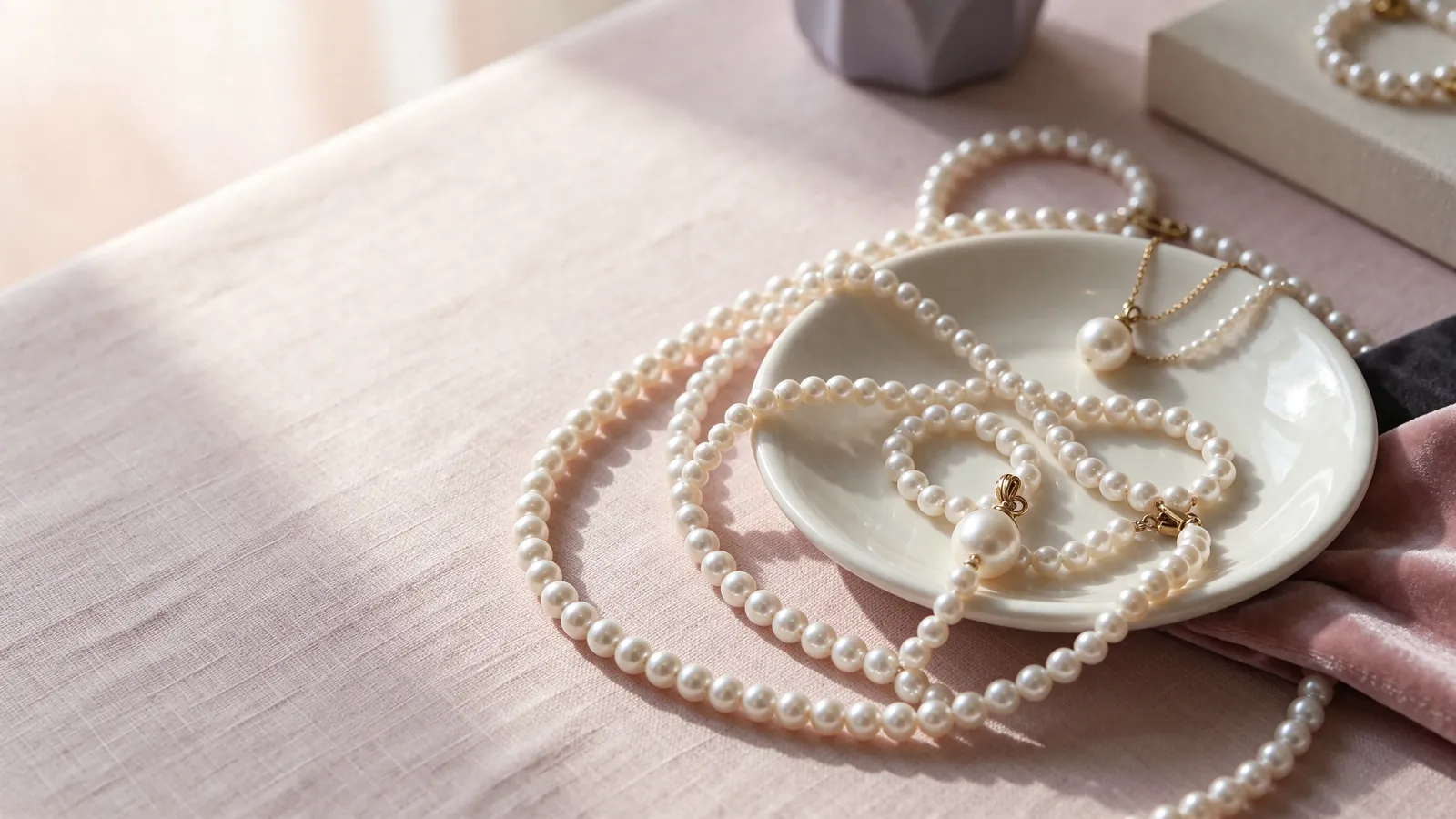
Let clothing and movement guide the everyday choice
Use an outfit close to the one you plan to wear when you compare pendant positions. A crew neckline may partly hide a piece that looks fully visible without clothing, while a shirt collar can frame or obscure it. Decide whether you want the pendant above the neckline or completely over the fabric. An uncertain halfway position may cause repeated catching or disappearing under the collar.
If the desired effect is a longer vertical line, consider a Y-shaped pearl pendant necklace rather than expecting an opening clasp to adjust necklace length. An enhancer changes its connection to the strand; it is not automatically a sliding length control. To move an attachment, take the necklace off and support it, reposition the clasp at a suitable space, and inspect the new closure.
Think beyond the mirror to straps, scarves and hair
Consider what will share the space around your necklace during the day. A bag strap, scarf or long hair can repeatedly contact a pendant and change how practical the combination feels. Remove the necklace before changing clothes, and watch for fabrics that catch at the attachment. On a busy day, a less layered arrangement may serve you better than a focal point that needs constant attention.

Compare attachment types without confusing their functions
A through pearl pendant is a different construction: its defining question is how the chain passes through the pearl. An enhancer's defining question is how an opening clasp attaches to a compatible necklace. The front of a pendant may not show this clearly. Compare construction as well as appearance when deciding whether you want an integrated chain line or a removable accent for an existing strand.
Ask for an explanation of the moving component and views of the back and open position. A ring-shaped attachment is not proof that a clasp opens. If the mechanism is fixed, it should not be pried apart to imitate a clicker. Clear operation matters more than a familiar term, especially when several pendant styles have similar silhouettes in photographs.
For gifting, identify the necklace and the wearer's preferences
Before choosing a detachable accent as a gift, learn whether the recipient usually wears pearls on a strand or a metal chain. Ask about preferred pendant height and whether the necklace can be brought for a fitting. Ease of seeing and handling the closure also matters. Outfit photographs can explain taste, but they cannot confirm that an attachment will close correctly on the recipient's actual necklace.

Keep pearl quality and mechanical compatibility as separate decisions
GIA describes seven pearl value factors: size, shape, color, luster, surface quality, nacre quality and matching among pearls in a multi-pearl piece. These factors help organize a visual comparison between the pendant and strand. They do not answer whether an opening attachment fits between those pearls. Assessing a pearl's appearance and assessing a clasp's function are both useful, but one cannot stand in for the other.
Compare the pieces under the same lighting before deciding how closely they should coordinate. Similar color and luster can create continuity, while a different shape or tone can make the pendant a deliberate accent. Neither direction is inherently required. Do not infer pearl origin, natural-versus-cultured identity or certification from shape, color or a photograph; visual styling and identity documentation address different questions.
Look at the full necklace before concentrating on close-up detail
View the arrangement at a normal conversation distance to judge proportion, then move closer to examine the pearl surface and attachment joint. This sequence keeps a magnified detail from dominating the styling decision. A photograph can record your preferred outfit pairing, but the physical necklace remains essential to understanding fit. Aim for a combination whose appearance, closure and everyday use make sense together.

Give the pearls and the opening joint appropriate after-wear care
GIA's pearl care guidance rules out ultrasonic and steam cleaners. Routine care uses a very soft, clean cloth after wearing, with avoidance of acids, perfume, hair spray and excessive heat. Pay attention to the clasp without stuffing the cloth into its opening. If fibers or another obstruction prevent the meeting point from closing, repeated pressure is not a suitable way to clear it.
Detach the piece over a stable surface so you can support the necklace rather than pulling on its string. Store it away from harder jewelry that could rub against the pearls. When a strung necklace has been cleaned with water, the string must be fully dry before the necklace is worn. Each new pairing deserves a fresh closure check, even if the pendant worked well on another necklace.
Bring a specific necklace question to a pendant discussion
For a discussion with Flint Jewelry about pendant options, prepare photographs showing the necklace, its end fitting or the intended position between pearls, plus the neckline you want to wear. Explain the connection you are trying to achieve rather than relying only on a pendant name. If a clasp changes shape, stops closing smoothly or becomes unstable during wear, stop using the combination and seek advice. To discuss pendant options for your existing necklace, contact Flint Jewelry on WhatsApp +85260106207 and share your necklace photos and wearing preferences.
| Decision | Inspect | Do not assume | Practical approach |
|---|---|---|---|
| Pearl-strand fit | Space between pearls and unobstructed closure | Similar-looking strands have the same spacing | Use the necklace you intend to wear |
| Chain fit | Link thickness, turning movement and clasp joint | A link that enters will hang freely | Check front and side positions |
| Pendant placement | Direction and the strand's curve | An off-center point will remain fixed | Watch the arrangement during gentle movement |
| Clothing | Visibility and contact with the collar | An opening clasp changes necklace length | Compare the actual neckline |
| Pearl appearance | Color, luster, shape and proportion | A photograph establishes identity or certification | Choose a coordinated or contrasting accent |
| Care | Clean meeting point and dry string | Steam or ultrasonic cleaning suits pearls | Wipe softly and prevent rubbing in storage |
Pearl knowledge and authoritative references
GIA identifies seven pearl value factors: size, shape, color, luster, surface quality, nacre quality and matching among pearls in a multi-pearl piece. They inform visual comparison, not the mechanical fit of an enhancer clasp.
Read the reference for this factFrequently asked questions
Can the enhancer be fastened around a pearl instead of between pearls?
Do not use the clasp to squeeze a pearl. Evaluate an appropriate space between pearls, and stop if the attachment presses neighboring pearls together or pulls the string taut.
Does hearing the clasp click confirm that it is closed?
A sound is not a substitute for inspection. Look at the meeting point, the moving component and any trapped string or clothing. Different mechanisms can operate differently.
Why does my off-center pendant slide back toward the center?
The strand's movement and pendant weight can change the position. Consider a centered composition if the asymmetrical look does not remain as intended. Do not grip pearls more tightly to stop it moving.
Can a fixed bail be opened to work like an enhancer?
A fixed bail should not be pried open. It is a different construction from a clasp designed to open and close, regardless of a similar outline.
Should I steam-clean the pearl necklace with the pendant still on it?
No. GIA advises against steam and ultrasonic cleaning for pearls. Use gentle routine care, and let the string dry completely before wearing a strung necklace that has been cleaned with water.
Updated: