

What proportions should you consider in a crescent moon pearl pendant or crescent pearl pendant?
Begin by deciding what you want to notice first. A substantial crescent gives the metal a strong role, while a slender arc lets the pearl lead the composition. Next, look at the gap between the pearl and the two tips. Open space can make the moon easy to recognize; a pearl that fills most of the opening can create a more compact impression. These choices describe style, not a ranking of pearl quality.
Look beyond a magnified photograph. At everyday viewing distance, does the curve remain distinct, or do the frame and pearl blend into a single highlight? Comparing a pearl pendant with another layout can reveal whether you prefer a framed center or a pearl that appears to extend below the outline. Check the camera angle before attributing a narrow opening to the design itself; perspective can compress the space.
How can chain length balance a crescent moon pearl pendant or crescent pearl pendant against your neckline?
Use a favorite T-shirt, blouse or dress for a position test. The whole pendant should have a clear place on exposed skin or on an uncluttered area of fabric, rather than straddling a neckline seam. Sit, turn and lean slightly to see whether the crescent tips catch the edge. Chain length alone does not determine the result: the pendant's height and the location of its bail change where the pearl lands.

Read the pearl's attachment and the direction of the arc
A pearl secured within a frame and a pearl suspended from a moving connection can produce different everyday effects. The first maintains a more consistent outline; the second may swing and change its reflections as you move. Ask how the attachment works and whether the pearl can contact the crescent. Do not infer a flexible connection, durability or a stable wearing position just because a photograph appears balanced.
Consider the opening's direction alongside your clothing. A side-facing crescent can relate to a diagonal neckline, side-swept hair or an asymmetric jacket. There is no general rule that makes one direction correct. Try to distinguish the orientation you like in a still image from the orientation that the chain and collar allow during movement. Both influence whether the design feels natural on you.
The back and bail answer practical questions
Check the inside of the bail against the widest part of your chain clasp. Measuring only the chain strand can miss the part that actually needs to pass through. A view of the reverse also reveals projecting connections and edges that a front image hides. If the pendant will sit directly on skin, these details deserve as much attention as the polished front outline.
Do not let the moon shape stand in for pearl information
A moon pearl pendant is a motif description. It does not establish the pearl's species, origin or natural-versus-cultured identity. Nor can a white, blue-green or uneven appearance answer those questions by itself. Visually, you can examine the sharpness of reflections and where surface features appear, then decide how the pearl's color works with the frame. Keep that personal assessment separate from written information about the pearl.
GIA identifies seven pearl value factors: size, shape, color, luster, surface quality, nacre quality and matching. Matching concerns multiple pearls rather than a separate score for a single-pearl pendant, although coordinating with existing earrings may still be a personal styling choice. Reading the guide to a pearl pendant with GIA certificate can help you distinguish the contents of a laboratory document from sales descriptions. Neither a crescent shape nor a letter grade is a certificate, and these general factors do not establish GIA certification for a Flint product.
Use lighting consistently when comparing color
A warm indoor image and a cool daylight image are poor starting points for a direct color comparison. Try to view similar backgrounds and lighting, then look at the composition under the conditions in which you expect to wear it. Bodycolor, overtone and orient are different color components; a pearl does not necessarily show all three. A vivid reflection in one image is not proof of a fixed bodycolor.

Style the curve with casual, work and dressy necklines
For a crew-neck tee, place the pendant clearly above or below the neckline rather than letting the seam divide the design. With an open blouse, check the collar corners as you turn your head. If your everyday style is restrained, use a dainty pearl pendant comparison to think about the total visual weight. A smaller pearl inside a broad frame can still create a noticeable piece, so pearl size is only one part of that decision.
For a dressier look, plain fabric can give the open crescent room to stand out, while bold patterns may ask for fewer competing accessories. A coordinated look does not require moon shapes on every item. The color ideas in a pearl and sapphire pendant discussion can help you consider a cool accent in earrings, a ring or clothing, without assuming that a particular moon design contains that gemstone.
Build a layered arrangement one piece at a time
Wear the crescent alone first, then add a second necklace and examine the spacing while sitting and walking. A difference in chain length may not be enough when the pendants themselves are tall or mobile. Keep the moon opening visible and avoid repeated contact between another metal charm and the pearl. The goal is a readable arrangement, not simply the largest number of layers.
Make a moon-themed gift personal rather than prescriptive
The crescent might bring to mind a night-sky memory, a favorite shape or a personal story. Those associations belong to the wearer; they do not create a universal religious meaning or a promised effect on health, luck or relationships. Before choosing the theme, notice whether the recipient regularly wears recognizable symbols or favors abstract forms. A preference for soft curves does not necessarily mean a preference for every moon-shaped accessory.
Think about where the gift would fit into their routine. A necklace for frequent workdays must coexist with collars, scarves and possibly an ID lanyard; an occasional evening accessory may be chosen around a favorite dress. Browsing Pearl Jewelry as a wider set of wearing options can also clarify whether a pendant is the right format, rather than assuming that liking pearls means wanting a necklace.
Ask about habits without losing the surprise
You can learn a great deal by asking which necklace they reach for most, whether they prefer a piece on skin or over clothing, and how convenient they find small clasps. A person who rarely wears necklaces may prefer a different accessory even if the crescent story is appealing. Separate the emotional idea from everyday ease of use when considering the gift.

Ask specific questions before comparing design options
Make a short comparison list with three categories. Under silhouette, include overall height, width, opening direction and the reverse. Under chain fit, include the bail opening, clasp passage and whether chain details are stated separately. Under pearl information, include the stated identity and quality description. Read written dimensions rather than estimating them from a model's proportions, and find out whether the overall measurement includes the bail and a hanging pearl.
For a general conversation about pearl pendant preferences with Flint Jewelry, describe what you already wear and what you want the pendant to do visually. You might prefer a clear open curve without a large metal presence, or a pearl-centered composition that stays clear of a blouse collar. Those priorities are more useful than broad words such as luxurious. An inspiration picture establishes a direction, not the specifications of another piece.
Use front, side and wearing images for different purposes
A front close-up helps with the line junctions and visible surface. A side view helps with thickness and projecting parts. A wearing view helps with clothing scale and position. If one of these is absent, turn that gap into a concrete question about the back, bail or movement. Do not supply an answer from the apparent symmetry or attractiveness of the front photograph.
Protect the pearl and avoid pulling on the crescent tips
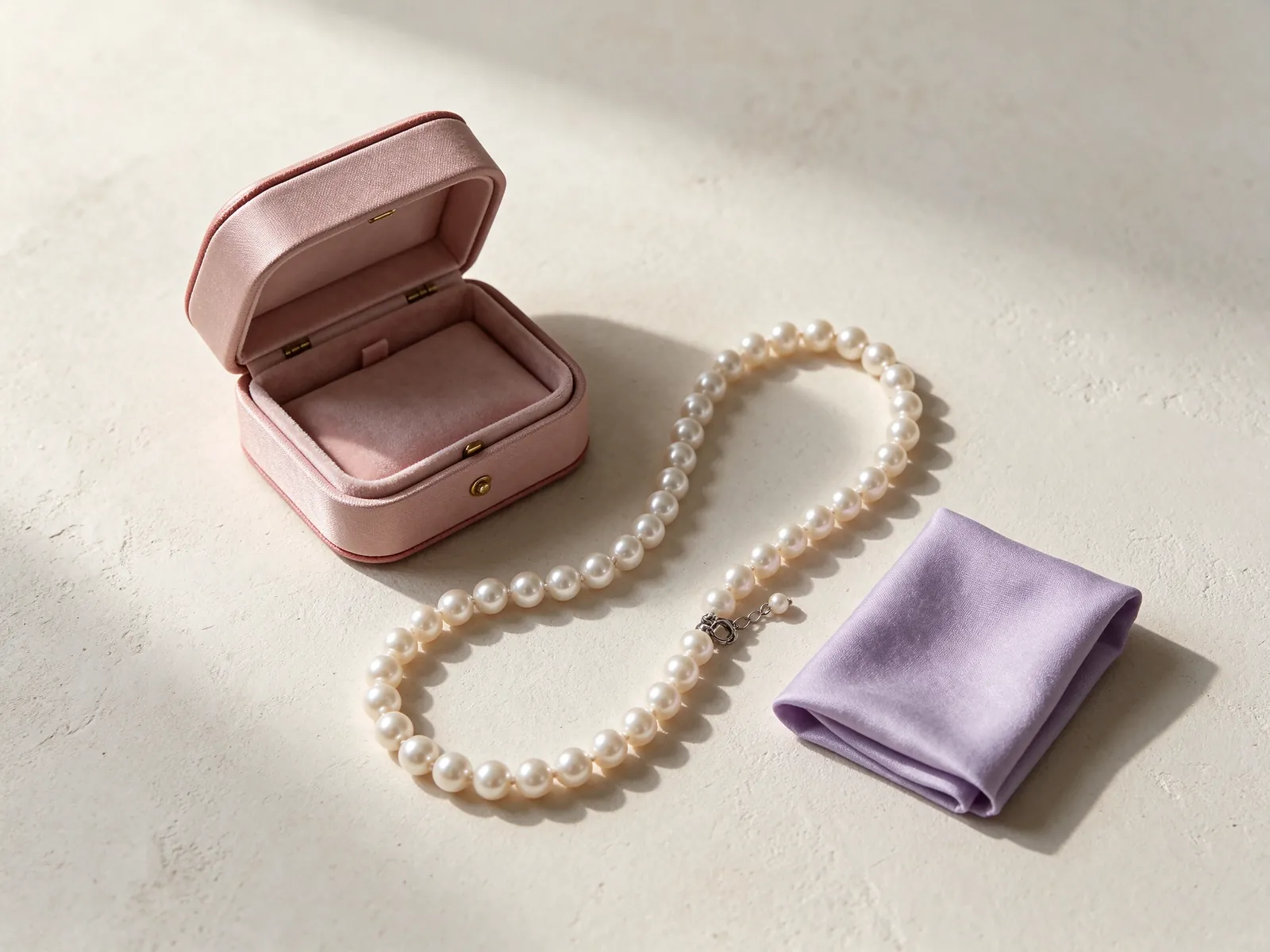
Store the pendant separately from loose chains and hard-edged accessories that can become tangled in the open curve. When wiping, support the whole piece rather than pulling on the pearl, particularly if it hangs from an articulated connection. Use a very soft, clean cloth after wearing. Check for fine fibers caught near the crescent tips, and take care when the necklace meets lace, knitwear or a scarf.
GIA ranks pearl at 2.5 on the Mohs hardness scale and says pearls should never be cleaned with ultrasonic or steam cleaners. Treating the entire pendant like a metal-only item is therefore inappropriate. Avoid acids, perfume, hair spray and excessive heat, and put the necklace on after beauty preparations. If a connection looks loose or catches during wiping, stop manipulating it rather than attempting to straighten or glue it yourself.
Check the necklace before wear and after travel
Before leaving home, confirm that the clasp is closed and the crescent is not trapped beneath a collar or twisted around another chain. For travel, give it a separate space rather than packing it tightly against rigid accessories. These habits reduce unnecessary friction and pulling; they are not tests of pearl quality or promises that a necklace is immune to damage.
To talk through your preferred curve, everyday necklines and existing chain, contact Flint Jewelry on WhatsApp +85260106207 about general pearl pendant preferences.
| Design detail | What it tells you | How to test it | Useful question |
|---|---|---|---|
| Pearl placement | The balance between center and curve | View the whole composition at a normal distance | Is the pearl attached in a fixed or moving position? |
| Crescent opening | How clearly the moon outline reads | Compare front and angled views | How much space remains around the pearl? |
| Neckline landing | Whether clothing interrupts the silhouette | Sit and turn in a favorite top | Does the stated height include the bail and hanging pearl? |
| Chain passage | Whether an existing clasp can fit | Compare clasp width with the internal bail opening | Can it pass without pushing or altering the bail? |
| Movement and care | Where tangling or contact may occur | Test alone before adding another necklace | How can the whole pendant be supported during wiping? |
Pearl knowledge and authoritative references
GIA lists seven pearl value factors: size, shape, color, luster, surface quality, nacre quality and matching between pearls. Evaluate the pearl separately from the crescent composition; these factors do not certify or grade a Flint product.
Read the reference for this factFrequently asked questions
Is a moon outline evidence of a particular pearl type?
No. The outline identifies a design motif. Pearl species, origin and natural-versus-cultured identity need their own information; they cannot be established from the crescent, a color impression or the shape of the pearl alone.
Can a crescent pendant look subtle without using a tiny pearl?
Yes. The thickness of the frame, amount of open space and position against clothing all contribute to visual weight. Compare the entire silhouette at ordinary viewing distance rather than treating pearl diameter as the only measure of a restrained look.
What should I check if the pendant keeps turning sideways?
Look at whether the chain is twisted, whether a collar pushes one tip and how the bail sits. Test it without another necklace first. Do not bend the crescent or alter the attachment to force a preferred position.
Are two different chain lengths enough for safe layering?
Not by themselves. The pendants' heights, widths and movement can still bring them together. Watch the spacing when seated and walking, and avoid repeated contact between a metal charm and the pearl or an arrangement that hides the moon opening.
Can I clean the metal frame and pearl together in an ultrasonic cleaner?
No. GIA advises that pearls should never be cleaned with ultrasonic or steam cleaners. Support the pendant and use a very soft, clean cloth for routine after-wear wiping rather than applying a metal-only cleaning method to the whole piece.
Updated: