

How can you read the surface bands of circle pearls, also called ringed pearls or circled pearls?
Treat the outside contour and the surface bands as two separate parts of the description. First follow the edge to understand the pearl’s outline. Then look at where the ring-like lines sit on that outline. The pearl shape guide is a helpful starting point for comparing silhouettes, but an outline term does not replace a description of texture. A photograph from the front may hide part of a band around the back, so include a side view when judging its visible continuity.
Look again with the pearl turned slightly. Reflections can emphasize a line in one image and make it less noticeable in another. Similar lighting and backgrounds make comparisons easier to interpret. Use close-ups for the local pattern, then step back to a wearing view to see how much detail remains visible. This prevents a strongly enlarged image from becoming your only impression of the appearance.
Do the bands on circle pearls—also called ringed pearls or circled pearls—mean the pearl is round?
The name does not promise a round shape. It refers to bands, while roundness concerns the overall contour. You might describe a pearl as having a longer outline with visible rings near the center. That wording is more informative than treating circle as a geometric guarantee. It also leaves identity and formation questions separate from what a photograph actually shows.

Find out whether you prefer the contour or the texture
Before focusing on rings, decide what kind of outline suits your taste. A compact form and an elongated one can create different impressions even when both have visible bands. Compare drop shaped pearls if you are interested in a taper and a fuller end. That comparison asks about the direction of the silhouette, not the number of lines. It helps you distinguish an attraction to the whole shape from an attraction to surface detail.
A comparison with coin pearls can clarify a preference for a broader, flatter face. The two descriptions are not interchangeable: one focuses on shape, while ringed describes visible bands. Look at the side profile as well as the face when considering a flatter outline. Then compare at a normal viewing distance before returning to the close-up. You may discover that proportion matters more to you than the pattern that first caught your attention.
Choose a visual theme without ranking shapes as better or worse
If you like corners and less regular contours, square baroque pearls offer another shape topic to consider. A preference for angular or curved forms is a style decision. To make a look feel intentional, identify which feature you want to repeat across the jewelry: an outline, a color impression or a band rhythm. You can allow other features to differ without treating those differences as an automatic quality judgment.

Use a broader quality framework than the number of bands
GIA lists seven pearl value factors: size, shape, color, luster, surface quality, nacre quality and matching. This separates several questions that a ring count cannot answer. Look at the reflections for luster, the contour for shape and local areas for visible surface characteristics. Appreciating a ringed pattern does not require calling it either a defect or a premium grade. You can enjoy its character while still asking about the other relevant information.
For fairer photo comparisons, avoid contrasting one dramatic, spotlighted image with one subdued image. Ask for the same area under comparable conditions and from another angle. Identify the spot that interests you instead of asking a broad question such as whether the pearl is excellent. The wider view can help with overall balance, while the close-up explains local appearance. Neither image alone establishes every quality factor.
Make room for both a preference and a careful inspection
Write down what you like about the bands, then separately note what you want to see more clearly. You may want a distinct pattern at the center and still need a close-up of the outward-facing surface. These requests support each other. Individuality should not be a reason to ignore another area, and a photograph should not be treated as confirmation of nacre quality.
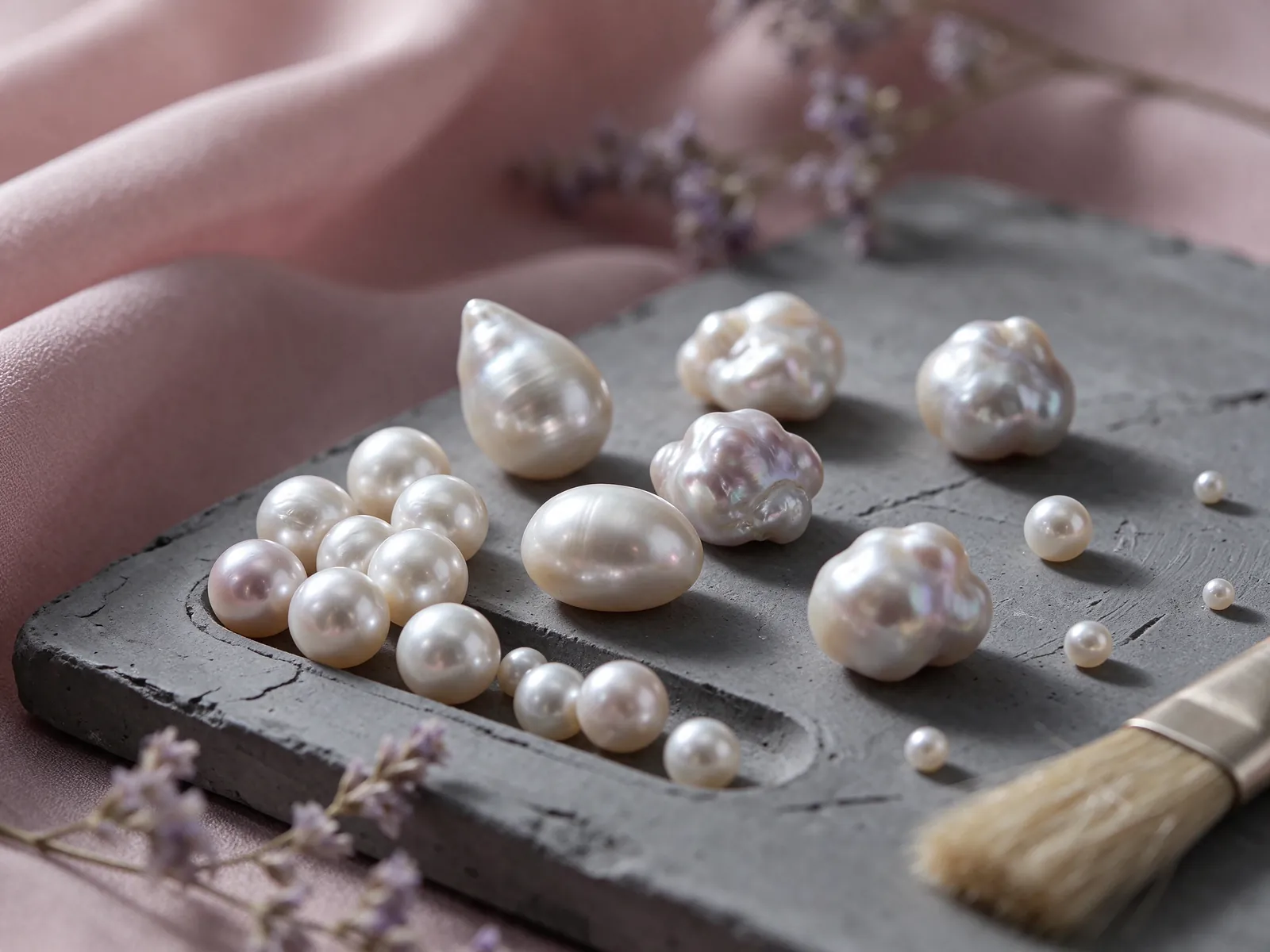
Style the rings against a background that makes sense for your wardrobe
A banded surface contributes its own pattern. If your top already has narrow stripes, gathered fabric or a detailed knit, start with fewer additional accessories and see whether the pearl remains easy to read. Against a plain blouse, the outline may become the stronger feature. Check where a pendant rests: an open neckline and a fabric background create different contrasts, so the same piece can feel more or less prominent.
The pearl color guide can help you compare lightness and warmth with the colors you actually wear. Try viewing the pearl beside warm ivory, lavender or pink fabric if those shades are familiar in your wardrobe. A white-background photo may not convey that relationship. Greater contrast can create a focal point, while a closer color relationship can keep the overall impression quiet and let the bands emerge on closer inspection.
Do not confuse color effects with the direction of the rings
Learning about pearl body color and overtone gives you a different set of observations from looking at surface bands. GIA distinguishes bodycolor, overtone and orient, and not every pearl shows all three components. If a line seems to border a different color in a photo, compare another angle before assuming a permanent color boundary. Describe the visible effect rather than assigning identical color components to every pearl.

Consider the facing direction and balance of the jewelry
The view you will see while wearing a piece matters as much as an isolated close-up. Earrings present different impressions from the front and side, and a pendant may shift as you move. Ask which part of the pearl faces outward in the intended setting. With a pair, compare the two outlines, their visual weight and the locations of the bands. A comfortable sense of balance need not mean every line is copied exactly.
For a pendant, consider how the chain direction relates to the pearl’s longer axis. Bands running across an elongated contour add another direction to the composition. A simple neckline may make those relationships clearer. If your main interest is a long, linear outline rather than rings, explore stick pearls as a shape comparison. This keeps your design preference specific without treating every long pearl as a ringed one.
Use wearing photographs to judge the role of the detail
Ask whether you want the bands to be noticeable across a conversation or mainly appreciated up close. A work outfit and an evening outfit may call for different levels of emphasis, according to your own taste. Read any stated dimensions alongside the photographs. Camera framing can enlarge the impression of a pearl, so its share of the image is not a dependable diameter measurement.

Keep pearl identity separate from an appealing surface name
Circle pearls, ringed pearls and circled pearls are appearance descriptions. The bands alone do not identify species, origin or natural-versus-cultured status. In a jewelry description, distinguish terms that describe the pearl from terms that describe its visible form. Then ask targeted appearance questions, such as which face shows the rings clearly. Identity information and useful photographs play different roles in a well-informed choice.
When choosing a gift, learn more than whether the recipient likes pearls. Ask whether they favor orderly contours or more individual forms, and whether they prefer closely balanced earrings or visible variation. Their usual hairstyle, neckline and other jewelry can help explain the intended look. Write down those preferences before focusing on a name. A surface term is a useful starting point, not a complete description of what will suit someone.
Read documentation for the information it actually provides
If documentation accompanies an item, check what it identifies and which matters it addresses. Do not expand its meaning because the pearl has an attractive pattern. A photograph describes visible appearance, while a document may supply separate identity information. Rings are not a certificate, and ringed is not a quality grade. Keeping those distinctions clear avoids guessing a formation process from a surface feature.

Protect the pearl surface without brushing the ring lines
A visible line is not a reason to scrub the surface. GIA gives pearl a Mohs hardness of 2.5 and recommends wiping with a very soft, clean cloth after wearing. Store pearls separately from harder jewelry so the pieces do not rub together. For a closer look at the bands, use gentle lighting and clean hands rather than scraping with a fingernail to test the surface.
Avoid acids, perfume, hair spray and excessive heat. GIA advises that pearls should never go into ultrasonic or steam cleaners. Care should not aim to make the rings deeper or erase them. If something remains on the surface after suitable gentle care, establish an appropriate cleaning method for the whole piece instead of reaching for a strong household product that may affect the pearl or other components.
Dry the string completely before wearing a cleaned strand
GIA states that when strung pearls are cleaned with water, the string must be completely dry before wearing. Surface dryness alone does not answer that question. Avoid using excessive heat to speed drying, and consider moisture before storage. When putting the piece on again, look at the string and connecting points as well as the pearl surfaces. These routine checks matter regardless of whether the pearls have rings.
Keep a short list of the contour, ring placement and wearing effect that appeal to you. Contact Flint Jewelry on WhatsApp +85260106207 to share your preferred neckline or earring style and discuss pearl appearance and styling ideas. Describing those visual preferences is more useful than treating a surface name as a promise of a particular product.
| Feature | Visual check | Question to ask | Why it matters for styling |
|---|---|---|---|
| Silhouette | Overall length impression and edge contour | May I compare front and side views? | Clarifies the outline you want to emphasize |
| Rings | Where the bands sit and how they continue | Which surface will face outward? | Shows how the pattern relates to a neckline |
| Luster and surface | Reflections apart from other local marks | Can I see this spot from another angle? | Separates texture preference from other observations |
| Color | Base color and angle-dependent effects | How does it look next to similar fabric? | Helps select a quiet or contrasting background |
| Pair harmony | Outline, visual weight and shared rhythm | Can I see the two fronts side by side? | Clarifies your preference for similarity or variation |
Pearl knowledge and authoritative references
GIA names 7 pearl value factors: size, shape, color, luster, surface quality, nacre quality and matching. Surface rings and outline therefore form only part of the information used to assess a pearl.
Read the reference for this factFrequently asked questions
Are circle pearls a name for pearls on hoop earrings?
No. Circle pearls refers to ring-like surface bands on the pearl, not to a hoop-shaped jewelry setting. When discussing a design, specify whether you mean the pearl’s visible texture or the shape of the earring.
Can I use the number of rings as a quality grade?
No. GIA’s seven value factors cover multiple aspects, including shape, luster, surface quality and matching. Your preference for more or fewer bands is a visual choice and should not replace information about the other factors.
Why do the bands look stronger in one picture than another?
Lighting, reflections and viewing angle can change how clearly the lines appear. Compare similar conditions and ask for a turned view of the same location. A single front image cannot show every part of a curved surface.
Is a pair unsuitable if the rings are not identical?
Not necessarily. Look at the broader balance of the outlines, color impression and band rhythm. Some wearers prefer close visual echoes, while others enjoy variation. Decide which differences fit the intended style instead of evaluating only individual line positions.
Should the bands be scrubbed during cleaning?
Visible bands are not a reason to scrub. GIA recommends a very soft, clean cloth after wearing and says not to use ultrasonic or steam cleaners. If a strung piece is cleaned with water, allow the string to dry completely before wearing.
Updated: