

How do setting proportions help a teardrop Mabé pearl pendant or a Mabe pearl pendant top complement your neckline?
Think of the pendant as a complete composition. The pearl face may be rounded or elongated, but the frame and bail can substantially change the outline you see while wearing it. Begin a pearl pendant comparison with a favorite top: does its opening create a wide area, a narrow downward line, or a small space above the fabric? A rounded dome can offer a compact center, while a drop can continue the direction of an open neckline.
Notice how much of the visual area belongs to metal rather than pearl. A broad border can give the pendant a stronger graphic edge, and a longer bail can make it appear more elongated. A finer-looking border can draw attention back to the luminous face. None of these choices proves higher quality. Hold the comparison against plain and patterned clothing, because a frame that looks prominent in a close-up may become useful definition against a busy print.
Which chain and bail details matter when styling a teardrop Mabé pearl pendant or a Mabe pearl pendant top?
An existing chain needs more than a visually suitable thickness. Compare the bail opening with the chain body, end fitting, and widest part of the clasp. If an end will not pass comfortably, do not push or squeeze it through. Once paired, watch whether the bail moves freely or sits tilted. A chain shown with a pendant top may be part of the styling photograph rather than an included component, so clarify that distinction before choosing. The pearl pendant chain compatibility guide helps you compare the chain body, clasp and bail as separate details rather than judging fit by thickness alone.

Understand domes and drops without confusing their names
A half-sphere has a rounded face and a raised profile. Its curved surface can appear quite different when viewed from the side, particularly where the pearl meets the frame. If a setting covers part of the edge, the finished outline may not show the pearl's entire shape. Compare the face and the complete pendant separately. This helps you identify whether you are attracted to the dome itself or to the way a particular border presents it.
A teardrop outline can have broad or narrow shoulders and a softer or more defined point. WSP describes Kaku-Tsuyu in its product information as a particular square-teardrop Mabé form shaped by a specially crafted nucleus. It should not be used as a catch-all term for every pendant with a pointed bottom. Ask whether the description refers to the pearl's own contour or to a drop-shaped setting around it; those are different design observations.
Keep shape descriptions separate from pearl identity
Kaku-Tsuyu is not interchangeable with baroque, Keshi, or seed. A small, irregular, or elongated appearance does not establish species, origin, or natural-versus-cultured identity. When reading a Mabe pearl pendant top description, identify the pearl name, shape name, and setting outline independently. If only a general shape is stated, discuss that visible form without filling in biological or geographic details that the description does not provide. If you are asking what is a Mabé pearl, the formation guide helps separate how the pearl is made from the outline you prefer in a pendant.

Look at the side and back before judging wearability
The side view reveals how far the dome rises from the frame, while the back shows the surfaces that may rest against your clothing. These views help explain visual depth and potential fabric contact, but they do not replace a fitting. Move gently, lean forward, and sit down while observing the pendant's position. A shape that looks balanced on a display can behave differently with your chain and neckline; a front image alone cannot reliably answer questions about comfort or turning.
Use the 18K gold pearl pendant guide to think about framing rather than assuming a material name answers every design question. Compare the metal's visual tone with your usual earrings or watch and with the pearl face in everyday light. A warm border can make the edge more distinct, while a pale border may create a quieter transition. The useful question is which composition you enjoy wearing, not which metal color is supposedly mandatory for your skin tone. For a material discussion, consider 18K 750 white gold, 18K 750 yellow gold, 18K 750 rose gold, PT950 platinum and PT900 platinum as comparison options, then read the material description for the individual piece.
Check edges around delicate fabrics
Pay attention to the parts of the frame and bail that touch a fine knit, blouse, or collar. Look for a comfortable resting position rather than pulling the pendant to test it. Never bend the bail or disturb the setting yourself to change the fit. If you have only a front image, request the viewing angles that address your concern instead of guessing the unseen construction or inferring weight from apparent thickness.
Evaluate the pearl face in more than one kind of light
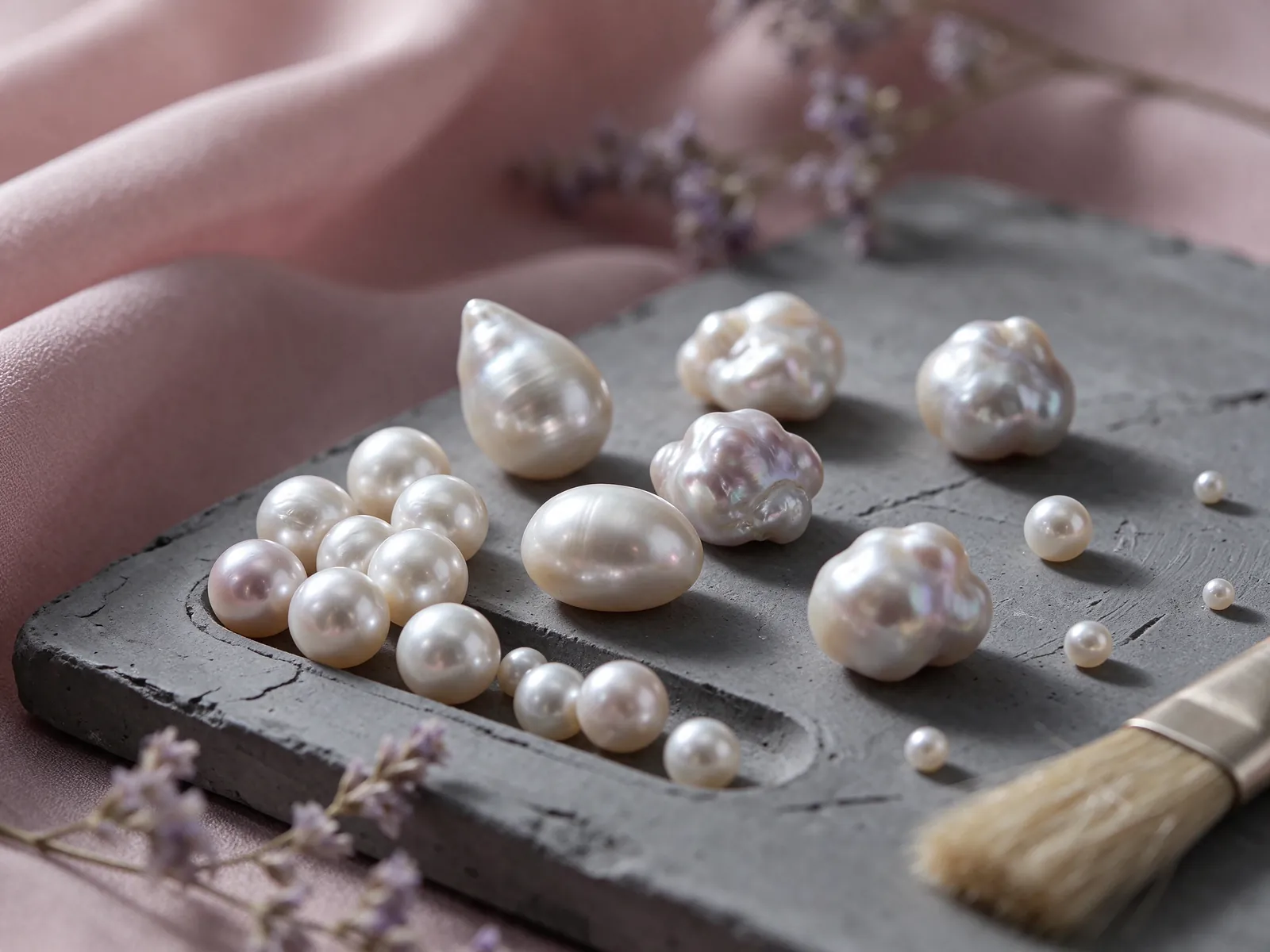
Shape is only one part of a pearl assessment. GIA identifies seven value factors: size, shape, color, luster, surface quality, nacre quality, and matching. A smooth-looking outline does not automatically outrank an elongated one, and an uncommon-looking shape does not establish rarity. For a single pendant, start with luster and overall visual appeal, then examine visible surface details. If you are pairing it with other pearl jewelry, consider a pleasing relationship rather than requiring every piece to have the same contour.
Look at the face under soft daylight and the indoor lighting where you normally get dressed. A spotlight may create a strong bright patch that dominates a photograph. Changing the angle helps you see how reflections and color impressions move across the face. A small spot in an image may be reflection or surface detail, and the area hidden under a border cannot be judged from the visible portion. Additional views are more helpful than giving a pearl a grade from one picture.
Describe color impressions precisely
GIA separates bodycolor, overtone, and orient, noting that not every pearl displays all three. If a shifting appearance is important to you, identify the light and viewing position in which you like it most. That is more informative than choosing solely from an appealing color name. Neither color nor shape establishes origin or a certificate, so keep a styling preference separate from the pearl's stated identity and documentation.

Build an outfit around a clear focal point
With a V-neck, an elongated pendant can echo the opening without needing to land at its exact lowest point. Give the tip enough space to remain visible. A rounded dome can make a distinct central accent against a broader scoop or crew neckline. Check whether the garment edge cuts across the pearl or bail when you move. If the top has a bold print, the frame may help define the pendant; a plain background gives subtle reflections more room to show.
Other color-focused guides can make your preferences easier to articulate. The pink pearl pendant guide invites a comparison of soft color with ivory or pale lavender clothing. The white South Sea pearl pendant guide helps you consider how a light pearl face reads against a white top. These are separate styling discussions, not names to assign to a Mabé pearl. When earrings are already prominent, simplifying the pendant's frame can keep the overall outfit from having competing focal points.
Adjust the composition for layers and jackets
Put on the cardigan or jacket you intend to wear before settling on placement. Its opening may hide part of a pendant that was fully visible against the underlying top. If you layer necklaces, keep another charm from resting directly on the pearl face. Separating the elements makes the outline easier to see and reduces opportunities for contact between jewelry pieces during normal movement.

Make comparisons useful rather than photograph-led
Choose one comparison question at a time: do you want more visible pearl area, a longer silhouette, or a stronger contrast against your wardrobe? A Tahitian black pearl pendant discussion can help with the idea of a dark focal point against light clothing. A golden South Sea pearl pendant discussion can help with warm-on-warm color relationships. Those comparisons do not establish a Mabé pearl's species or imply that any particular pendant is available.
Separate the size of the pearl face from the apparent size of the finished pendant. A broad border or long bail can change the impression, and photographs taken at different distances cannot provide a reliable measurement comparison. Use a piece you already wear comfortably as a reference for placement and visual presence, not as a way to estimate an unknown pearl diameter. This keeps your choice grounded in how the design will fit your clothing and habits.
Bring the details that explain your styling needs
For a styling conversation with Flint Jewelry, describe the neckline you use most, your chain's clasp and end fitting, and the outline you prefer. A garment photograph can show the available space without revealing sensitive personal information. A focused question such as whether a collar would obscure the bail is easier to discuss than asking for a universally best pendant. Keep the conversation about the specific wearing combination you want to understand.

Care for the face, frame, and chain together
GIA gives pearl a Mohs hardness of 2.5 and states that ultrasonic and steam cleaners should never be used for pearls. This is useful material-care guidance, not a performance guarantee for a pendant. Wipe gently after wearing with a very soft, clean cloth. Avoid pressing hard at the pearl's edge or using a pointed tool between the face and frame. Store it where harder jewelry cannot rub or press against the visible pearl surface.
Finish applying perfume and hair spray before putting the pendant on, and keep it away from excessive heat. During removal, open the clasp rather than pulling the chain over your head by its pendant. Be cautious when changing clothes with rough zippers, rigid decorations, or loops that may catch. If the bail stops moving normally, the frame feels loose, or the pearl appearance changes, avoid home glue or forceful adjustments and seek an appropriate jewelry professional's assessment.
Pack without tight tangles or surface contact
Before putting the pendant away or packing it for a trip, lay out the chain so it is not tightly wound around the bail. Keep the pearl face separated from hard edges on other pieces. Gentle wiping and orderly storage are more sensible than occasional harsh cleaning. If routine care does not remove dirt, ask about a suitable cleaning method instead of increasing pressure or applying an unfamiliar chemical. To discuss a neckline, an existing chain or your preferred pearl outline, contact Flint Jewelry on WhatsApp +85260106207 and describe the wearing combination you want to understand.
| Design element | What to see from the front | What another view adds | Outfit check | Decision question |
|---|---|---|---|---|
| Rounded half-sphere | A compact curved face | Dome profile and frame junction | Leave the face clear of a crew neckline | Is the dome or its frame the attraction? |
| Teardrop | Shoulders, curve, and point | Border around the tip | Keep the point visible against a V-neck | Does the fabric interrupt the outline? |
| Kaku-Tsuyu | A specific square-teardrop form | Separate pearl contour from metal contour | Balance geometric lines with the garment | Does the description identify this form? |
| Bail and chain | Length added above the pearl | Opening and freedom of movement | Look again with a jacket on | Will the end fitting and clasp pass? |
| Frame | Visual area assigned to metal | Edges and clothing contact | Avoid competing with strong earrings | Is the pearl still the focal point? |
Pearl knowledge and authoritative references
GIA identifies seven pearl value factors: size, shape, color, luster, surface quality, nacre quality, and matching. Shape is only one consideration when comparing Mabé pendants; look at luster, the visible pearl face, and the complete styling combination rather than ranking domes and drops by outline alone.
Read the reference for this factFrequently asked questions
Is every pointed Mabé pendant a square teardrop?
No. A pointed outline can be described broadly as teardrop, while Kaku-Tsuyu refers to a specific square-teardrop form. Also distinguish a pointed metal setting from the pearl's own shape.
Why might my thin chain still not fit a pendant top?
Its clasp or end fitting may be wider than the chain body. Compare each part with the bail opening and do not force a tight fit. A visually suitable chain is not automatically a mechanically compatible one.
Can I use photo size to choose between a dome and a drop?
Not reliably. Camera distance, framing, and the metal border can alter apparent size. Separate pearl shape from the finished pendant outline and use actual wearing placement rather than estimating diameter from unrelated photographs.
Should a Mabé pendant match my earrings exactly?
Exact shape matching is not necessary for a coherent outfit. Consider how the luster, color impression, and amount of detail work together. Strong earrings may pair more comfortably with a quieter pendant frame.
How should I pack a Mabé pendant with other jewelry?
Keep its pearl face separated from hard edges and lay the chain without a tight tangle beside the bail. Wipe gently before storage and avoid pressure on the face. Do not use ultrasonic or steam cleaning to prepare it for travel.
Updated: