
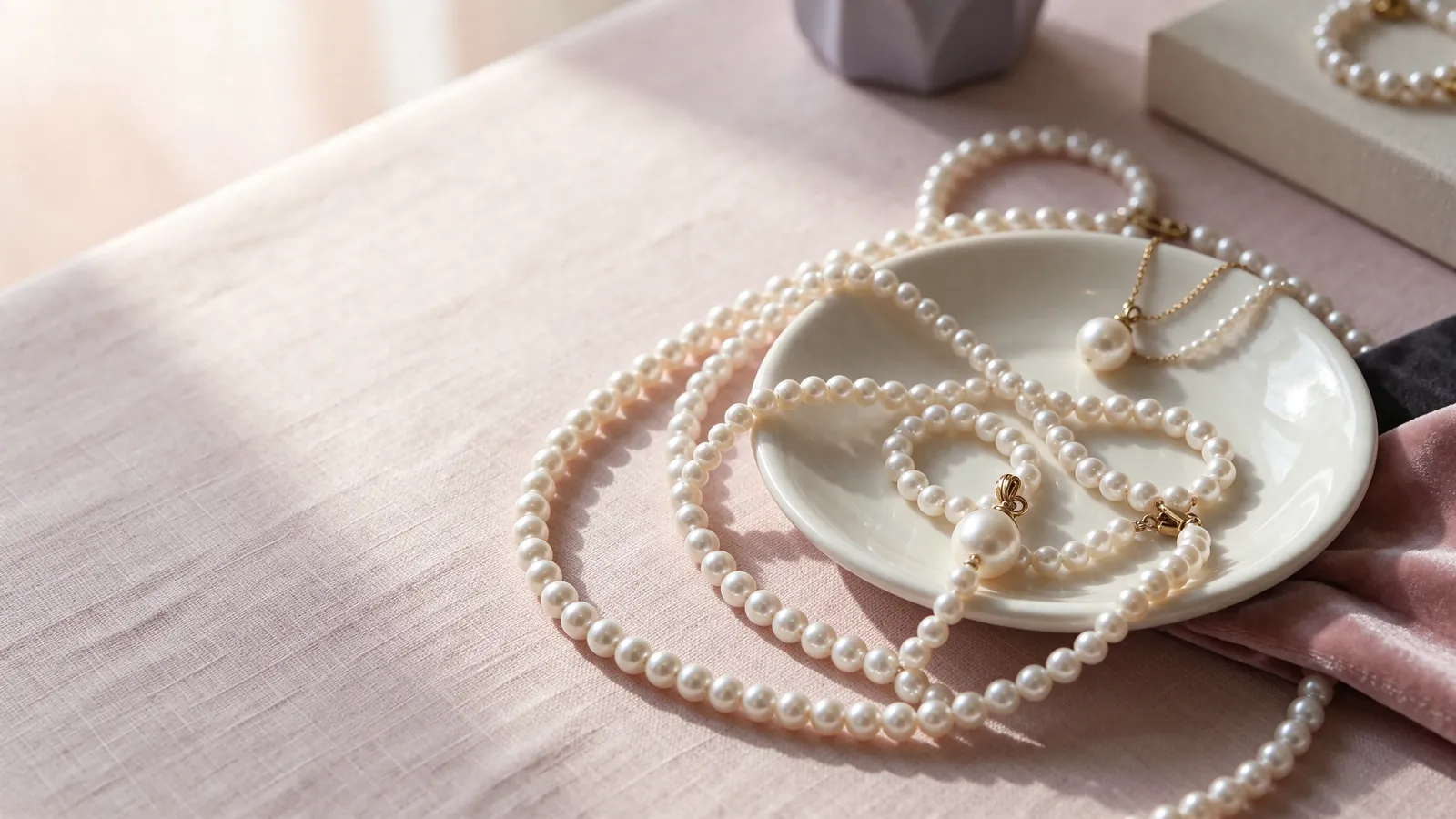
How does sliding adjustment affect a Y-shaped pearl pendant necklace in an adjustable pearl Y necklace or sliding pearl pendant necklace design?
The Y in a Y-shaped pearl pendant necklace describes a meeting of two upper lines with a section continuing downward. It does not tell you whether that meeting point moves. When looking at a pearl pendant, separate the front junction from the back clasp and any chain-tail adjuster. A fixed junction can still create a Y silhouette, even when you can choose a different clasp position.
For an adjustable pearl Y necklace or sliding pearl pendant necklace, ask to see the actual adjustment. Does it redistribute the neck loop and hanging section, or act on a different part of the chain? Watch where the pearls land afterward. A chain made to your preferred fixed length answers a sizing question, but that customization does not turn it into a sliding mechanism.
Does pearl placement on an adjustable pearl Y necklace or sliding pearl pendant necklace keep the Y-shaped pearl pendant necklace balanced against your neckline?
Use a familiar top for the first comparison and adjust only in the demonstrated way. Look at the junction and the end pearl together. If you like a longer drop but not a lower junction, find out whether the construction can separate those preferences. A good-looking outline in a close-up is less helpful than seeing how both points sit on your actual outfit.

Use the garment opening to judge the visible drop
With a V-neck, decide whether the end pearl should remain within the exposed area or hang completely over the fabric. A pearl placed right at the edge can slip out of sight as the garment moves. A long pearl pendant necklace is a useful comparison if the real attraction is an extended vertical line rather than an adjustable front junction.
Button a shirt as you normally wear it before evaluating the opening. For a crew neck, check the whole Y against the fabric color and pattern. A fine chain may be harder to distinguish against a busy print, while a neckline with decorative trim may compete with the pearl. Try a jacket too, since lapels can change how the upper chain sits even when the drop remains visible.
Make ordinary movements part of the fitting
Sit, turn gently and check the view from the side. Notice whether a button, zipper or fabric fold meets the hanging section. This is a way to identify contact points, not a stress test. When clothing pushes the necklace off center, change the combination or the permitted position instead of tugging on the chain to straighten it.

Choose the focal point before counting the pearls
A single prominent pearl near the end can anchor the vertical line, while pearls near the junction can draw attention higher on the chest. Decide where you want the visual emphasis first. A multi pearl pendant can show how several highlights share attention, but pearl count and Y construction are independent features. More pearls do not automatically make an arrangement more balanced.
If pearls run down the hanging section, look at the spaces between them and where the most noticeable pearl sits. A graduated pearl pendant explores a transition in size or arrangement rather than proving adjustability. Compare the necklace on the body, because camera angle can change apparent proportions. Do not infer pearl species, origin or grade from a pale color, round outline or bright photographic highlight.
Check whether an uneven arrangement is intentional
An asymmetric composition may deliberately place pearls at different levels. Establish that layout before checking for a twisted chain or an unexpectedly shifted component. Compare the arrangement before and after a gentle turn. If it no longer sits as intended, ask about positioning and operation; do not pull on a pearl attachment to restore the outline.

Ask how the chain, slider and attachments work together
A chain for pearl pendant wear needs to be considered in relation to its attachments, not only its appearance. In a Y design, pay attention to the section passing through an adjuster, the hanging tail and the pearl connections. Have the correct supporting hand position demonstrated. A component that catches or needs a sudden pull should prompt a question, not stronger force.
Do not confuse a through pearl pendant with a chain that slides through an adjusting component. The first describes a pearl-and-chain relationship and does not establish a movable Y junction. Ask which pearl positions are fixed, whether any section detaches and whether changing the back clasp affects the front. If you want to switch chains, check the actual detachable connections instead of assuming compatibility from the pendant's outline.
Treat metal choice as a separate styling decision
Compare metal tone with the pearl, your skin and the clothing you intend to wear. Distinguish 18K 750 white gold, 18K 750 yellow gold, 18K 750 rose gold, PT950 platinum and PT900 platinum when discussing materials. None of those names by itself establishes how far a slider travels, how its operation feels or whether a pearl section can be removed.

Build a layered look only after the Y fits alone
Start with the Y necklace by itself, then add another piece and observe what changes. Separation between the neck loops is only part of the issue: a second pendant may still meet the Y junction. If the chains cross repeatedly, remove one and look for the point of interference. A simple top makes this comparison easier than an outfit whose pattern obscures the chains.
If interchangeable wear appeals to you, consider the function of a pearl necklace enhancer separately from sliding adjustment. An opening attachment concerns connecting a pendant to a suitable necklace; a moving junction concerns proportions. Neither feature implies the other. Choose according to your likely combinations, such as a button-front shirt or a sweater, rather than an abstract idea that every additional function will be useful.
Balance earrings against the necklace's strongest point
When the hanging pearl already commands attention, try simpler earrings first. If the necklace blends into a quiet outfit, earrings may provide a different focal point. The goal is a clear relationship, not identical pearl shapes or apparent sizes. Check with your hair both up and down, since the visible earrings can change the balance of the whole look.

Connect pearl quality observations with sensible care
GIA lists seven pearl quality factors: size, shape, color, luster, surface quality, nacre quality and matching. For pearls positioned along a Y, matching offers a useful way to observe the composition under consistent light. Look at how tones and brightness relate as the pearls turn. An intentionally uneven layout is not automatically poor matching, and these observations do not establish a pearl's identity or certify a grade.
According to GIA, pearl has a Mohs hardness of 2.5 and should never be cleaned with ultrasonic or steam cleaners. A hanging pearl may meet a zipper, button or table edge, so notice those contacts in daily wear. Use a very soft clean cloth after wearing, and put on perfume or hair products before the jewelry. Do not introduce oil or cleaning liquid into the slider to make it move more easily.
Avoid pulling a knot against a pearl connection
For storage, arrange the loop and hanging section smoothly and separate the necklace from other jewelry. If a knot develops, do not use the pearls as opposing handles. Check the clasp, junction and attachments before the next wear. A changed fit, loose connection or unexpected slider behavior calls for pausing wear and asking for appropriate guidance rather than forcing the previous position.

Describe the result you want in practical terms
A photo of your usual shirt or neckline can make a styling conversation more precise. Explain whether the end pearl should clear a particular button, remain on skin or show over a sweater. These details say more than a request for a longer necklace. You can use an existing necklace to explore the visible space, but that comparison does not demonstrate how a slider would operate.
Review the outline, the adjustment, pearl placement, garment contact and care before focusing on decoration. When discussing pearl pendant styling with Flint Jewelry on WhatsApp, describe the wardrobe outcome you want and ask about the functions of the particular construction under discussion. Keep an adjustable junction separate from a preferred fixed length so that the conversation addresses the right feature.
Prioritize the condition that matters most in everyday wear
If you mostly wear shirts, a pearl that stays clear of the opening may matter more than a dramatic drop. If you layer, a clean junction may be the priority. If tiny components are difficult to handle, correct operation deserves attention first. Settle a close choice with a frequently worn outfit, not only with the pose that produces the most attractive photograph.
To discuss pearl pendant styling with Flint Jewelry, WhatsApp +85260106207 and describe your everyday neckline and preferred drop.
| Feature | Identify the construction | Observe during fitting | Styling priority | Useful question |
|---|---|---|---|---|
| Fixed junction | Front meeting point stays fixed | End pearl and neck-loop positions | A suitable consistent proportion | What changes when the clasp position changes? |
| Moving front junction | Chain travels through an adjuster | Pearl placement after adjustment | A clear drop against the neckline | How should the component be supported? |
| Tail adjuster | Adjustment occurs at the chain tail | Effect on the front arrangement | Separate loop sizing from drop balance | Does the front junction move too? |
| Multiple pearl positions | Pearls distributed at different heights | Focal point while turning | Spacing and visual rhythm | Which positions are fixed? |
| Layering or detachable wear | Second chain or opening attachment | Contact and crossing at the junction | Establish the single-necklace fit first | What detaches and what does it fit? |
Pearl knowledge and authoritative references
GIA describes seven pearl quality factors: size, shape, color, luster, surface quality, nacre quality and matching. This framework is useful for observing a Y necklace's pearl composition, but its silhouette cannot establish a grade.
Read the reference for this factFrequently asked questions
Are two Y necklaces with the same overall length likely to fit the same way?
Not necessarily. Junction position, pearl placement, chain-tail arrangement and adjustment method all influence the visible proportions. Compare the loop and hanging section on your outfit instead of relying only on the overall length.
Is a higher Y junction always a better choice?
No. Moving it higher may alter both the loop and the drop, depending on the construction. Check the pearl's position against your usual neckline and in a seated view. The highest setting is not automatically the most useful one.
Can I use the largest pearl to pull the slider into position?
Do not use a pearl as an adjustment handle. Ask which part should be supported and moved, and follow that method. Pulling on the pearl can concentrate force at its attachment rather than operate the component as intended.
What should I check before wearing a Y necklace with another pendant?
Fit the Y alone first, then check whether the second pendant meets its junction and whether the chains cross. Different loop heights do not guarantee that the front sections stay separate. If there is repeated interference, simplify the combination.
Does a bright, round pearl tell me its species or grade?
No. Appearance alone cannot establish pearl species, origin or a certificate. For styling, compare visible color, luster and placement under consistent lighting. Keep those observations distinct from identification and grading information.
Updated: