
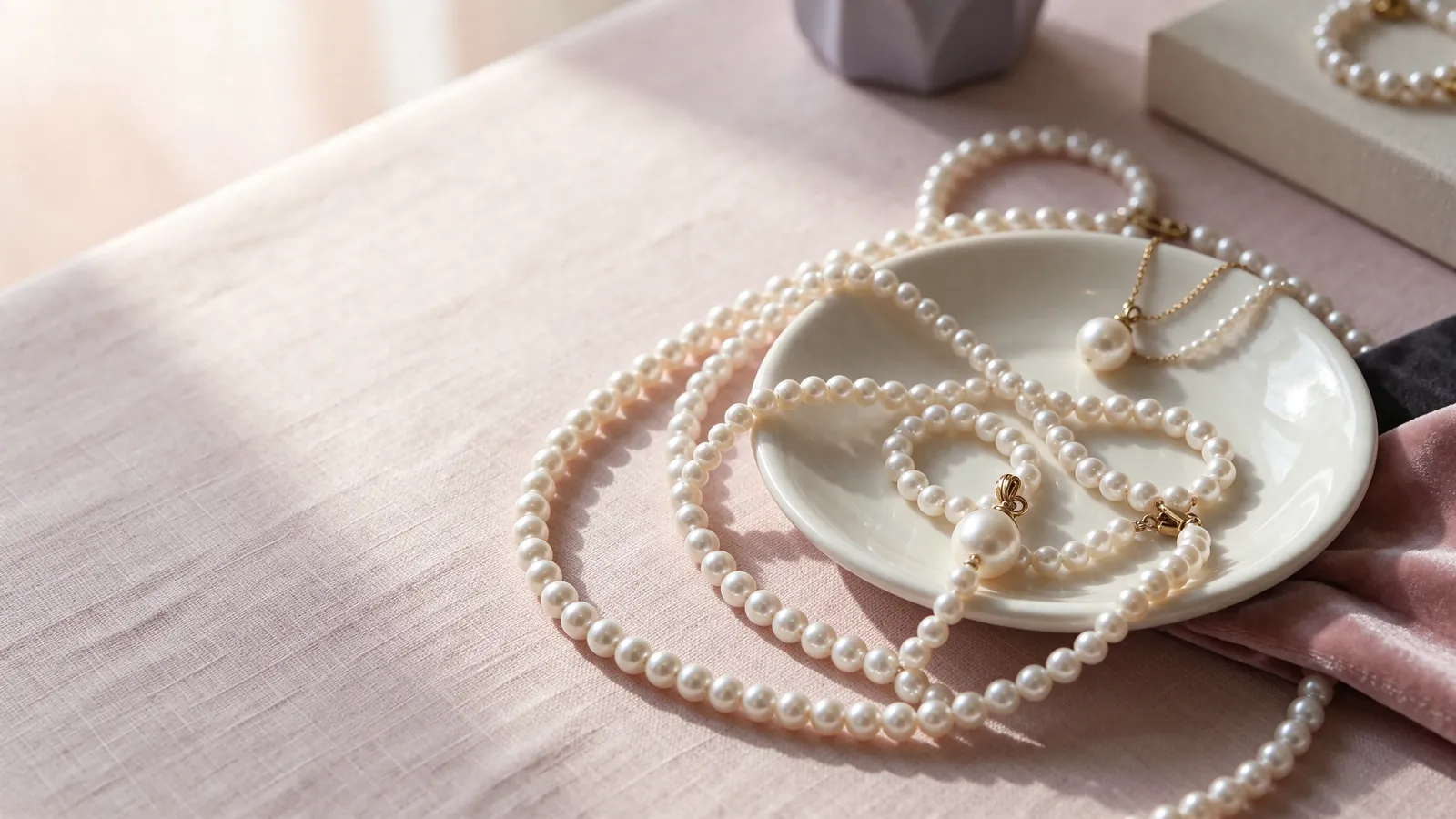
How do an adjustable pearl Y necklace and a sliding pearl pendant necklace balance the drop of a Y-shaped pearl pendant necklace?
A Y-shaped pearl pendant necklace has two lines meeting above a descending section. That meeting point may be fixed or movable, so the outline alone does not establish adjustability. When comparing a pearl pendant, locate the clasp, the front junction and the hanging end separately. A choice of clasp positions changes how a necklace is worn, but does not necessarily make its front junction slide.
An adjustable pearl Y necklace and a sliding pearl pendant necklace should be assessed through their operation, not just their names. In some constructions, moving a component changes the relationship between the neck loop and the drop. A slider elsewhere may affect only the chain tail. Ask to see what changes before and after adjustment, and distinguish this from a chain made to a chosen fixed length.
When comparing an adjustable pearl Y necklace with a sliding pearl pendant necklace, does the Y-shaped pearl pendant necklace sit well against your neckline?
Start in the top you wear most often and make small adjustments using the demonstrated method. Watch the junction as well as the bottom pearl. If the pearl rests exactly on the fabric edge, it may disappear into the opening as you move. Decide whether you want the pearl on exposed skin or fully over the garment, rather than judging the drop in isolation.

Fit the drop to the neckline, not the other way round
A V-neck can echo a Y outline, but an extended drop is not automatically the best match. Locate the lowest point of the neckline and check whether the pearl clears it. Piping, lace and busy prints can compete with a fine chain. Comparing a long pearl pendant necklace can help you decide whether your priority is a longer overall line or a junction that changes position.
For a shirt, button it as you normally would before trying the necklace. There is little benefit in a drop that works only with an opening you would not usually wear. With a round neck, consider showing the entire Y over the fabric. A knitted high neck needs attention to possible contact between chain links and the weave, while jacket lapels should not push both sides of the necklace together.
Check a seated view and the effect of a jacket
Sit down, turn gently and put on your usual jacket. Look for contact with buttons, folds or a zip, and see whether the junction stays visually centred. These are styling checks rather than durability tests. If the clothing interferes, alter the combination or the permitted adjustment instead of pulling the chain into place.

Read pearl placement as a composition
Notice where your eye goes first: to the junction, an upper pearl or the hanging end. A prominent bottom pearl directs attention towards the centre of the outfit; pearls higher up may place more emphasis near the neck. A multi pearl pendant offers a useful comparison for distributed highlights, but multiple pearls do not by themselves create a Y shape.
Where several pearls follow the drop, compare their spacing and the position of the most visually prominent pearl. A graduated pearl pendant concerns transitions in size or arrangement, which is a separate question from sliding adjustment. Photographic proportions can change with camera angle and distance. A round, pale or bright-looking pearl does not establish its species, origin or quality grade, so keep styling observations separate from identity claims.
Distinguish intentional asymmetry from movement after fitting
Check whether unequal pearl heights are part of the intended layout before deciding that a necklace sits incorrectly. Then see whether the chain has twisted after wearing. If the arrangement changes unexpectedly, ask how the component should be positioned and operated. A pearl should not become a handle for adjustment; follow the demonstrated method without concentrating a pull on its attachment.

Examine the chain and connections as well as the slider
Choosing a chain for pearl pendant styling involves more than visual thickness. For a Y construction, examine the chain passing through the adjusting component, the descending tail and the pearl connections. Find out which part should be supported during adjustment. If a link catches or movement requires a sudden pull, stop and ask about operation rather than forcing the component.
A chain passing through a pearl and a chain passing through a slider describe different features. A through pearl pendant does not necessarily have a movable Y junction. Ask whether the pearl is fixed, whether the descending section can be detached and whether the clasp works independently of the adjusting part. If changing chains matters to you, establish which parts can separate rather than assuming that every pendant is interchangeable.
Keep metal colour and mechanical function separate
Try a white-toned, yellow-toned or rose-toned metal against your clothing and the pearl rather than judging it from a close-up alone. The material names to distinguish are 18K 750 white gold, 18K 750 yellow gold, 18K 750 rose gold, PT950 platinum and PT900 platinum. A material name does not establish slider travel, detachable parts or the suitability of a particular chain for that mechanism.

Decide whether you want a single statement or a layered arrangement
Fit the Y necklace on its own before adding a shorter necklace. Then inspect both the neck loops and the front junction: another pendant may collide with the junction even when the loops are well separated. If the chains repeatedly cross, remove one to identify the interference. A plain garment is a useful starting point when a delicate descending line becomes hard to distinguish against a print.
A pearl necklace enhancer may appeal if you enjoy changing how a pendant attaches, but opening and closing an attachment is not the same as moving a Y junction. Treat detachable wear and adjustable proportions as separate requirements. List your likely combinations, such as a shirt, a knit and a shorter chain, then test those combinations instead of choosing a design simply because it sounds more versatile.
Give earrings and the drop a clear visual relationship
If the lower pearl is already the focal point, start with simpler earrings and assess the outfit as a whole. Matching does not require every pearl to share the same shape or apparent size. Look once with your hair down and once with it tied back: the visible area of the earrings changes, which can change how prominent the necklace feels.

Apply pearl quality and care knowledge to a moving design
GIA describes seven pearl quality factors: size, shape, colour, lustre, surface quality, nacre quality and matching. Matching is worth observing where pearls occupy different heights and turn as you move. Under the same lighting, consider whether their tones and brightness form the composition you want. Deliberate asymmetry is not automatically poor matching, and this framework does not let a photograph establish a pearl's identity or grade.
GIA places pearl at 2.5 on the Mohs hardness scale and says pearls should never be cleaned with ultrasonic or steam cleaners. A Y necklace's hanging end deserves attention near buttons, zips and table edges. Wipe pearls with a very soft clean cloth after wearing, and apply perfume or hair products before putting the necklace on. Do not add oil or cleaning liquid to a slider in an attempt to improve its movement.
Store the neck loop and drop without wrapping them around the pearls
Lay the sections smoothly and keep the necklace separate from other jewellery. If the chain knots, do not pull against the pearl attachments to undo it. Before wearing again, check for changes at the clasp, junction and connections. Unexpected movement or a loose attachment is a reason to pause wearing and ask for guidance, not to tighten the arrangement by force.

Turn your wardrobe preferences into useful buying questions
Bring a front view of a frequently worn outfit and explain whether the necklace should sit on skin or fabric. Saying that the pearl should clear a particular shirt button is more informative than simply asking for something longer. If you are considering customisation, keep a chosen chain length separate from any request for a moving junction; they answer different needs.
Compare silhouette, operation, pearl placement, garment contact and care in that order. Establish what moves before deciding whether the decorative details suit you. You can discuss pearl pendant styling with Flint Jewellery on WhatsApp by describing your usual neckline and preferred drop. Focus the conversation on your wardrobe goals and the functions of an individual construction rather than treating a styling term as a promise of a mechanism.
Let the most frequent outfit settle a close choice
If two arrangements appeal equally, return to the outfit you wear most. A shirt wearer may prioritise a pearl that stays clear of the opening; someone who layers may prioritise a clean junction. If small components are awkward for you, ease of correct operation matters. A proportion that works with ordinary habits is more useful than one that looks good only in a carefully posed view.
For a pearl pendant styling conversation with Flint Jewellery, WhatsApp +85260106207 and share your usual neckline and the drop you prefer.
| Feature | Structure to identify | Fitting observation | Wardrobe decision | Question to ask |
|---|---|---|---|---|
| Fixed Y junction | Meeting point does not slide | Position of loop and end pearl | Choose a suitable fixed balance | Which section changes at the clasp? |
| Front sliding component | Chain passes through adjusting part | Pearl positions after movement | Keep the visible drop clear of the neckline | Which part should be supported? |
| Chain-tail adjustment | Adjuster acts at the tail | Whether the front junction changes | Do not confuse it with a front slider | Does it change the loop, the drop or both? |
| Several pearl positions | Pearls at different heights | Visual focus when turning | Compare spacing and highlights | Are the pearl positions fixed? |
| Layered or detachable wear | Another chain or opening attachment | Crossing or contact at the junction | Fit alone before adding another necklace | Which parts detach and what can they attach to? |
Pearl knowledge and authoritative references
GIA identifies seven pearl quality factors: size, shape, colour, lustre, surface quality, nacre quality and matching. For a Y composition, matching helps frame observations of pearls placed at different heights without turning a styling judgement into a grade.
Read the reference for this factFrequently asked questions
Does a Y outline prove that the necklace is adjustable?
No. A fixed junction can produce the same outline. Identify the adjusting component and ask which sections change when it moves. A chain made to a preferred fixed length does not provide the same function as a sliding junction.
Why does the bottom pearl disappear inside my shirt?
It may sit on the boundary between the opening and the fabric. Try the shirt with your usual buttons fastened, then compare permitted adjustments that place the pearl wholly on skin or over the garment. A different neckline may be more suitable than repeatedly pulling the drop out.
Can an opening pendant attachment replace a Y-necklace slider?
Not automatically. An opening attachment concerns how a pendant connects to a suitable necklace. A slider concerns movement along the chain and the resulting proportions. Check these functions independently.
Should the pearls look identical in an asymmetric arrangement?
Not necessarily. Consider whether their colour, lustre and placement produce a coherent effect under the same lighting. Different heights or shapes can be intentional. Styling compatibility alone does not establish the pearls' identity or grade.
What should I do if adjustment starts to feel difficult?
Stop pulling and ask about the correct operation and care of that component. Do not use the pearl as a handle or add oil to the slider. If a connection appears loose or the position changes unexpectedly, pause wearing until you have appropriate guidance.
Updated: