

How does the rice pearl shape distinguish rice pearls from rounder forms when comparing rice shaped pearls?
The useful starting point is the whole outline, rather than the word on a label. Rice shaped pearls suggest a slender body with a rounded transition between the middle and the ends. Follow the longest axis with your eye, then check where the pearl is widest. A narrow view can exaggerate slenderness, so turn the pearl or compare another angle before deciding that it has the silhouette you want. The balance of the ends matters as much as the overall length.
WSP includes rice among the shape descriptions associated with freshwater pearls. That context explains a use of the term; it does not identify every pearl carrying the label. The pearl shape guide helps keep outline separate from size and pearl type. For a meaningful comparison, ask about dimensions independently and read any identity information on its own terms. Rice pearls and the rice pearl shape are shape-led descriptions, not substitutes for information about origin, treatment or certification.
When comparing rice shaped pearls, which end contours and proportions give rice pearls their characteristic rice pearl shape?
Look for the way each end narrows from the middle. Both ends may appear softly rounded, or one may attract more attention. Decide whether you prefer a balanced outline or a slightly less symmetrical rhythm. Do not crop away the ends when comparing photographs: that removes precisely the information needed to judge how the elongated body finishes.

Compare neighbouring shapes without relying on a single photograph
A comparison with oval pearls is most useful when the images are shown at the same scale. Both outlines can have a long axis, but an oval impression is often fuller, while a rice description emphasises slenderness. This is an observation method rather than a universal numerical boundary. Request length and maximum width instead of assuming that a smaller-looking oval must be a rice shape. The middle and the curves towards the ends can change your impression even when proportions are similar.
With drop shaped pearls, attention goes to the contrast between a fuller end and a narrowing end. With round pearls, the visual effect is more point-like, whereas an elongated pearl introduces direction. Compare these effects in the complete arrangement, not as a contest to find the roundest specimen. Turning an elongated pearl can alter its apparent width and rhythm, which matters when you want a calm, repeated line rather than a collection of separate focal points.
Use side views to distinguish slenderness from flatness
Compare stick pearls for the course of the sides and the rounded character of the body, rather than treating every long outline as identical. Looking at coin pearls offers another useful reminder: a broad face and a thin side are different observations. Front and side views together reveal more than an attractive close-up alone.

Keep rice, seed, Keshi and baroque wording separate
The everyday image of a grain of rice can encourage an assumption that the pearl must be tiny. Resist that shortcut: outline and measured size are separate questions. Likewise, a name containing rice, seed or Keshi should not be read as a translation between equivalent terms. Ask what each word describes in the particular item, then separate the visible silhouette from information about the pearl itself. This makes comparisons clearer without requiring a single label to answer everything.
Reading about baroque pearls can help you observe irregular outlines, but baroque is not an exact synonym for rice. Describe what you can see: an elongated body, uneven sides, a fuller middle or an asymmetrical end. These observations can be more useful than trying to force the pearl into one category. A different label does not automatically indicate inferior quality, and a similar label does not establish matching identity or a shared origin.
Ask questions that have concrete answers
Instead of asking only whether something is a 'genuine rice pearl', ask which dimensions were measured, whether the body is flattened, and how the ends differ. Ask separately about natural or cultured identity and any treatment information. A clear description and item-specific documentation are more informative than reassurance based solely on a shape name.
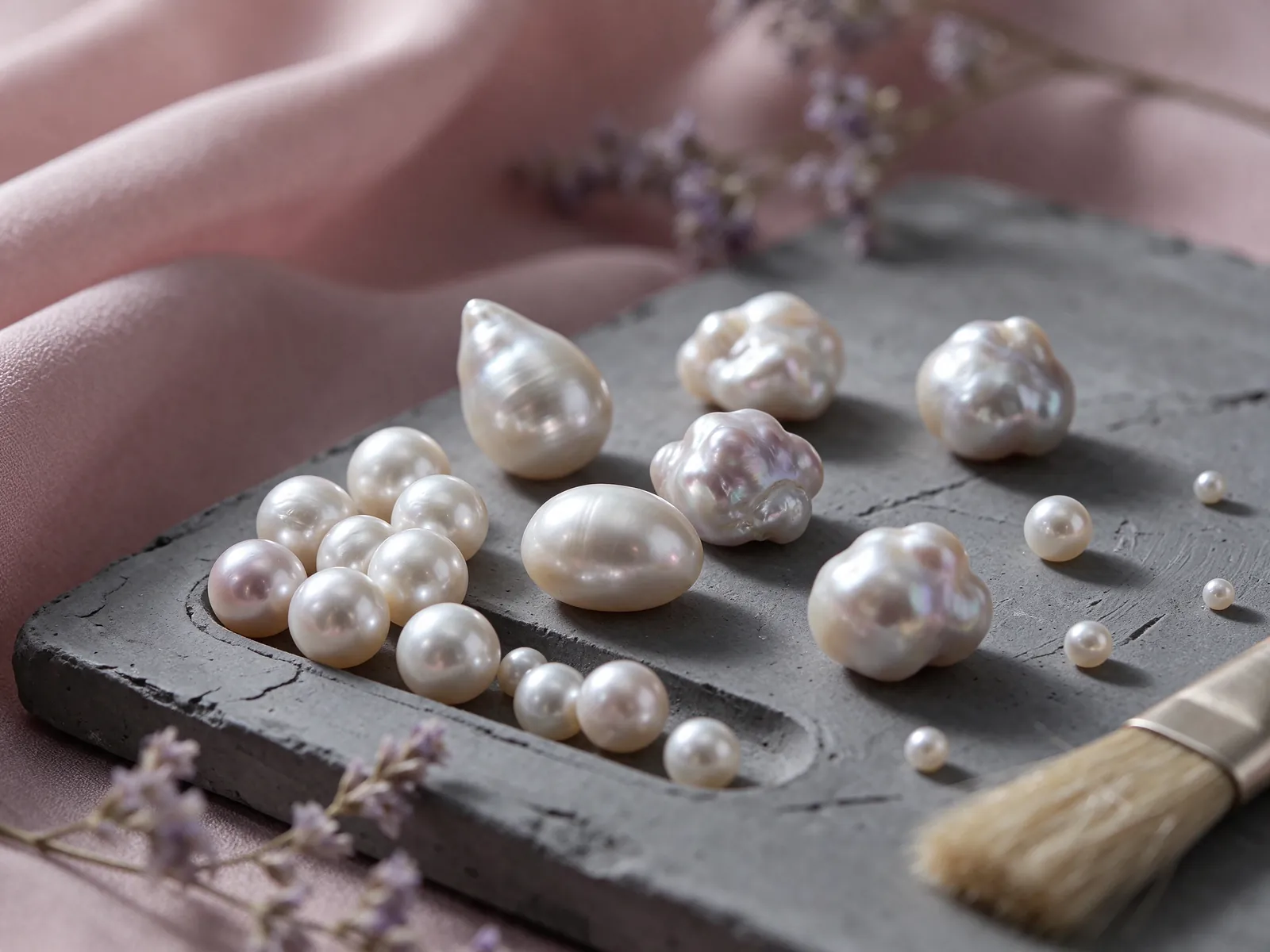
Read dimensions, drilling and arrangement together
An angled photograph may shorten the apparent long axis, while generous empty space can make a pearl look finer than it is. Read length and maximum width as separate measurements. Their relationship helps you imagine the outline, but it should not be converted into an invented industry-wide cut-off for rice shapes. Side thickness and the contour at either end can still differ between pearls with comparable proportions. For an assembled piece, ask to see the pearl from the angles you will actually notice.
The drilling direction also affects the visible arrangement. A hole along the long axis and a hole across it can produce different orientations; a close-up of an unmounted pearl does not show the final result. For multiple pearls, check whether their directions are deliberately aligned and how widths and colours transition. An orderly composition need not make every pearl identical, but any variation should feel consistent with the look you intend to wear.
Separate surface rings from the overall outline
The guide to circle pearls provides a helpful comparison when visible rings draw your attention. A ring on the surface and the pearl's overall silhouette are different features. Look at the complete outline before letting one surface line determine your shape description, and use a full-arrangement photograph to judge how those details read together.
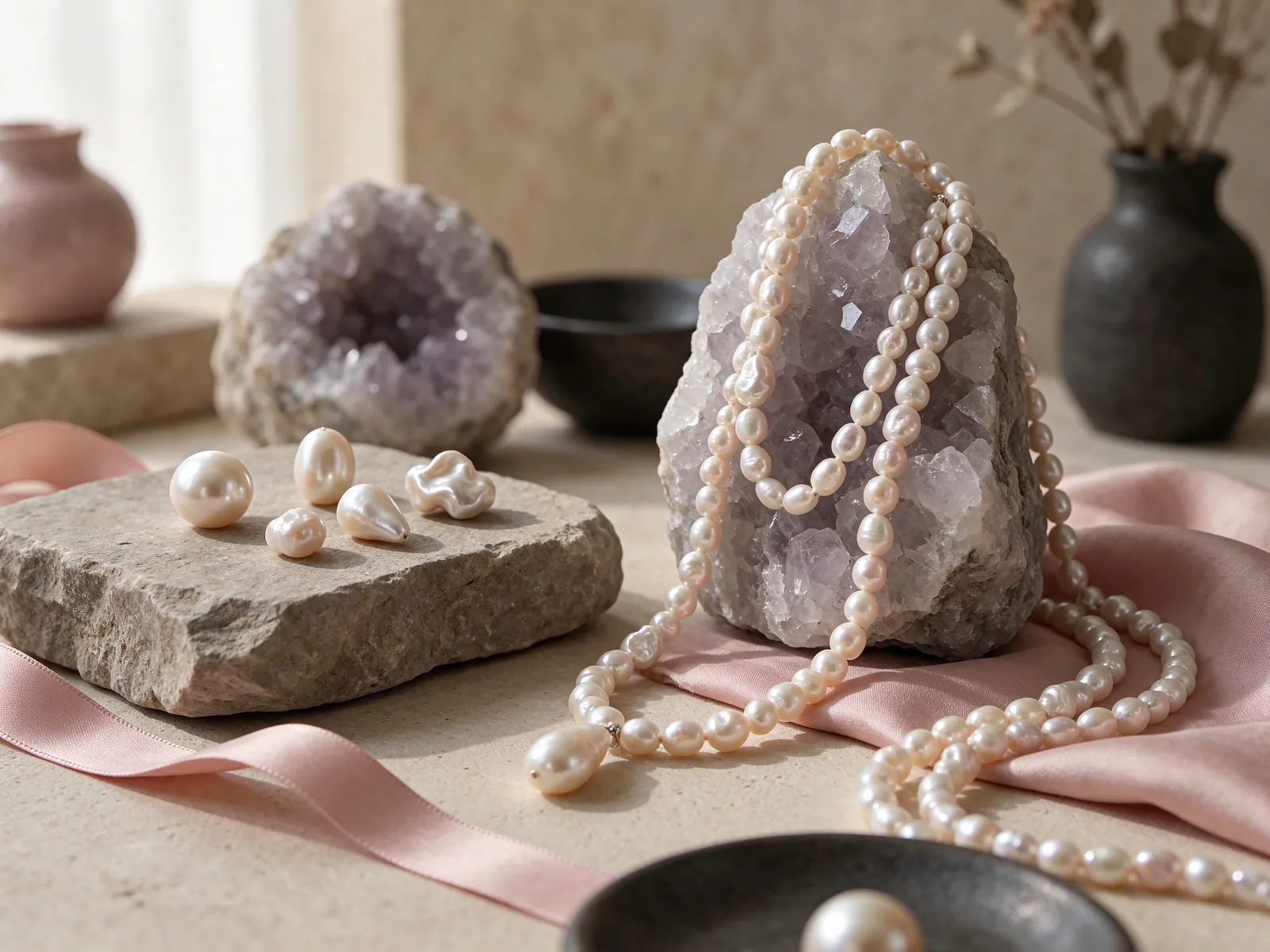
Assess quality beyond the appeal of a slender silhouette
GIA identifies seven pearl value factors: size, shape, colour, lustre, surface quality, nacre quality and matching. Shape is one part of that framework, not an overall verdict. An appealing rice outline does not remove the need to consider the other factors, and a non-round shape should not be dismissed simply for being non-round. When comparing options, separate your preference for a silhouette from the evidence available about the quality of the particular pearls.
For lustre, observe the clarity of reflected light rather than brightness alone. For surface quality, note visible pits, wrinkles or other features and their positions within the complete arrangement. Compare colour under similar lighting, as a warm background or different exposure can distort the impression. Do not infer origin or pearl type from a pinkish or purplish photograph, and do not treat an elongated shape or a bright reflection as a measurement of nacre.
Make a style list and a quality list
On the style list, write the traits you enjoy: slender, softly finished, evenly directed or gently varied. On the quality list, record dimensions, lustre, visible surface features and matching. Keeping those lists separate helps you explain whether you prefer a look or are comparing quality information. It also prevents the longest pearl from becoming the automatic winner.

Style the outline as a rounded short line
In an outfit, the rice silhouette can read as a short line with softened ends. Begin with directions already present in the clothing: a shirt placket, a neckline or a repeated print. A consistent pearl direction can echo those lines, while a contrasting arrangement can add variation. This is a composition choice, not a promise to change the appearance of body proportions. Step back to assess the whole outfit instead of judging impact from a close-up of the jewellery.
Busy prints and textured knits can obscure a fine outline. A quieter colour block or more space around the jewellery may make the silhouette easier to see. With plain clothing, small variations between pearls can become part of the interest. If combining rounded and elongated forms, choose a main rhythm and let the other shape act as an accent. This often gives a clearer result than asking every element to be equally prominent.
Do not equate rice shape with a miniature look
Actual dimensions, the number of pearls and their spacing all influence visual presence. A shape name alone cannot tell you whether the result will feel discreet or bold. Compare it against clothes you wear regularly, and include any existing accessories in the same view. That reveals whether you like the outline itself or the setting of a styled photograph.

Finish the comparison with practical care considerations
Before choosing, review the outline, measurements, orientation and quality information in that order. If pairing with jewellery you already own, photograph the pieces under the same light and compare colour and visual weight, rather than relying on a description such as 'white pearls'. For a multi-pearl arrangement, establish whether the photograph shows the complete composition or a single example. The distinction matters when judging matching and the rhythm of the finished look.
GIA gives pearl a Mohs hardness of 2.5 and advises against ultrasonic and steam cleaning. A rice outline does not create an exception. After wearing, use a very soft, clean cloth and avoid contact with perfume, hair spray, acids and excessive heat. Do not scrub the ends or holes with a hard brush in an attempt to reach every detail. A smooth appearance is not a guarantee against scratching or damage.
Protect the ends and allow wet string to dry fully
Store pearls separately from harder objects so that an elongated body is not trapped against a clasp or another accessory. If strung pearls have been cleaned with water, GIA advises that the string must be completely dry before wearing. Dry pearl surfaces alone are not enough. Gentle handling and reduced contact with hard objects matter more than assumptions about the durability of a particular outline.
Would you like to compare rice outlines with other pearl shapes or discuss the look you prefer? Contact Flint Jewellery on WhatsApp +85260106207 and share the contours and styling ideas that interest you.
| Check | What to observe | Useful comparison | Styling implication | Question to ask |
|---|---|---|---|---|
| Length and width | Slenderness across the full body | Read both measurements | A directional rather than point-like effect | What are the length and maximum width? |
| End contours | How each end narrows | Compare both ends at the same scale | Balanced ends can support repeated rhythm | Can I see both ends clearly? |
| Side profile | Thickness beyond the front view | Use a turned or side photograph | Consider how the body sits beside fabric | What does the reverse look like? |
| Lustre and surface | Reflections and visible features | Compare under similar lighting | Quiet backgrounds reveal fine outlines | Where are visible surface features located? |
| Matching | Direction, width and colour together | View the complete arrangement | Choose a main rhythm before adding accents | Is this the whole arrangement or one example? |
Pearl knowledge and authoritative references
GIA identifies 7 pearl value factors: size, shape, colour, lustre, surface quality, nacre quality and matching. Shape is only one of the seven.
Read the reference for this factFrequently asked questions
Does the rice label set a fixed length-to-width ratio?
A length-to-width ratio alone is not enough to define the outline. Compare actual length, maximum width, end contours and side thickness. A ratio helps describe proportion but does not capture every feature of the outline.
Can I identify freshwater origin from the rice silhouette?
No. WSP discusses rice among freshwater pearl shapes, but that usage is not an identification method for an individual pearl. Read pearl identity and origin information separately from the shape description.
Why does the same pearl look shorter in another picture?
A change of angle can reduce the apparent long axis, while cropping and image scale can change perceived size. Compare different views and use actual dimensions rather than relying on one photograph.
What should I compare when several rice pearls are used together?
Look at orientation, width, colour, lustre and how the sequence transitions. A complete-arrangement view is more useful than a single-pearl close-up for assessing matching and the intended rhythm.
Is a slender shape less important than being perfectly round?
Not as a style choice. GIA includes shape among seven value factors, so it should be considered alongside the others. Choose the silhouette you enjoy, then assess the available quality information rather than treating roundness as the only goal.
Updated: