

How does a Japanese Akoya pearl pendant necklace work with different necklines?
Start with your usual work shirt, round-neck top or open-neck knit rather than a close-up of a pearl. An open shirt can frame a pendant in the centre, but a button or folded fabric may interrupt its position. With a round neckline, decide whether the pendant should remain above the fabric or sit fully on it. When comparing a pearl pendant, a view of the whole outfit reveals this relationship more clearly than an isolated product image. To discuss pendant placement around your usual necklines, contact us on WhatsApp at +85260106207.
A V neckline draws attention towards the centre without requiring the pendant to reach the very bottom of the opening. A square neckline offers a broader horizontal frame, so check that the pendant's outline leaves enough visual space. In Hong Kong, a jacket or cardigan often becomes part of the same outfit indoors. Put that layer on when considering placement: the chain may disappear beneath a lapel even when the pendant looked well balanced without it.
Where should a Japanese Akoya pearl pendant necklace sit against your neckline?
Chain length alone cannot predict the final position. Neck circumference, shoulder line, pendant height and the curve of the fastened chain all contribute. Look in a mirror while standing, then sit down and turn your head to see whether the pendant catches the neckline or tilts. If considering an adjustable chain, understand its adjustment points and fastening method. A model's photographed placement is a styling illustration, not a promise of the same fit on you.

Read Akoya identity and Japanese origin as separate information
Akoya and the Chinese name 阿古屋 are different ways of writing the same name, not competing quality levels. Pendant describes a jewellery format, while Japanese origin concerns information about an individual pearl. A Japanese-inspired design is a different idea again. The introduction to what are Akoya pearls can help organise these questions, but a white, round appearance cannot establish the identity or origin of the pearl in a particular piece.
GIA’s pearl description notes that Akoya pearls are produced in Japan and China, so the Akoya name alone does not establish Japanese origin. Read each description for what it actually refers to: the pearl, the metal setting or the location where the jewellery was made. These details should not silently substitute for one another. The phrase Japanese Akoya pearl pendant is useful only when its origin wording is understood alongside the individual description. For a gift, explaining the neckline and visual balance that influenced your choice is more personal than describing every white pearl as Japanese.
Use documents for identity and try-on views for style
When reading a document, first establish which pearl or piece it describes, then consider the identity and any origin information it contains. Colour and shape alone do not establish natural-versus-cultured status, and natural material is not another way of saying wild natural pearl. Photographs remain helpful for appearance and proportions. Keep these roles separate: documentation addresses identity, while an outfit view helps you decide whether the pendant suits the way you dress.

Compare lustre and outline without letting the photograph decide
A single-pearl pendant concentrates attention on one focal point. Look at the definition of reflections and how the surface appears as the piece turns, rather than judging from one bright highlight. GIA identifies seven pearl value factors: size, shape, colour, lustre, surface quality, nacre quality and matching. The first six are the main considerations for a single-pearl pendant; matching becomes relevant when comparing multiple pearls. Lustre, surface quality and nacre quality are distinct observations. If photographs use different exposure or backgrounds, remember that a whiter-looking image is not automatically evidence of a better pearl. Close views and a view at normal wearing distance answer different questions.
The complete outline includes the bail and setting, not just the pearl. A prominent upper fitting can make a simple-looking design feel directional, while a surrounding frame increases the area visible against clothing. Ask whether you want the pearl's light to attract attention or the overall shape to act as a graphic accent. Neither preference requires a universal ideal size: the useful comparison is how each individual pendant looks with your own neckline and accessories.
Explore alternatives through the same visual questions
A freshwater pearl pendant can be considered using the same questions about placement, reflections and the setting, without assuming that its name alone settles quality. A baroque pearl pendant introduces another outline to explore: do irregular lines work with your clothing patterns, or do you prefer a more symmetrical focal point? This is a comparison of styling choices. It does not turn an irregular shape into proof of a particular pearl type or origin.
Treat the chain, bail and metal colour as one arrangement
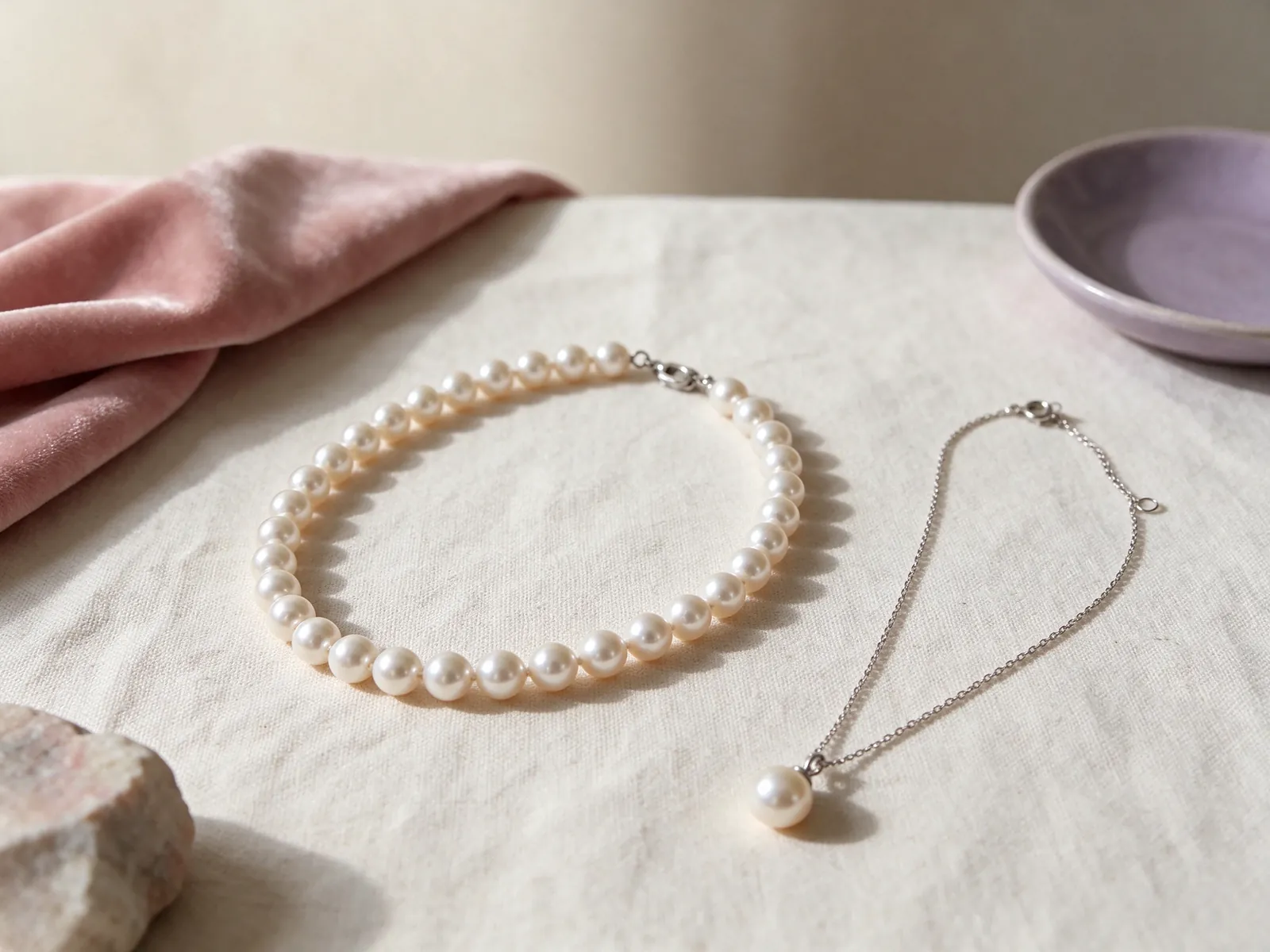
If you already have a favourite chain, determine whether the pendant is integrated with its chain or designed to be removable. For a removable arrangement, the chain end and clasp must work with the bail opening; a fine chain body alone does not establish compatibility. For an integrated design, assess the complete necklace rather than imagining a different chain. Also consider whether fastening small components feels comfortable and whether the pendant tends to turn during ordinary movement.
Use your watch, earrings and clothing fastenings as references for metal colour. The five material directions to discuss are 18K 750 white gold, 18K 750 yellow gold, 18K 750 rose gold, PT950 platinum and PT900 platinum. They are material options to consider, not an indication that a particular Akoya design is available. You need not match every metal colour in an outfit; a clear focal point can be more coherent than exact repetition.
Look at the side and back as well as the front
A side view helps explain how far the pendant projects from fabric or skin, while a back view helps you understand the arrangement of the setting. With knitwear, consider whether projecting details could catch the fabric. With a smooth blouse, observe whether the pendant repeatedly shifts sideways. If layering necklaces, check whether the pendants and clasps meet. Think about comfortable movement as part of the design, not as an afterthought to its front-facing appearance.

Change the outfit's emphasis from workday to dinner
Office clothing may already include a shirt collar, jacket lapel or lanyard. Give the pendant a clear space instead of asking it to compete with every line. If earrings are the main feature, the pendant can provide a quieter response; if the top is plain and earrings are discreet, it can become the focal point. A video-call view is worth checking too, because its upper-body crop can produce a different balance from a full-length mirror.
An evening change need not depend on a larger pearl. A different neckline or decorative surround can alter the emphasis. A halo pearl pendant invites you to compare the frame with its centre, while a pearl and diamond pendant raises the question of how pearl lustre and diamond reflections sit together. Consider whether you prefer a contained focal point or a more extended outline. Added decoration is not automatically more formal or appropriate for every occasion.
Use the background to change the same pendant
Try a plain top and a patterned one before adding more jewellery. A fine chain may blend into a busy print, while a plain background makes its curve easier to see. An open collar reveals that curve; a high neckline lets the pendant act as a shape against fabric. Compare photographs of outfits you genuinely wear, and notice which combination needs the least repositioning. An arrangement that stays comfortable in movement has practical value beyond a still photograph.

Choose a gift around the recipient's real habits
Look for habits rather than assigning a pearl style by age or profession. Does the recipient wear pendants close to the neck or over clothing? Are high necklines or a uniform part of her week? Does she enjoy handling small clasps? These observations help define a wearable gift without presuming a preferred diameter or grade. If a direct conversation is possible, asking which existing necklace feels most comfortable can be more useful than asking for a broad favourite style.
For someone who likes colour contrast, a Tahitian black pearl pendant is a related topic for exploring a darker focal point. A white South Sea pearl pendant offers another descriptive and design direction for a person drawn to white accents. Compare the actual outline and individual description rather than ranking gifts by names alone. A pearl category does not, by itself, tell you the size, price or whether its proportions suit the recipient's clothes.
Explain the thought behind the styling choice
A gift message can mention the shirt collar, understated accessories or metal colour that inspired your choice, instead of claiming that the pendant suits everyone. If the recipient has a much-loved chain, discuss whether preserving its familiar position matters before considering the pendant structure. A short care note is also thoughtful: explain gentle wiping after wear and separate storage. Practical information helps her enjoy the gift without attaching a durability or lifetime promise to it.

Care for the pearl and its connections, not only the chain
GIA gives pearl a Mohs hardness of 2.5, making separation from harder jewellery a sensible storage consideration. Arrange the chain so it does not tangle and give the pendant its own soft space rather than dropping it among other pieces. A very soft, clean cloth after wearing is part of routine care. Keep perfume, hair spray and acidic substances away from the pearl, and avoid excessive heat; a metal chain does not make the pearl insensitive to its environment.
GIA states that pearls should never be cleaned with ultrasonic or steam cleaners. Do not apply a cleaning method intended for the metal to the entire pendant. If the pearl appears loose, a chain link is distorted or the clasp seems unreliable, stop wearing the piece and have its structure examined by a jewellery professional. Avoid twisting the pearl or attempting a household-glue repair. Surface cleaning and the assessment of a connection are different tasks.
Build a brief before-and-after wearing routine
Before going out, look for a properly closed clasp, a knot-free chain and any unexpected change in how the pendant sits. Do not pull forcefully to test it. At home, remove the necklace before using sprays or cleansing products, wipe it gently and put it away without crossings or tangles. For travel, prevent repeated contact with other jewellery inside a bag. These habits support considerate care; they are not a claim of waterproofness or suitability for every activity. For a more personal discussion of Akoya pearl pendant placement, chain proportions or gift styling, share your wearing preferences on WhatsApp at +85260106207.
| Consideration | What to observe | Outfit context | Practical approach | Avoid assuming |
|---|---|---|---|---|
| Neckline position | Space between pendant and fabric edge | Shirts, round necks and V necks | Compare standing and seated views | A model's chain placement will match yours |
| Lustre and surface | Reflection definition and changing angles | Plain tops emphasise a single focal point | Use close and normal-distance views | Brighter exposure proves higher quality |
| Identity and origin | What each description actually refers to | Explaining a thoughtful gift | Read pearl and design details separately | White and round means Japanese origin |
| Chain and bail | Integrated or removable arrangement | Existing chains and layering | Check the chain end and clasp as well as its body | A fine chain always fits a bail |
| Routine care | Pearl surface and connection condition | After wearing and during travel | Wipe gently and store separately | Ultrasonic or steam cleaning is suitable |
Pearl knowledge and authoritative references
GIA identifies seven pearl value factors: size, shape, colour, lustre, surface quality, nacre quality and matching. For a single-pearl pendant, focus on the first six; matching matters when comparing multiple pearls. One bright highlight does not establish overall quality.
Read the reference for this factFrequently asked questions
Does Akoya describe a chain style?
No. Akoya is the pearl name, while pendant necklace describes the jewellery arrangement. Read the chain and pendant structure separately from the pearl identity and Japanese origin wording.
Why does a pendant disappear when I put on a jacket?
The lapels or collar can cover the chain and interrupt the clear space around the pendant. Compare placement with the outer layer you actually wear, rather than choosing from an open-neck top alone.
Can a setting make the same-looking pearl feel more prominent?
Yes, the bail and surrounding outline contribute to the visible area and direction of the pendant. Judge the whole piece against clothing, not only the pearl in a close-up.
Should a gift pendant match all the recipient's metal colours?
Not necessarily. Her existing accessories are useful references, but a clear focal point can work without exact colour repetition. Comfort, neckline position and her usual habits remain important.
Is a metal-chain pendant cleaned like an all-metal necklace?
Not automatically. Pearl-specific care still applies, and GIA advises against ultrasonic and steam cleaning for pearls. A very soft, clean cloth is appropriate for routine wiping; structural changes need professional attention.
Updated: