

How can you read the surface bands of circle pearls, also called ringed pearls or circled pearls?
Begin with the outside edge of the pearl, then move your attention to the bands on its surface. The edge tells you about the overall silhouette; the bands describe a different visual feature. A curved line in a front photograph may show only part of a ring, so a side view and a gently turned view are useful companions. The pearl shape guide provides language for the outline, allowing you to describe the surface separately rather than expecting one name to explain the whole object.
Notice how lighting affects what you can see. A band may appear prominent beside a bright reflection and quieter when the pearl turns. Compare photographs with a similar background and lighting before deciding which example has the stronger visual rhythm. An unfiltered close view helps with texture, while a wider view shows whether that texture remains noticeable at a normal wearing distance.
Do the bands on circle pearls—also called ringed pearls or circled pearls—mean the pearl is round?
No: ring-like markings and roundness are separate observations. A useful description might be an elongated outline with bands around the middle, rather than simply calling it a round circle pearl. Describe where the lines sit and how the outline changes from front to side. This gives a clearer account of the appearance without guessing the pearl’s identity or how the bands formed.

Choose the silhouette before choosing the strength of the rings
Think about whether you prefer a compact shape, a longer outline or a flatter face. Bands add a repeated surface detail, but the silhouette still determines the broad impression. Comparing drop shaped pearls can help you separate an interest in a tapered outline from an interest in rings. Ask yourself whether you are drawn to the direction of the whole pearl or to the small lines visible when you look closely.
For a flatter visual reference, consider coin pearls as a shape comparison, not as another name for circle pearls. A flatter outline asks you to compare its face with its side profile; a ringed surface asks you to follow lines across a curved surface. Looking at both helps clarify what matters most to you. Start at conversational distance, then move closer, so a highly enlarged photograph does not make the decision on your behalf.
Use irregularity as a style choice, not a quality shortcut
If you enjoy more angular outlines, square baroque pearls offer a useful topic for comparison. You may favour curves, corners or an intentionally uneven silhouette. None of these preferences supplies a quality ranking. For a coherent look, choose which elements should repeat: the broad outline, the colour impression or the rhythm of the bands. Other differences can remain part of the visual character.

Assess lustre and surface condition without counting rings as a grade
A preference for rings does not remove the need to look at other features. Observe the reflections, then the band pattern, then any other local surface marks. GIA identifies seven pearl value factors: size, shape, colour, lustre, surface quality, nacre quality and matching. Shape is one part of this framework. The number of visible bands should not stand in for all the other information, nor should a distinctive pattern automatically be described as a flaw.
When comparing examples, request views of the same area from different angles. This is more useful than comparing a dramatic spotlight photograph with a softly lit one. A close view answers questions about local appearance; a wider view helps with proportion and harmony. If something catches your eye, identify its location clearly rather than asking only whether the pearl is good. A precise question encourages an equally precise description.
Keep a texture preference separate from a surface question
You can like pronounced bands and still want a clearer photograph of the face that will show when worn. Write these as separate requirements. For example, an interest in visible middle bands need not prevent careful inspection of another surface area. This approach preserves the appeal of individuality without using it as a reason to skip examination. A photograph also cannot, by itself, confirm nacre quality.
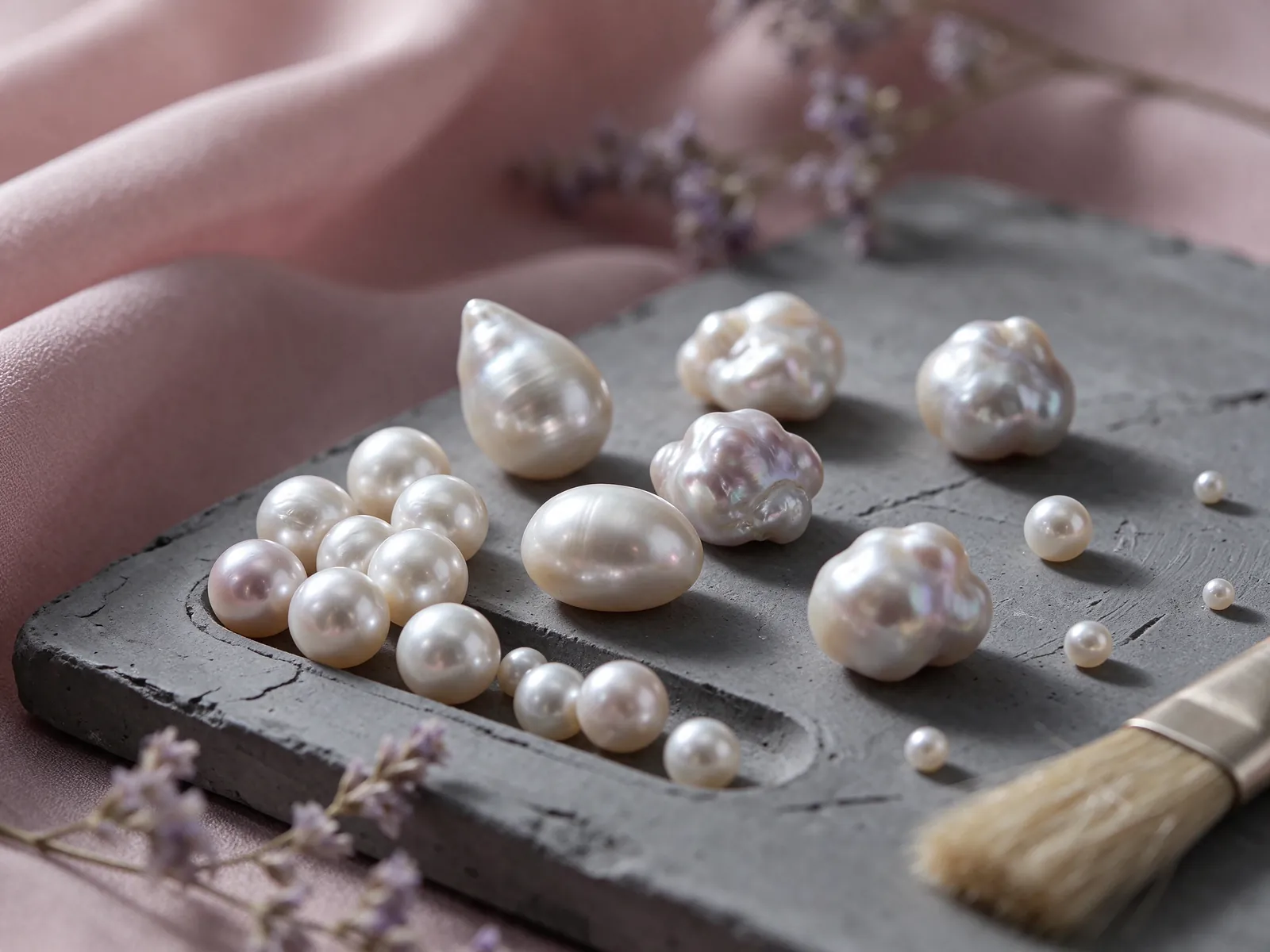
Let clothing and colour support the surface rhythm
Ring-like lines bring detail of their own. With a finely striped blouse or textured knit, try reducing other accessories so the pearl does not compete with several patterns at once. A plain neckline gives more space to read the silhouette. Check whether a pendant sits against fabric or within an open collar: the background changes the contrast, even though the pearl itself has not changed.
Use the pearl colour guide to consider lightness and warmth alongside your usual clothes. Warm ivory, pink and lavender fabrics can each create a different visual relationship with the same pearl. Compare beside a fabric you actually wear rather than relying entirely on a white-background photograph. Choose stronger contrast when you want a focal point, or a quieter relationship when you want the texture to reveal itself only at close range.
Colour components and surface bands answer different questions
Reading about pearl body colour and overtone helps distinguish colour effects from band direction. GIA describes bodycolour, overtone and orient as separate colour components, and not every pearl has all three. If a band looks differently coloured in one photograph, compare a turned view before treating that appearance as a fixed boundary. Describe the effect you can actually see instead of attaching the same colour vocabulary to every pearl.

Check outward-facing bands when choosing earrings or a pendant
Jewellery placement changes the way a ringed surface is read. Earrings have a front and side impression, while a pendant may turn as you move. Look for the bands on the face most likely to be visible in the intended design. For a pair, compare the overall outlines and where the visual weight sits before checking individual lines. Matching can be about a shared rhythm rather than exact duplication of every mark.
For a pendant, consider how the outline meets the chain direction. An elongated silhouette with transverse bands contains two different visual directions, which a simple collar can make easier to appreciate. If the long outline is your main interest, stick pearls provide another shape topic to explore. That comparison helps identify a preference for length without confusing an elongated shape with the separate presence of rings.
Balance close-up detail with a realistic wearing view
A close photograph may make fine bands the dominant feature, although the outline is what you notice from farther away. Think about whether you want discreet office detail or a more visible accent with an evening outfit. Neither is a rule for this pearl appearance. Use stated dimensions alongside wearing photographs; the fraction of the frame occupied by a pearl is not a reliable measurement of its diameter.

Ask about appearance and identity as separate matters
The words circle pearls, ringed pearls and circled pearls describe a visible feature. They do not establish species, origin or natural-versus-cultured identity. When reading a description, ask which terms refer to the pearl’s identity and which describe its shape. Then ask where the bands are clearest and whether the same surface can be shown from another angle. These are different questions, and separating them makes a buying discussion more useful.
For a gift, find out whether the recipient enjoys regular outlines or more individual forms. Someone may like pearls generally but prefer a restrained pair with a similar overall balance. Another person may welcome visible differences. Refer to their usual neckline, hairstyle and existing jewellery when describing the intended look. A preference for a named appearance is only a starting point; the actual visual relationship with the wearer matters more.
Read documents for their stated scope, not for an imagined ring grade
Where documentation is provided, look at the item it identifies and the information it actually states. A surface photograph helps with appearance; a document may address different matters. Attractive rings are not a certificate, and the word ringed is not a quality grade. Keeping these roles distinct allows you to appreciate the pattern without guessing a formation mechanism or expanding a document’s meaning.

Care for the surface gently rather than scrubbing along the bands
Visible ring lines are not an instruction to brush along the surface. GIA places pearl at 2.5 on the Mohs hardness scale and recommends a very soft, clean cloth after wearing. Keep pearls apart from harder jewellery in storage to reduce rubbing. When examining the bands, use clean hands and gentle light rather than a fingernail or repeated scraping to test what you can see.
Avoid acids, perfume, hair spray and excessive heat. GIA says pearls should never be cleaned in ultrasonic or steam cleaners. Cleaning should care for the surface, not try to deepen or remove its existing pattern. If a mark does not lift with appropriate gentle care, first establish a suitable approach for the whole piece rather than experimenting with a strong household cleaner.
Allow a cleaned strand’s string to dry completely
If pearls are strung and cleaned with water, GIA advises letting the string become completely dry before wearing. A dry-looking pearl surface does not mean the string is ready. Do not use high heat to hurry the process. Before putting a strand away, consider moisture as well as the visible surface; before wearing it, pay attention to the string and connection points as part of ordinary jewellery care.
To bring these observations into your everyday styling, note the outline, band position and level of detail you enjoy. Contact Flint Jewellery on WhatsApp +85260106207 to share your neckline or earring preferences and discuss pearl appearance and styling ideas. Begin with the look you want, rather than assuming a surface name promises a particular product.
| Observation | What to compare | Useful question | Styling purpose |
|---|---|---|---|
| Outline | Length impression and changes at the edge | Can I see the front and side? | Choose a compact, elongated or flatter silhouette |
| Band direction | Position and visible continuity of the lines | Which face shows the rings most clearly? | Relate surface rhythm to a neckline |
| Lustre and surface | Reflections separately from local marks | Can the same area be shown turned? | Distinguish quiet detail from a stronger accent |
| Colour effects | Body colour and changes with viewing angle | How does it look beside similar clothing? | Choose contrast or tonal harmony |
| Pair balance | Outline, visual weight and band rhythm | Can both fronts be shown together? | Decide how much difference you enjoy |
Pearl knowledge and authoritative references
GIA identifies 7 pearl value factors: size, shape, colour, lustre, surface quality, nacre quality and matching. A ringed appearance or silhouette alone therefore does not represent the full assessment.
Read the reference for this factFrequently asked questions
Does circle pearl mean a pearl used on a hoop earring?
No. It describes ring-like markings on the pearl’s surface, whereas a hoop describes the jewellery design. Specify whether you are discussing surface bands or an earring outline so the two meanings do not become confused.
Do more visible rings mean a better pearl?
Ring count is not a substitute for an overall quality assessment. GIA’s seven value factors include shape, lustre, surface quality and matching, among others. You can prefer a busy or restrained band pattern while considering the other factors separately.
Can a front photograph show a complete band?
Not necessarily. Part of the curved surface is hidden, and lighting affects visibility. A side view and a turned view of the same area help show how a line continues. Specify the location you want to understand rather than relying on another unrelated close-up.
Must every band line up perfectly in a pair of earrings?
That is a styling preference, not the only consideration. Compare the pair’s overall outline, colour impression and visual balance. You may prefer closely echoed rhythms or accept deliberate differences, depending on the look you want.
Should I clean the rings with a toothbrush?
Do not treat visible bands as a reason for routine scrubbing. GIA recommends a very soft, clean cloth after wearing and advises against ultrasonic and steam cleaning. If a strung piece is cleaned with water, the string must dry completely before it is worn.
Updated: