

Will a pearl necklace enhancer fit your necklace? Matching a pearl clicker pendant or clip-on pearl pendant
A pearl necklace enhancer introduces a detachable focal point by using an opening clasp at a suitable position between pearls. The useful distinction is mechanical: an opening attachment is not the same as a fixed loop through which a chain must pass. When comparing a pearl pendant, first establish how the attachment works before considering whether its outline suits your necklace.
Bring your own strand to a fitting rather than relying on another necklace with similar-looking pearls. The opening must admit the intended attachment position, and the closed clasp needs appropriate internal space. Knots, pearl shapes and the arrangement of the string can change that position. A description such as pearl clicker pendant or clip-on pearl pendant does not establish a universal fit.
When trying a pearl necklace enhancer, how should the clasp of a pearl clicker pendant or clip-on pearl pendant close?
With the necklace supported on a stable surface, inspect the clasp from the front and side. Its moving part should return to its intended position without trapping the string or pressing neighbouring pearls together. Look for an unobstructed meeting point and a natural downward hang. If closing requires force against the pearls, stop that combination instead of trying to squeeze the attachment into place.

Moving from a pearl strand to a chain requires a fresh fit check
A clasp that sits well between pearls may behave differently on a metal chain. A link can be broad in one direction and narrow in another, while a joint may be thicker than the rest of the chain. When selecting a chain for pearl pendant styling, consider the link profile, attachment space and pendant weight together, not simply the chain's appearance from the front.
It also helps to distinguish the pendant from the complete necklace. A pearl pendant top allows the attachment and the chain to be considered separately, but separate selection does not make every chain compatible. With a fixed bail, the chain or its end fitting may need to pass through. With an opening clasp, the relevant question becomes how the chain sits once the clasp is closed.
Passing through is not the same as hanging freely
Allow the attached pendant to turn gently and observe the chain from the side. A link that enters only at a particular angle may still catch against the closed clasp. Check whether the pendant faces forwards, whether the chain is pinched and whether a link touches the closure joint. Do not twist the clasp or force the chain to overcome an awkward fit.

Choose the focal position around the strand's balance
A central pendant usually creates an easy-to-read, symmetrical composition, but the centre still needs a suitable space between pearls. Once attached, look at the necklace as a whole: the pendant should face as intended and the two sides should form a natural curve. Sit down and turn gently to see whether the arrangement changes rather than assessing only a motionless mirror view.
An off-centre focal point can work well with a simple blouse or a clean shoulder line. However, the strand may slide and the pendant's weight can alter its position. Compare the result with your earrings and neckline, and notice whether the pendant repeatedly meets the edge of the clothing. If it keeps travelling towards the centre, a central arrangement may be a better styling choice.
Decide whether one pearl or a fuller outline is the main feature
A single pearl pendant offers one clear visual point, while a multi pearl pendant can introduce a fuller outline. Compare these approaches with the visual density of your existing strand rather than counting pearls alone. If the necklace already makes a strong statement, a distinct silhouette may be more effective than additional detail. The aim is a deliberate hierarchy, with one element leading the composition.
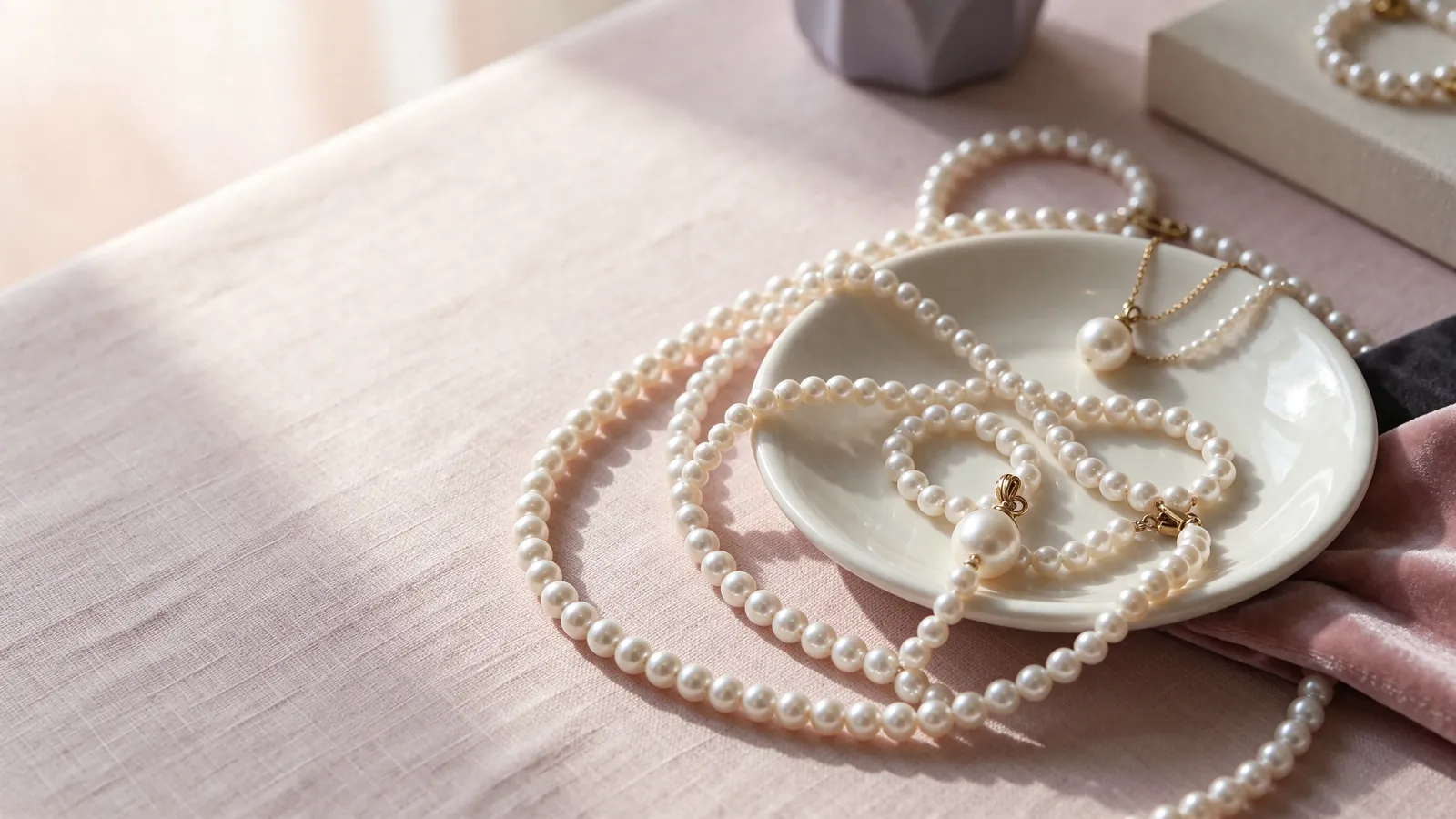
Use your usual neckline and daily movements as the styling test
Try a similar garment to the one you plan to wear. With a round neck, compare a pendant sitting above the neckline with one displayed fully over the fabric; avoid a position that repeatedly disappears under the edge. With an open shirt, leave a clear background between the collar points. Fabric thickness and collar shape can change the apparent position even when necklace length stays the same.
An opening attachment changes how a piece connects, not necessarily its length. If your main aim is a lower focal point or a vertical line for an open neckline, compare a Y-shaped pearl pendant necklace as a separate styling approach. Do not treat an enhancer as a slider along the strand. Remove the necklace before repositioning the attachment, then check the closure again.
Include scarves, bag straps and long hair in the comparison
A look that works in the mirror may be less practical when a scarf, a shoulder strap or long hair repeatedly meets the pendant. Observe these interactions before choosing a combination for a busy day. Remove the necklace before changing clothes so the collar is less likely to catch the attachment. For snag-prone fabrics, a simpler necklace arrangement can be more useful than constant repositioning.

Separate an opening clasp from other pendant constructions
A through pearl pendant concerns the way the chain passes through the pearl, whereas an enhancer concerns an opening attachment to a suitable necklace. Their front-facing outlines may not reveal that difference. If you prefer a chain line integrated with the pearl, compare the former construction; if your aim is to add a removable focus to an existing strand, concentrate on the clasp and the attachment position.
Ask to see the front, back and open position of a design, with a clear explanation of which component moves. A loop-like shape alone does not show that a part is designed to open. Names such as enhancer and clicker can be useful starting points, but operation and fit remain the deciding questions. Never prise open a fixed bail to imitate an opening mechanism.
For a gift, understand the recipient's necklace first
Knowing that someone likes pearls is only the beginning. Find out whether they usually wear a strand or a chain, where they prefer the focal point and whether their necklace can be brought to a fitting. Consider whether they can comfortably see and operate the attachment. Without the necklace, photographs can help explain preferences, but they cannot demonstrate the completed fit of a clasp.

Assess pearl appearance separately from clasp performance
GIA identifies seven pearl value factors: size, shape, colour, lustre, surface quality, nacre quality and matching among pearls in a multi-pearl piece. These provide useful ways to compare the pendant's visual relationship with a strand. They do not determine whether the clasp fits that strand. An attractive pearl and a compatible attachment answer different questions, so neither assessment should be used as a substitute for the other.
View the pendant and necklace together under the same light. Decide whether you prefer a continuation of the strand's colour and lustre or a contrasting focal point. Shape can contribute to that choice without establishing pearl identity. A photograph, a colour description or a pendant name alone does not establish origin, natural-versus-cultured status or certification. Choose the visual relationship you enjoy, without drawing unsupported identity conclusions.
Start with the whole necklace, then examine the details
Look first from a normal conversational distance, then inspect the pearl surface and closure closely. This keeps a small detail from overshadowing the overall proportion. Photographs of your usual outfit can help you remember the styling result, while the actual necklace remains important for fitting. The practical aim is agreement between appearance, attachment and wearing habits, rather than a judgement based on one enlarged image.

Care for the pearl and the moving attachment after wear
GIA advises against ultrasonic and steam cleaning for pearls. For routine care, use a very soft, clean cloth after wearing and avoid acids, perfume, hair spray and excessive heat. An opening clasp also deserves a visual check for trapped fibres. Wipe gently around the attachment rather than pushing cloth into the meeting point, and do not repeatedly press the clasp to force an obstruction out.
Remove the pendant over a stable surface, taking care not to pull the strand with it. Store the pieces where they are not rubbing against harder jewellery. If a strung necklace has been cleaned with water, its string must be completely dry before it is worn again. Recheck the attachment whenever you assemble the look, particularly after changing to a different strand or chain.
Make a pendant enquiry specific to your necklace
When discussing pendant choices with Flint Jewellery, prepare views of the necklace, its end fitting or the intended space between pearls, together with your preferred neckline and wearing height. Asking how a connection would work with that necklace is more useful than asking only for a design name. If a closure becomes distorted, difficult to operate or unstable in wear, stop using that combination before seeking advice. To discuss pendant choices for your existing necklace, contact Flint Jewellery on WhatsApp +85260106207 and share your necklace photographs and wearing preferences.
| Check | What to observe | Common confusion | Useful next step |
|---|---|---|---|
| Space between pearls | An unobstructed attachment and completed closure | Similar pearl size does not mean identical spacing | Bring the intended strand |
| Chain profile | Free movement inside the closed attachment | Passing through does not establish a comfortable fit | Compare width, thickness and side views |
| Focal position | Forward-facing pendant and natural strand curve | Weight and movement may shift an off-centre pendant | Observe standing, sitting and turning |
| Neckline | A visible pendant without repeated catching | An opening clasp is not a length adjuster | Try your usual garment |
| Pearl coordination | Colour, lustre, shape and overall proportion | Appearance does not establish identity or a certificate | Choose continuity or contrast deliberately |
| After-wear care | A clear closure and completely dry string | Pearls should not be steam or ultrasonically cleaned | Wipe gently and store without rubbing |
Pearl knowledge and authoritative references
GIA lists seven pearl value factors: size, shape, colour, lustre, surface quality, nacre quality and matching among pearls in a multi-pearl piece. They help assess visual coordination; clasp compatibility remains a separate check.
Read the reference for this factFrequently asked questions
Should an enhancer clasp grip the surface of a pearl?
The intended attachment is at a suitable position between pearls, not by squeezing a pearl. If the clasp needs to press pearls together or pull the string tight to close, do not use that position.
Is a click sound enough to confirm the closure?
No. Inspect the completed meeting point and ensure no string or fabric is trapped. Mechanisms differ, and a sound alone cannot show how the clasp is sitting.
Why does an off-centre enhancer move towards the middle?
The strand can slide, and pendant weight and body movement can change the focal position. Try a central composition if the off-centre arrangement does not stay as intended; do not clamp pearls to hold it.
Can I open a fixed pendant bail with a tool?
Do not prise open a fixed bail to turn it into an enhancer. A fixed connection and a designed opening clasp are different constructions even when their outlines look similar.
Can I clean the pearl strand with steam while the enhancer is attached?
Pearls should not be cleaned with steam or an ultrasonic cleaner. Follow GIA's gentle care guidance, and allow a string cleaned with water to dry completely before wearing the necklace.
Updated: