

How can a smile pearl pendant or smiley pearl pendant bring a smile pearl necklace into balance with your neckline?
Discuss smile-inspired pendant styling with Flint Jewellery on WhatsApp +85260106207. Share your usual neckline and preferred outline to explore placement, proportions and pendant choices.
Start with the neckline you actually wear most often. On a round-neck top, a smile pearl pendant can sit against exposed skin or fully over the fabric, but an arc caught halfway across the edge is harder to read. Check both ends rather than just the centre. The wider view used when choosing a pearl pendant helps you judge whether the curve has enough clear space beside the collar.
With a V-neck, allow the curve to occupy the opening without forcing it into the lowest point. A shirt needs a different test: fasten the buttons as you would for work, then look at whether the collar covers an end of the pendant. Styling that only works with an unusually open shirt may not suit your everyday routine. The useful question is where the outline stays visible, not which neckline is supposedly correct.
Where should a smile pearl pendant or smiley pearl pendant sit when styling a smile pearl necklace?
Chain length alone cannot predict placement because neck proportions and attachment positions also matter. Compare any available adjustment positions while wearing the same top. Stand, sit and lean slightly forward to see whether the curve stays clear of the fabric. This separates a placement issue from an outline that is simply too wide for that neckline.

Decide whether you prefer an abstract arc or a recognisable face
A smiley pearl pendant is a design description, not a promise of eyes, mouth details or a particular pearl arrangement. Look first at the silhouette. A shallow curve may read as a quiet horizontal accent, whereas a deeper arc can make the smile more apparent. Notice whether the metal line or the pearl row carries the expression. This helps you distinguish a discreet everyday idea from a more literal motif.
Comparing a tiara pearl pendant encourages you to look at an upward-focused outline beside the lower curve of a smile. An apple pearl pendant offers a different question: do you enjoy a clearly recognisable object, or prefer a suggestion created by a line? Use the same clothing background for these comparisons. Motif names are helpful for discussing taste, but they do not establish the proportions or specifications of individual pieces.
Read the outline before zooming into the details
A straight-on view is useful for comparing the height of the two ends, while a side view shows how far the arrangement projects. Return to the whole pendant after studying a close-up. Perspective can make one end appear higher, so avoid treating an angled photograph as proof that the design itself is uneven.
Assess the pearls as a continuous arrangement
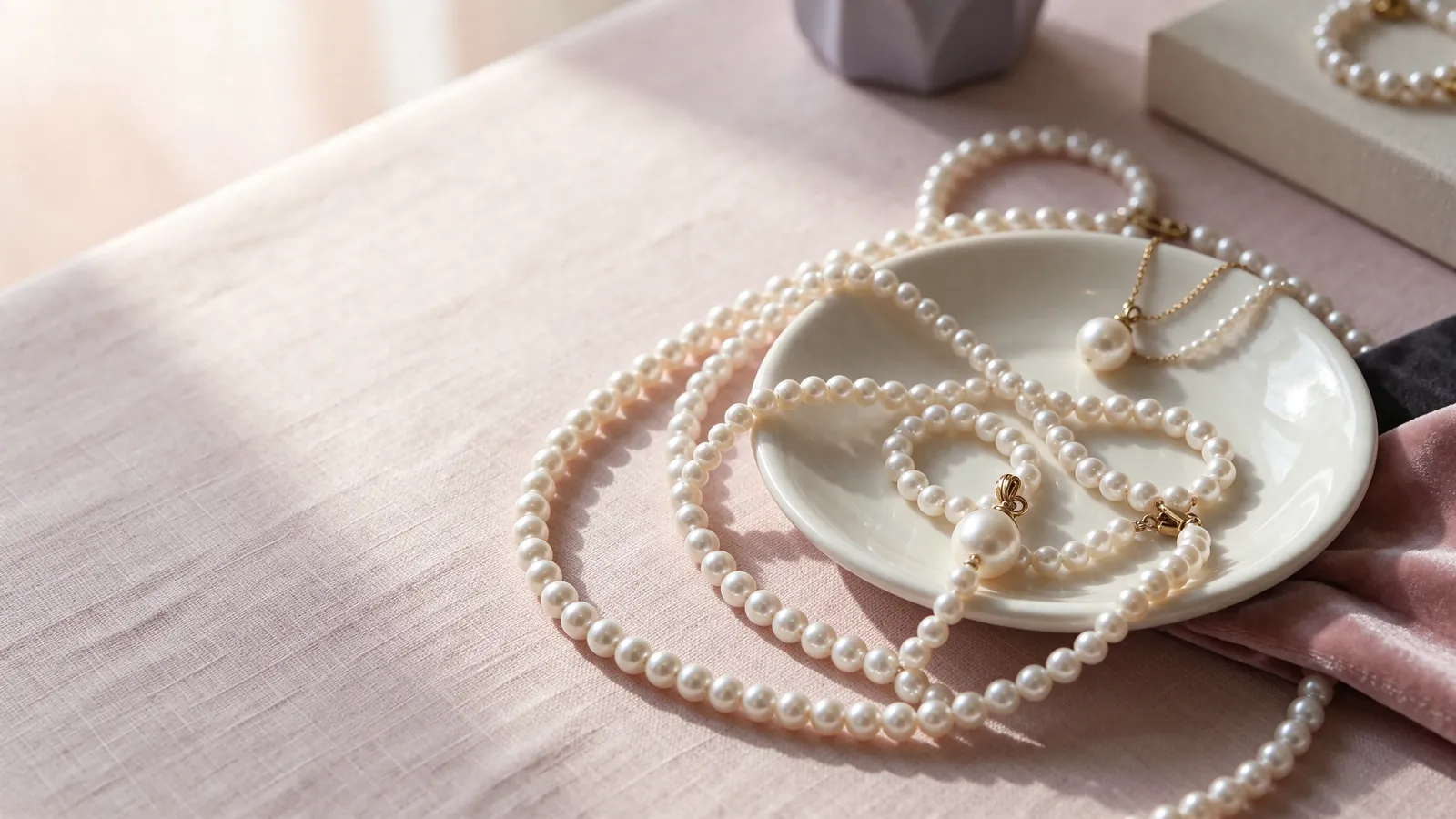
When the pearls form the smile, the relationship between neighbouring pearls deserves attention. Compare their reflected highlights, colour and spacing as a group. A deliberate change in size or shape can create rhythm; identical-looking pearls are not the only possible aesthetic. View the piece from an ordinary wearing distance as well as close up, because a detail that dominates an enlarged photograph may be less noticeable in the overall curve.
GIA describes seven pearl quality factors: size, shape, colour, lustre, surface quality, nacre quality and matching. Matching is especially relevant to understanding the visual coherence of a pearl row, while individual surfaces and lustre still deserve consideration. These factors cannot all be established from a photograph. Shape or colour alone does not prove origin, natural-versus-cultured identity or treatment status; any written identification should relate to the particular piece you are considering.
Compare colour under consistent viewing conditions
Use the same light and background when comparing arrangements, then turn the piece gently to observe changing reflections. A coloured shirt can influence what you see on a pearl's surface. Try a plain background if colour is important to you, and keep an overall wearing view beside the close-up rather than choosing from the enlarged detail alone.

Check how the horizontal outline behaves in movement
Look at how the chain meets the pendant: connections towards the ends and a central attachment can produce different visual behaviour. Do not assume that an arc shown level in a photograph will stay in exactly that position during wear. Walk a little, turn your head and sit down before checking it again. If you repeatedly need to straighten the pendant, decide whether that adjustment fits your usual jewellery habits.
The back matters because it sits against skin or clothing. Check the edges, fastening and any projecting parts near the pearl arrangement, especially with fine knitwear. If pendant and chain are being selected separately, ask whether their attachment arrangements are compatible. A chain that fits through an opening does not necessarily create the same placement or balance as another chain. Comfort and an easy-to-use clasp should remain part of the comparison.
Include hair, scarves and outerwear in the trial
Let long hair fall naturally, then try your usual jacket or scarf. Gently turn your head to see whether anything catches near the ends; there is no need to pull at the pendant to test it. A cross-body bag strap may also pass through the wearing area, so check the complete outfit rather than the necklace alone.

Keep the smile readable in workwear and layered styling
For workwear, begin with the arc as the main neckline detail and keep other jewellery visually quiet. Horizontal stripes can compete with the pearl row, so compare a plain top before changing the necklace. A geometric pearl pendant is a useful contrast when deciding whether a soft curve or a straighter outline works better with your usual tailoring. A smile motif need not be restricted to casual clothing if its proportions fit the outfit.
For a relaxed weekend look, a simple T-shirt can give the arc a clearer background than a busy neckline. When layering necklaces, separate their resting positions and then check again after movement; pieces that begin apart can still overlap. Comparing a butterfly pearl pendant can help you assess another laterally spread silhouette. The practical issue is whether the clothing leaves room for the ends, rather than which motif looks larger in a close-up.
Judge the composition with shoulders and earrings visible
Take an upper-body view instead of cropping tightly around the pendant. Include the neckline and earrings so you can see where attention gathers. If several motifs compete, remove one piece and compare again. A ruffled collar or fabric bow may already provide enough detail; adding more chains is not always the way to make the smile clearer.

Choose a gift around the recipient's habits, not just the symbol
A smile can convey a friendly sentiment, but the recipient's wardrobe remains the better starting point. Notice whether they usually wear shirts, round necks or high collars, and whether their jewellery tends towards recognisable motifs. Someone who favours understated pieces may prefer a suggestion of a smile rather than a complete face. Consider horizontal shapes separately from the message of the gift, so the sentiment does not override practical wearing preferences.
A flower pearl pendant gives you a way to discuss a concentrated petal-like outline, while a heart diamond pearl pendant prompts a conversation about a more explicit heart motif. These are comparisons of visual taste, not fixed rules about occasions or emotional significance. When discussing pendant choices with Flint Jewellery, an outfit photograph and a description of the preferred outline can make questions about placement, connections and proportions much more specific.
Separate essential preferences from optional details
Find out about the recipient's usual necklace position and ease of operating clasps where possible. If the gift is a surprise, their frequently worn necklaces can offer clues without assuming your own proportions are the same. Keep these practical preferences distinct from favourite motifs, so an appealing photograph does not displace the requirements that affect regular use.

Care for the pearl row without stressing the curve
GIA places pearl at 2.5 on the Mohs hardness scale, making gentle care appropriate. After wearing, wipe with a very soft, clean cloth rather than pulling a cloth vigorously along the row. Avoid acids, perfume, hair spray and excessive heat. Use fragrance and hair products before putting on the jewellery. Pearls should never be cleaned with ultrasonic or steam cleaners, regardless of whether their arrangement forms a smile or another silhouette.
Before storing, ease out chain tangles and keep the pendant separate from harder jewellery that could rub against it or catch an end. Do not twist the curve to fit it into a small space or lift the necklace by a pearl. If an attachment, pearl setting or clasp seems loose, stop wearing the piece and ask about an appropriate inspection. A changed resting position can also be a reason to check for tangled connections.
Treat persistent marks according to the construction
Do not scrape near a pearl or dismantle the row to remove a mark. GIA notes that strung pearls cleaned with water must have completely dry string before wear; a pendant's construction may differ from a strung necklace. Ask about a method suited to the particular piece if gentle wiping is insufficient, rather than applying a general cleaning routine indiscriminately.
Ready to compare the curve with your usual wardrobe? Contact Flint Jewellery on WhatsApp +85260106207 and share an outfit photograph or your preferred necklace position to discuss pendant proportions, attachments and everyday styling.
| Outfit | Position to explore | Movement check | Decision point |
|---|---|---|---|
| Round-neck top | Fully on skin or fully over fabric | Sit and inspect the collar edge | Keep the whole pearl row visible |
| V-neck top | Within the opening with space beside the ends | Turn gently and watch the fabric | Avoid collar contact that obscures the arc |
| Buttoned shirt | At your normal button arrangement | Try your usual workwear posture | Do not rely on opening extra buttons |
| High-neck knitwear | Against the fabric background | Add your regular outerwear | Check contact with projecting details |
| Layered necklaces | Different resting positions | Walk before checking again | Avoid overlap that hides the smile |
Pearl knowledge and authoritative references
GIA identifies seven pearl quality factors: size, shape, colour, lustre, surface quality, nacre quality and matching. Matching is particularly useful when considering the coherence of pearls arranged along a smile-shaped curve.
Read the reference for this factFrequently asked questions
Can a smile pearl necklace look understated rather than playful?
Yes. A gentle arc without a complete face can act as a quiet horizontal accent. Look at the depth of the curve, the visible metal and the pearl arrangement together, then judge it against the clothes you normally wear.
Should I choose the chain length before considering the neckline?
It is more useful to compare them together. Neck proportions and attachment positions affect the result, so try available positions with your usual top and check again while seated. A length number alone does not establish the final placement.
Is perfect uniformity essential in a curved pearl row?
Not for every aesthetic. Changes in size or shape may be deliberate. Assess whether spacing, colour and lustre make a coherent arrangement, and look from an ordinary wearing distance as well as in close-up.
What should I check when pairing the arc with another necklace?
Check both resting positions, then walk and sit to see whether the pieces overlap or make contact. Keep the whole curve visible and include the collar in your assessment. Separation in a still photograph does not guarantee separation during wear.
Does the curved design change how pearls should be cleaned?
The outline does not remove the need for gentle pearl care. GIA advises against ultrasonic and steam cleaning. Use a very soft, clean cloth after wear, and ask about construction-specific treatment for marks that do not wipe away easily.
Updated: