
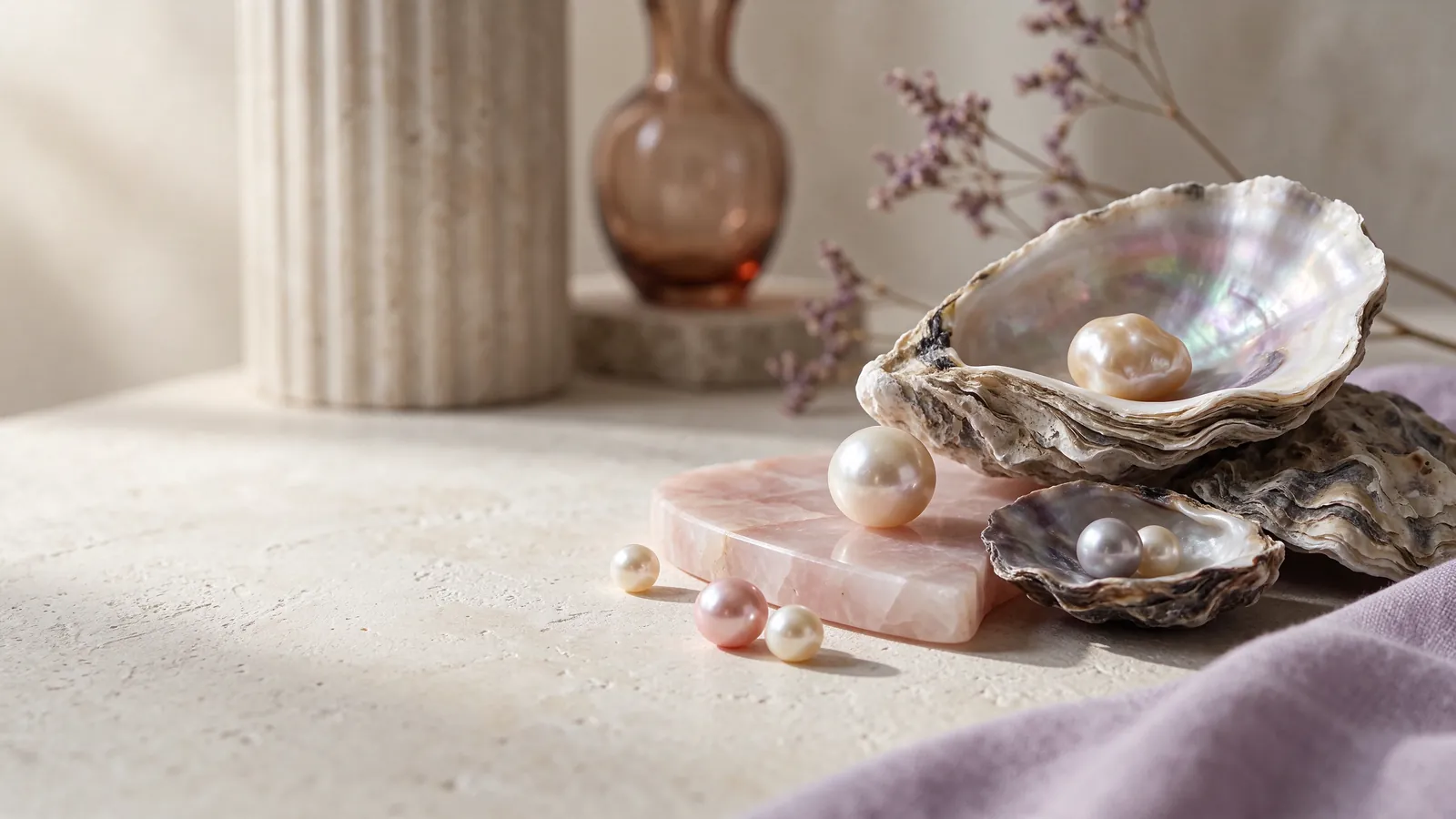
how Mabe pearls are made: what is a Mabé pearl, and how does a cultured half-pearl reach its finished form?
Curious about Mabé construction or how it may suit your style? Contact Flint Jewellery on WhatsApp +85260106207 to discuss your pearl questions.
A Mabé pearl begins with a nucleus fixed to the inner shell. The mollusc deposits nacre over the exposed surface, while the side against the shell does not develop into the other half of a sphere. This explains the raised front and flat-backed form. It is not simply a round pearl cut in two, so describing it as half a pearl should not suggest that it is an offcut from another gem.
Once the dome is separated from the shell, further work turns it into a component suitable for jewellery. WSP describes most finished Mabé pearls as having the original nucleus removed, the cavity filled and the back completed with mother-of-pearl. Cultivation explains how the nacre forms; assembly explains how the finished component is constructed. Both descriptions matter. A pearl types guide provides a wider comparison, but a shape name alone cannot establish a pearl's origin or species.
what is a Mabé pearl with a mother-of-pearl backing? how Mabe pearls are made clarifies the finished cultured half-pearl structure
Mother-of-pearl closes the back of most finished Mabé pearls. A metal setting may conceal that backing, so a rear photograph showing only metal does not settle what lies underneath. Ask whether a description refers to the loose pearl component or the complete mounted piece. Never lever a pearl out to inspect its back: understanding an assembled structure does not require dismantling the jewellery.
Half-round is a shape description, not a complete identification
Mabé is associated with a domed front, but its outline need not be a perfect circle. Oval and teardrop forms can follow the shape of the nucleus used in cultivation. Separate the front outline from the height of the dome and the construction of the back when comparing pieces. These are different questions, and a dramatic outline does not tell you whether the pearl has a particular origin or treatment history.
The term blister pearl concerns a pearl attached to a shell; it should not be treated as an exact synonym for every assembled Mabé component. Nor does a photograph of half round pearls reveal whether their nuclei were removed or their cavities filled. A useful description explains the formation and finished construction as well as the visible shape. Reading those details together is more informative than relying on a single short label.
Ask what the flat back consists of
A practical question is: does this finished pearl have a filled cavity and a mother-of-pearl backing? This avoids an unhelpful choice between calling the whole component real or artificial. Nacre, filling and backing have different roles. A clear answer about assembly still does not establish a grading report, species or geographic origin; any document should be read for the details it actually states.

Compare the dome in more than one view
The broad face makes lustre a prominent part of Mabé's appearance. Turn the piece slowly under soft light and observe how clearly reflections appear and how they move across the curved surface. A strongly lit photograph can exaggerate a bright patch without showing the rest of the pearl. Examine the surrounding surface too, especially near the rim, rather than choosing solely by the brightest reflection.
Two pieces with a similar front width may have different dome heights, frame thicknesses and setting depths. A raised dome can look striking from the side but may meet a sleeve or another object more readily. A flat pearl back does not guarantee a flat-fitting piece of jewellery. Request front, side and rear views, then consider the complete setting in relation to how you intend to wear it.
Decide whether you want a sphere or a front-facing accent
A round pearl suits an arrangement that shows a sphere from several directions. Mabé concentrates its effect on a domed front, which can work well near the face or on the chest. Mabé pearls vs round pearls is therefore a comparison of formation, construction and presentation, not a ranking of complete versus incomplete gems. Shape alone is not a reliable shortcut to value.

Look at colour under comparable conditions
Mabé pearls may have a white appearance or show blue, green, pink and gold effects across the surface. GIA distinguishes bodycolour, overtone and orient, and notes that not every pearl has all three components. A pink reflection is not necessarily the pearl's underlying colour. Equally, an attractive colour cannot by itself establish the mollusc species, geographic origin or absence of treatment.
Compare pearls under the same light and against a similar background. Warm lighting and colourful clothing can change what you see reflected in a glossy dome. Try the piece with a frequently worn top, then inspect it against a plain surface to separate the styling effect from the pearl's appearance. For earrings, place the pair together and look for compatible colour, lustre and outline rather than selecting two individually bright pearls.
Use the seven quality factors as questions, not a certificate
GIA's seven pearl quality factors are size, shape, colour, lustre, surface quality, nacre quality and matching. For a Mabé comparison, begin with what you can observe: colour, reflections, surface and proportions. Nacre quality is not established simply because a dome looks substantial. The framework helps organise a conversation, but does not grade a particular pearl or imply that the jewellery has a GIA report.

Place the soft shine at the neckline or near the face
A Mabé pearl pendant can give a plain blouse a clear focal point. Check how the bail, chain and setting support its orientation, because the pearl's flat back does not prevent the complete pendant from turning. Stand normally, then move and look again. A circular outline creates a compact accent, while a vertical teardrop can follow the opening of a neckline. Choose the outline for the clothes you actually wear.
Earrings bring the dome's reflections close to the face and offer an alternative when you prefer to leave the neckline clear. With hair tied back, the front is easier to see; with hair loose, check whether it hides the pearl or catches around the fitting. Consider the full weight, support and movement during a fitting. A broad face is not evidence that the earrings will feel light or comfortable.
Let the neckline and frame support one focal point
With a patterned top, a clear neckline or a pair of earrings can avoid competing details. With a simple open neckline, one domed pendant may be enough without several bright chains. Look at how much of the pearl the frame covers and whether its metal colour fits your other jewellery. These are proportion and styling choices, not proof of better pearl quality.

A ring needs a realistic plan for hand contact
A mabé pearl ring puts the raised dome where you can enjoy it while wearing it, but hands meet desks, handles and bags throughout the day. During a fitting, look at how far the pearl rises above the frame and whether it interferes with normal finger movement. A rim may shelter part of the edge; it does not make exposed nacre scratchproof or eliminate the possibility of a knock.
If you enjoy stacking rings, keep neighbouring settings from rubbing against the pearl or pressing on its rim. Remove pearl jewellery before cleaning, lifting awkward objects or working with substances that could damage it. For someone whose day involves frequent hand contact, choosing when to wear the ring can be more useful than expecting a particular setting to remove every risk.
Inspect the junction without trying to repair it yourself
Look along the pearl-to-metal junction for an unexpected gap, visible damage or movement. Also check that the underside feels smooth on the finger. If an existing piece becomes loose or develops a crack, stop wearing it and have it examined professionally. Do not add glue or file a rough area yourself; an external symptom does not reveal the condition of the filling or backing.

Care for the nacre and the assembled piece together
GIA gives pearl a Mohs hardness of 2.5, indicating that it is easily scratched or abraded. This is not an impact-resistance or waterproof rating. Wipe the pearl with a very soft, clean cloth after wearing and store it so harder jewellery cannot rub the surface. Apply perfume and hair spray before putting jewellery on, rather than spraying them towards a pearl already at your neckline or ear.
Pearls should never go into ultrasonic or steam cleaners. A Mabé piece also contains a filling, backing and setting, so a method suitable for the metal alone may not suit the complete construction. Start routine care with gentle wiping. If dirt is trapped around the frame or backing, ask a professional to choose an approach for the whole piece rather than soaking it or working a tool into the junction.
Notice changes when putting jewellery away
A quick look before storage can reveal a new edge crack, separation at the back or movement within the setting. Put a damaged piece in a soft separate pouch or lined box until it can be examined. Avoid excessive heat and prolonged exposure to intense lighting. The aim is to reduce contact and catch changes early, not to promise permanent colour, an unchanging structure or a particular repair result.
Would you like to discuss Mabé shapes, assembled construction or everyday wearing considerations? Contact Flint Jewellery on WhatsApp +85260106207 and tell us which pearl questions you would like to explore.
| Area | Construction point | How to compare | Wearing consideration | What it cannot prove |
|---|---|---|---|---|
| Domed front | Exposed nacre surface | Compare reflections and surface in the same light | Where you want the focal point | Origin or treatment status |
| Side profile | Dome height and setting depth | Use a side view and try the whole piece | Contact with sleeves or nearby objects | Comfort from front width alone |
| Back | Most finished examples have mother-of-pearl backing | Read the construction description | Smooth contact and pendant orientation | Absence of backing when metal conceals it |
| Rim | Pearl-to-setting junction | Look for damage, gaps or movement | Rings encounter frequent hand contact | Complete protection against knocks |
| Earring pair | Overall matching | Compare colour, lustre and outline together | Try with your usual hairstyle | Identical appearance from a colour name |
Pearl knowledge and authoritative references
GIA ranks pearl at 2.5 on the Mohs hardness scale: it is easily scratched or abraded. The figure does not measure impact resistance or waterproof performance.
Read the reference for this factFrequently asked questions
Does cultured half-pearl mean a round pearl was cut in half?
No. A Mabé nucleus is fixed to the inner shell and nacre grows over its exposed surface. The half-dome shape comes from that cultivation method. Most finished examples then undergo nucleus removal, filling and mother-of-pearl backing.
Is a filled Mabé pearl entirely artificial?
Filling does not mean the nacre surface was manufactured. The mollusc forms the nacre, while filling and backing are assembly steps in most finished examples. A useful description explains those separate parts instead of reducing the complete component to a real-or-fake label.
Can I confirm the backing from a rear photograph?
Only if the construction is actually visible. A metal mount may cover the mother-of-pearl back. Ask about the finished structure and read any description; do not dismantle the jewellery to find out.
Must a Mabé pearl have a circular outline?
No. Oval and teardrop outlines can follow the nucleus used during cultivation. However, an outline alone does not identify a pearl as Mabé. Formation and finished construction are also relevant.
Is ultrasonic cleaning acceptable if I only want to clean the frame?
Not with the pearl still forming part of the piece. GIA advises against ultrasonic and steam cleaning for pearls. Dirt around a Mabé frame should be addressed with the nacre, filling and backing in mind, preferably by a professional when gentle wiping is insufficient.
Updated: