
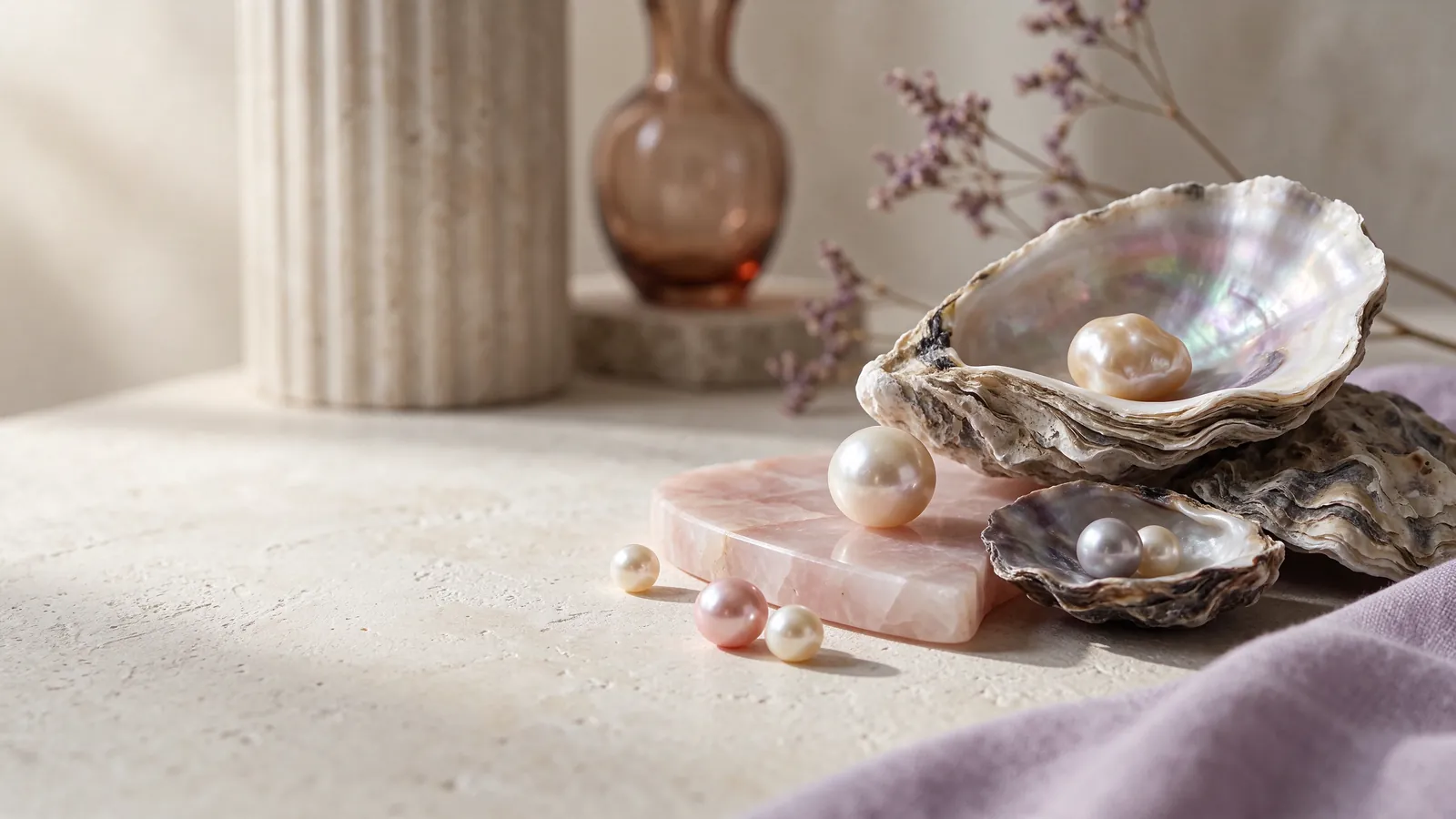
how Mabe pearls are made: what is a Mabé pearl, and how does a cultured half-pearl reach its finished form?
Curious about Mabé construction or how it may suit your style? Contact Flint Jewelry on WhatsApp +85260106207 to discuss your pearl questions.
The starting point is a nucleus secured to the inside of a shell. As the mollusk coats the exposed face with nacre, the surface becomes a raised dome. The side resting against the shell does not round out into a sphere. Mabé therefore gets its half-pearl form during cultivation; it is not a leftover half created by sawing through a round pearl.
The dome is later separated from the shell. According to WSP's explanation, most finished Mabé pearls have their original nucleus removed, the resulting cavity filled and the back finished with mother-of-pearl. The nacre has a biological formation process, while the completed component also has assembly steps. Understanding both gives the name useful meaning. The pearl types guide can help compare categories without treating a visible shape as proof of origin or species.
what is a Mabé pearl with a mother-of-pearl backing? how Mabe pearls are made clarifies the finished cultured half-pearl structure
In most finished examples, the mother-of-pearl backing closes the filled dome. A jewelry mount may hide this part completely. Before interpreting a photo, establish whether you are looking at an unmounted component or a finished piece with a metal-covered back. An explanation of the construction is more useful than trying to identify hidden layers from reflections or opening the setting yourself.
Read the shape name and the construction description separately
A half-round profile describes what a pearl looks like; it does not tell its whole history. Mabé can also have an oval or teardrop outline shaped by the nucleus used in cultivation. When shopping, distinguish the outline seen from the front, the height seen from the side and the material closing the back. These details influence both appearance and mounting, but none alone identifies a particular geographic source.
Blister pearl is a term connected with a pearl attached to a shell. It is not an exact interchangeable label for every finished, filled and backed Mabé. Similarly, a collection of half round pearls in a photograph does not reveal which assembly steps each example has undergone. Ask for a description that connects the growth method with the finished component rather than relying on the silhouette alone.
Replace the real-or-fake question with a structural question
Ask how the finished pearl is constructed and whether it contains filling and a mother-of-pearl back. These questions make room for the nacre surface and the assembled interior to be described accurately. They do not establish treatment status or a laboratory conclusion. If documentation accompanies a piece, look for the actual wording rather than assuming that a descriptive trade name answers every identification question.

Judge the entire dome, not just its brightest spot
Mabé presents a concentrated, front-facing area of nacre. To assess its appearance, turn it gently under soft light and watch the definition and movement of reflections. Also examine the less brightly lit portions and the area near the frame. A photograph arranged around one strong highlight may not show surface unevenness or a crack elsewhere. Several views make a better starting point than one dramatic image.
Front width cannot tell you how far a piece projects. A tall dome, deep base or thick frame can change its profile even when another piece looks similarly wide. For a pendant, that affects how it sits against clothing; for a ring, it affects contact during hand movements. Ask to see the side and back, then evaluate the complete jewelry rather than assuming that a flat-backed pearl must sit close to the body.
Choose the presentation you want to see
A spherical pearl offers a rounded surface from multiple directions. Mabé's visual emphasis is the dome facing the viewer, which can create a focused accent on an earring or pendant. Thinking about Mabé pearls vs round pearls in these terms is more helpful than treating a half-dome as an inferior sphere. Compare luster, surface, color and workmanship before making any judgment about value.

Separate the pearl's color from the lighting effect
A Mabé may look white or show blue, green, pink and gold effects across its curved face. GIA distinguishes bodycolor, overtone and orient; not every pearl displays all three. The color of a reflection is not automatically the pearl's underlying bodycolor. Nor can a blue or green appearance prove a species, location or untreated status. Keep visual preference separate from claims that need identification evidence.
For a fair comparison, keep the lighting, angle and background similar. Warm room light can shift the impression of white, while a colorful shirt may reflect onto the nacre. First try the piece with clothing you often wear; then use a plain background to see its appearance with fewer distractions. With earrings, compare both pearls side by side for a balanced overall effect instead of expecting a shared color name to guarantee a match.
Build a comparison around GIA's seven factors
GIA identifies seven pearl quality factors: size, shape, color, luster, surface quality, nacre quality and matching. For a shopper, this is a way to organize observations and questions, not a ready-made grade. A high dome does not demonstrate nacre thickness, and an attractive pair does not imply certification. Use the factors to avoid focusing on size while overlooking surface condition or how two earrings work together.

Choose between a neckline accent and light near the face
A Mabé pearl pendant can add a single soft highlight to a plain shirt or open neckline. During a fitting, check whether the chain and bail keep the front facing outward when you move. The flat back of the pearl is only one part of that behavior; the setting and suspension matter too. A compact round outline and a vertical teardrop create different proportions, so choose with your usual neckline in mind.
Earrings place the reflective surface close to the face without requiring a necklace. Try them with your normal hairstyle, looking for obstruction from loose hair and any catching around the fittings. Pay attention to support, weight and movement as well as the mirror view. A broad Mabé face does not guarantee a lightweight earring, because the full mount contributes to what you feel.
Use the outfit to decide how much detail to add
A heavily patterned collar may compete with a pendant, making earrings or a clearer neckline a more comfortable visual choice. With a simple top, one dome may already provide enough interest. Look at the frame's width and metal color in relation to your other jewelry. The purpose is a coherent outfit; a larger frame or brighter metal is not evidence of higher pearl quality.

Plan ring wear around the activities your hands perform
A mabé pearl ring makes the dome a visible feature on the hand. It also places nacre near desks, door handles and other surfaces. Check how high the pearl sits and whether the setting interferes when you bend your fingers. An enclosing rim can shelter some of the edge, but it cannot make the exposed surface scratchproof or remove every impact risk.
Avoid stacking another ring where its metal can touch the pearl or push against its rim. Remove pearl jewelry before household cleaning, moving bulky items or other tasks likely to expose it to chemicals or rough contact. For a wearer with an active hands-on routine, reserving the ring for suitable parts of the day can be a better solution than seeking a supposedly protective design for every task.
Treat movement or a new gap as a reason to stop wearing
Inspect the pearl-to-metal junction and the underside during a fitting, looking for an unexpected gap and checking that contact with the finger feels smooth. If a piece you own develops movement, a crack or separation, have it assessed professionally before wearing it again. Do not add adhesive or abrade the edge yourself: the visible symptom does not disclose the condition of the interior assembly.

Keep cleaning gentle and appropriate to the whole assembly
Pearl has a Mohs hardness of 2.5 according to GIA, so scratching and abrasion deserve attention. This number does not describe waterproof performance or resistance to a fall. After wearing, wipe the pearl with a very soft, clean cloth and keep it apart from harder jewelry during storage. Put it on after using perfume or hair spray, and avoid directing cosmetics or acidic substances toward the nacre.
GIA advises never using ultrasonic or steam cleaners on pearls. With Mabé, cleaning must also account for the filling, mother-of-pearl backing and mount. A process that suits the metal by itself may not suit the complete piece. If debris remains along the frame after gentle wiping, seek professional advice about the construction rather than soaking the jewelry or prying into a seam.
Check the edge and back before storing
Look for a newly damaged edge, separation at the backing or a pearl that moves in its setting. Keep a suspect piece in a soft individual pouch or lined box until it can be inspected. Avoid excessive heat and prolonged intense lighting, which can harm pearls. Good care reduces exposure and helps you notice changes; it is not a promise of permanent color, lifelong structural stability or a guaranteed repair outcome.
Would you like to discuss Mabé shapes, assembled construction or everyday wearing considerations? Contact Flint Jewelry on WhatsApp +85260106207 and tell us which pearl questions you would like to explore.
| View or feature | Relevant structure | Useful check | Connection to wear | Avoid assuming |
|---|---|---|---|---|
| Front | Nacre-covered dome | Inspect luster and the surrounding surface | A concentrated visual accent | Color proves origin or treatment status |
| Side | Dome plus frame and base | Compare the full profile | Projection can affect contact | Similar width means similar fit |
| Rear | Mother-of-pearl backing in most finished examples | Read the assembly description | Check smoothness and orientation | A metal-covered back reveals every layer |
| Edge | Junction with the mount | Look for damage, separation or movement | Hand jewelry meets more surfaces | A rim removes all impact risk |
| Pair | Matching of two earrings | Compare color, luster and outline together | Assess with your usual hairstyle | One shared color label guarantees a match |
Pearl knowledge and authoritative references
GIA lists pearl at 2.5 on the Mohs hardness scale. Pearl is easily scratched or abraded; the number is not a waterproof or impact-resistance rating.
Read the reference for this factFrequently asked questions
Why does Mabé have a flat back instead of a sphere?
The nucleus is attached to the shell, so nacre forms over its exposed face rather than surrounding it on every side. That cultivation position creates the dome. Most finished Mabé components are then filled and closed with mother-of-pearl after the original nucleus is removed.
Does the backing cancel out the fact that it is cultured?
No. Cultured describes how the nacre forms with human intervention in the cultivation process. Backing and filling describe later assembly. The two statements explain different stages and can both apply to a finished Mabé pearl.
Will a flat-backed Mabé pendant always lie flat?
No. The complete setting, its depth, the bail and the chain affect how the pendant sits or turns. Try the whole piece and observe it while moving rather than predicting its behavior from the pearl's back alone.
Can a colorful dome identify the pearl's source?
Color alone cannot establish origin, species or treatment status. Lighting, reflections and different color components also affect appearance. Enjoy the color as a styling feature, while reading any identification information separately.
What should I do if the pearl starts moving in its mount?
Stop wearing the piece and keep it protected until a professional can inspect it. Do not try to secure it with household glue. Movement may involve the mount or assembled pearl, and an external view is not enough to choose a repair method.
Updated: