

How neckline and fabric shape the look of a long pearl pendant necklace with a long chain pearl pendant
Think of a long pearl pendant necklace as a line that ends in one visible point. The top behind that point matters: a quiet surface can make the pearl easy to see, while a busy print or prominent pocket can compete with it. Begin with an outfit from your regular rotation, not a styled image you would rarely wear. The pearl pendant guide offers a starting comparison of simple single-pearl outlines and settings with more surrounding detail before you decide how much decoration you want.
An open neckline may place part of the chain on skin and part on fabric. Check where the pearl itself lands, especially if it stops at the edge of the neckline and alternates between being visible and hidden. With a closed neckline, notice seams, lettering and horizontal details that interrupt the drop. A long pearl pendant is not a guaranteed way to look taller. A more useful goal is a clear line that remains balanced without holding your shoulders differently or constantly straightening your clothes.
How to check the position and movement of a long chain pearl pendant on a long pearl pendant necklace
Try the long chain pearl pendant while sitting at a table, turning toward someone and reaching for a bag. Look for hiding, pressure and contact with hard edges. These ordinary actions show whether the resting point works beyond the mirror, without deliberately tugging or swinging the necklace as a test.

Describe the position you want instead of relying on a number
Before discussing chain length, identify a useful area on your own top where the pearl could rest. Its final position depends on the chain, the height of the pendant, the bail and the way the necklace follows your shoulders. The bottom of the chain is not always the bottom of the complete pendant. Explain both the position you like and the places you need to avoid, such as a button or desk edge. This gives a clearer starting point than copying another wearer's labeled length.
A long single pendant and a branching chain design do not create their vertical lines in the same way. In a Y-shaped pearl pendant necklace, the chain's downward continuation becomes part of the composition. Compare that approach if the start of the drop matters to you, but do not assume a single pendant has a sliding adjustment or detachable top. Establish how a particular fastening works before moving anything. The appearance of a long line does not tell you which parts can be changed.
Keep fitting comparisons consistent
Use the same shirt and a relaxed posture when comparing possible positions. A front photograph shows the overall line; a side photograph can reveal whether the pendant sits away from the fabric. Follow both with a sitting test, because a good-looking still image cannot confirm comfort at a desk.

Look closely at how the chain and setting meet
The pendant's small connecting parts influence how it behaves on a longer chain. Watch whether the bail moves freely in its intended direction and whether the pearl returns to the front after a gentle change in posture. Also check how the setting meets the neckline. A chain passing through the bail does not prove that its clasp can pass through, and neither fact should be guessed from a picture. Treat detachability as a construction question rather than a styling assumption.
Longer chains travel across more fabric, so examine the whole path for contact with loose knit loops, raised embroidery and button openings. A halo pearl pendant can give the pearl a stronger frame, but that frame may also change the edges that touch clothing. Compare it on the fabric you intend to wear. A larger-looking outline is not automatically easier to manage, and a delicate-looking chain is not automatically immune to catching. A practical choice balances the visual effect with how the pieces move together.
Avoid forcing a pendant onto a different chain
If you want to change chains, first confirm compatibility between the clasp, bail and attachment. Stop if the clasp needs to be pushed or squeezed through. The intended combination should support the pendant and allow normal movement; simply getting two pieces connected does not establish that they are a suitable pairing.
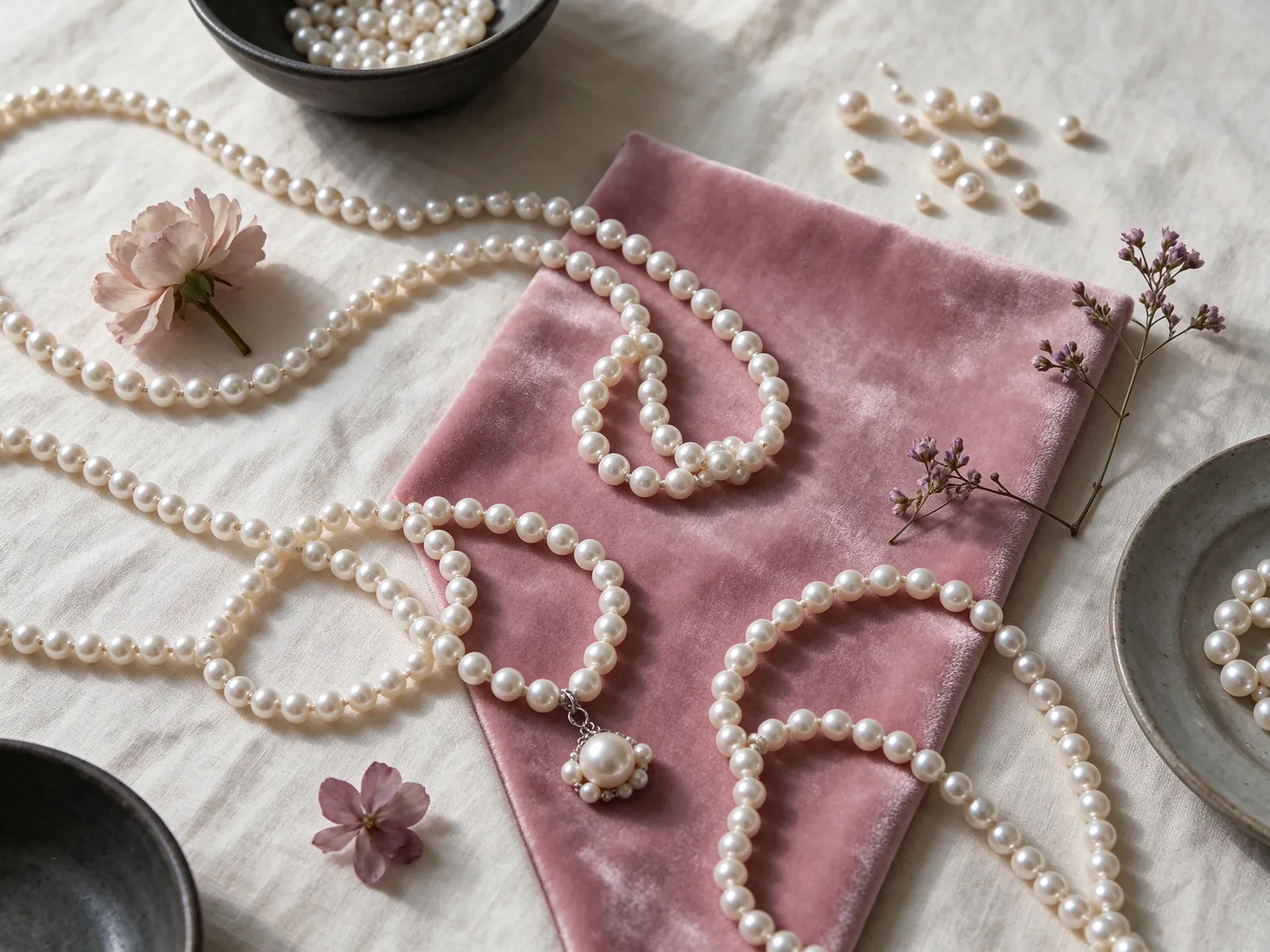
Evaluate the pearl as a focal point, not a label
On a longer chain, an individual pearl's outline can be a major part of the design. Turn it to see how reflections and contours change, then decide whether a balanced silhouette or an irregular one suits your clothing. The baroque pearl pendant guide provides a comparison for uneven curves and orientation. An unusual shape can be visually appealing, but it does not by itself identify species, origin or natural-versus-cultured status. Keep those factual questions separate from the style that first catches your attention.
GIA organizes pearl value around seven factors: size, shape, color, luster, surface quality, nacre quality and matching across multiple pearls. This encourages a broader assessment than relying on one enlarged photograph. For a single pearl, examine how its appearance works with the setting and background; a graduated pearl pendant offers a different composition if changing sizes are part of the look you want. Neither a pleasing outline nor an attractive color supplies proof of identity or a certificate. Ask about the particular pearl independently of its visual impact.
Check color against real wardrobe backgrounds
Compare the pearl in soft daylight and in the room lighting you commonly use. Include a familiar top rather than judging only against a display background. Camera settings can shift color impressions, so use images to explore style while keeping your assessment of documented pearl characteristics as a separate task.

Adapt the single-pearl line to work and evening outfits
For work, a cardigan or jacket can create a useful central opening, but the necklace should also make sense when that layer is closed. Check whether the pearl is hidden or pressed against a fastening. If a scarf, brooch or bold button already leads the outfit, decide whether the pendant needs to compete at all. Matching a ring or earrings to the metal tone can connect the look without adding another chest-level focal point. Coordination is about deliberate spacing, not maximizing the number of accessories.
For an evening outfit, first decide whether you want an isolated pearl, added reflective detail or a repeated pattern. A pearl and diamond pendant changes the surrounding sparkle, while a multi pearl pendant shifts the rhythm toward several pearl forms. These alternatives are not requirements for dressing up a longer chain. Compare them with the fabric and other jewelry you plan to wear, then choose the amount of detail that feels coherent. A purchase prompted by one event is easier to use again when it also suits your regular wardrobe.
Check layered chains while seated
Two necklaces can look separated when you stand and still touch when you sit or lean forward. Watch for pendants meeting and chains crossing before deciding the layers work. Wearing the long pendant alone may better preserve its single point and reduce the need to rearrange several chains during the day.

Manage contact with desks, bags and outer layers
A pendant below the neckline can move close to a handbag strap, jacket zipper, table edge or belt detail. Test normal movements rather than shaking it: sit down, stand up, turn and put on your outer layer. At a desk, notice whether it hangs below the edge or is pushed against a hard surface. Repeated contact deserves attention even when the necklace feels comfortable at the neck. If an activity regularly causes knocks or rubbing, change the pairing or remove the necklace before doing it.
GIA lists pearl at 2.5 on the Mohs hardness scale, which makes scratching relevant to care. The number does not describe resistance to every type of impact. Wipe the pearl gently after wearing with a very soft clean cloth, and keep it apart from harder jewelry in storage. Use perfume and hair spray before putting the necklace on. Pearls should never be cleaned with ultrasonic or steam machines. Avoid strong rubbing to chase a brighter finish, especially around the points where the pearl meets its setting.
Create an easy put-on and take-off routine
Finish zipping and fastening clothing before adding the necklace. At home, remove it before changing tops or unpacking a bag. Place the chain so it is not tightly tangled with other pieces and the pearl has separate space. Look at the clasp and bail for changes during this routine rather than overlooking them until the next wear.

Bring clear priorities to the design conversation
A useful conversation starts with the wardrobe and activities the pendant needs to serve. Bring a regularly worn top or photographs that show its neckline, texture and fastenings. Explain the resting point you prefer and anything that causes trouble, such as a pendant sitting on a pocket seam. Then ask how the chain length is measured, how the clasp works and whether adjustment or removal is part of the construction. Describing real limitations makes it easier to compare designs beyond their appearance in a photo.
Flint Jewelry's material options for discussion are 18K 750 white gold, 18K 750 yellow gold, 18K 750 rose gold, PT950 platinum and PT900 platinum. Consider the tone alongside your usual rings and earrings before choosing how much contrast you want against the pearl and top. Use WhatsApp to explain your preferred placement and practical needs when exploring customization. Pearl identity, construction, a quotation and available arrangements belong to the specific discussion; a styling illustration cannot settle those details or substitute for a concrete proposal.
Make a short list of non-negotiables
Separate essential needs, such as avoiding desk contact or matching a particular neckline, from flexible preferences like metal tone or outline. Record questions about the actual pearl independently. That makes it easier to recognize a genuinely useful option instead of letting one eye-catching detail outweigh the reason you wanted a long pendant. Contact Flint Jewelry on WhatsApp +85260106207 with your usual top, preferred placement and movement needs to talk about long pendant styling.
| Wardrobe situation | Visual priority | Placement question | Contact check | Next step |
|---|---|---|---|---|
| Open neckline | Keep the pearl clearly visible | Does it stop at the fabric boundary? | Check hiding during turns | Compare another resting position |
| Shirt with a pocket | Avoid competing chest details | Does the pearl land on a seam? | Check button gaps while sitting | Test a quieter shirt background |
| Textured sweater | Balance outline with knit texture | Is it resting on raised threads? | Look for contact with knit loops | Compare on a smoother fabric |
| Jacket or cardigan | Keep the central line readable | What changes when it is closed? | Notice zippers and bag straps | Test both open and fastened |
| Short-chain layering | Choose a leading focal point | Do pendants stay separated when seated? | Watch for touching and crossed chains | Compare the long pendant worn alone |
Pearl knowledge and authoritative references
GIA describes seven pearl value factors: size, shape, color, luster, surface quality, nacre quality and matching across multiple pearls. For a long single-pearl pendant, focus on the individual pearl and its relationship to the setting; this framework is not a product grade or certificate.
Read the reference for this factFrequently asked questions
Does an open neckline always suit a longer pearl pendant?
Not automatically. The pearl may rest at the neckline boundary and become partly hidden as you move. Check the actual placement on your own top, then compare a different resting point or a closed neckline with a quieter background.
How can I tell whether the pendant works with my desk routine?
Sit at a familiar table and make ordinary movements, including turning and leaning slightly forward. Notice whether the pendant drops below the edge or is pressed against a hard surface. A standing mirror check will not reveal all of these contact points.
Is an irregular pearl a better choice for a long chain?
It is a style preference, not a universal improvement. An irregular outline can make a distinctive point, while a balanced outline can create a quieter one. Compare orientation and the clothing background, and do not use shape alone to infer pearl identity.
Can a delicate-looking chain be worn safely over any sweater?
Appearance alone cannot answer that. Open knit loops, raised threads and pendant edges can interact regardless of how fine the chain looks. Check the whole route across the fabric, and reconsider the combination if it repeatedly catches or needs rearranging.
Should I choose metal color before the pendant's resting point?
Start with placement and movement needs because those determine practical use. Then compare the metal tone with your existing jewelry and usual tops. Keeping flexible appearance choices separate from essential fit requirements makes a customization discussion more focused.
Updated: