

pearl size ranges explained: a pearl size guide to lower and upper limits for pearl diameter in mm
First decide whether the number is a measurement or a category. WSP's published size explanation lists Akoya pearls in 0.5mm increments. Its 7.0–7.5mm example starts at 7.0mm and stops before 7.5mm, with 7.49mm given as the maximum. The label's upper number is not an exact diameter promised for every pearl. Nor is this example a measured specification for a Flint item. Individual pearls in the group may differ, so record their actual measurements separately if supplied.
When comparing descriptions, look for an explanation of the lower limit, upper limit and treatment of the endpoints. A rounded figure, a minimum and a bounded interval are not interchangeable pieces of information. Ask the seller which kind of description is being used before placing the options in size order. WSP's rule explains its labels, not a market-wide convention that can safely be applied elsewhere.
pearl size guide example: pearl size ranges explained for 9mm UP when comparing pearl diameter in mm
WSP uses 9mm UP as an example in its explanation for other pearls. It starts at 9.0mm and stays below 10.0mm, stated as up to 9.9mm. Keep the wording and its explanation together: UP alone does not communicate all those boundaries. For another seller's label, ask for the complete minimum, maximum and endpoint rule. Borrowing WSP's maximum would fill a gap with an assumption instead of information about the pearl you are considering.

Identify the object behind the dimension
A millimeter value beside a design may describe pearl diameter, the outer frame or the entire piece. Read the dimension's label before using the number. Comparing a pearl's diameter with another design's overall width gives you two different objects, not a meaningful size comparison. Keep separate entries for the pearl and the surrounding design so the larger outer silhouette does not obscure the pearl measurement.
Check the scope as well as the number. If several pearls are pictured, ask whether the dimension applies to all of them, the main pearl or a particular position. Keep ‘approximately’ when that is the supplied wording; do not add unsupported precision or assume a fixed tolerance. A grouping gives possible dimensions, while an individual measurement should identify the pearl measured. A description with more decimal places is not evidence of better quality, and it needs the same measurement basis before it can be fairly compared.
Build a comparison record without rewriting the label
Create entries for the original wording, what it measures, its boundary rule and any individual dimensions supplied. Copy 7.0–7.5mm as a range rather than shortening it to 7.5mm. Keep UP attached to its original label until its meaning is explained. An empty field shows a question still to ask; an invented decimal creates an answer that was never given.

Translate shape into a useful sizing question
A near-round outline is relatively straightforward to imagine from its diameter. An elongated, flattened or uneven outline may require dimensions in more than one direction. Ask whether the listed figure follows the longest direction, the widest direction or another defined axis, and whether length and width are available separately. Front and side views can clarify orientation and thickness, not create missing measurements. Two outlines sharing one number need not occupy the same space, especially if that number was taken in different directions.
Think about the visual role you want before focusing on the largest number. A subtle accent and a prominent focal shape are different styling goals. Readers interested in fine-scale details can explore baby pearl jewelry for the role of smaller pearls in a composition. Remember that a tightly cropped image enlarges details on screen without telling you how dominant they will appear beside clothing or other design elements.
Describe an uneven outline without assigning an identity
Ask for the longest direction, widest direction or the specific direction used in the listing. These are practical appearance questions. An outline alone does not prove origin or natural-versus-cultured identity, so a sizing conversation should not depend on guessing a pearl type from a photo. Establish the shape's footprint first and treat identity as a separate information question.

Control photographic differences before comparing scale
Images are not automatically life-size. Camera distance, cropping and your screen's zoom can make different diameters appear equal or make similar dimensions look far apart. Use the written dimensions as your starting point. Photographs then help you see the outline and relationships between elements. Measuring the displayed pearl with a ruler on your screen cannot supply an actual pearl diameter.
The metal outline can also draw attention outward, making the whole design's footprint different from the pearl's footprint. If the frame and its color are part of your choice, read choosing metals for pearl jewelry alongside the size comparison. Separate the pearl measurement from the surrounding lines, then decide whether the overall design looks as clean, soft or concentrated as you intend.
Give close-ups and complete views different jobs
Give a close-up and a complete view different jobs: one shows visible details, while the other explains relationships between elements. Neither is automatically life-size. A styling or knowledge illustration does not prove a particular product's measured size, pearl identity, grade or availability. Compare like viewing directions where possible; if an angled image differs from a face-on image, ask for comparable dimensions instead of treating that difference as evidence of a larger diameter.
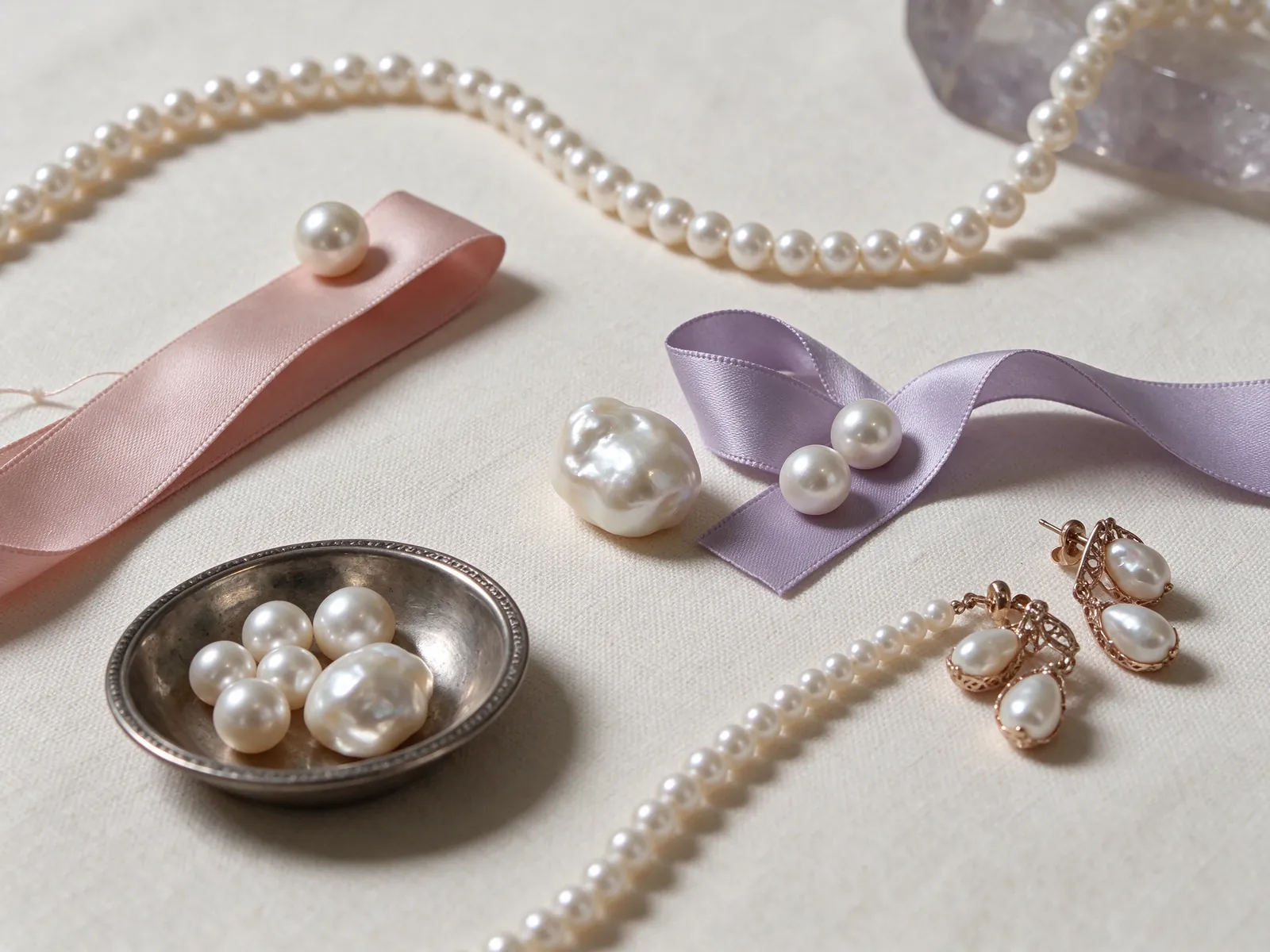
Read a multi-pearl range alongside the arrangement
A common interval allows individual variation; it does not promise identical measurements. First ask whether the design is intended to have an even visual rhythm or a deliberate progression in size. Consistent arrangements call for attention to neighboring outlines, while changing arrangements call for attention to the sequence. The interval's endpoints cannot reveal where the larger or smaller pearls sit within the design.
The guide to pearl matching quality explains why a coordinated appearance cannot be reduced to one size group. Shape, color, luster and surface features can affect the result when diameters are similar. A deliberate progression in diameter can also be visually coherent. Tell the seller whether uniformity or a graduated rhythm matters to you, then examine the whole arrangement. The shared interval gives a numerical boundary, not a verdict about how well all the other factors match.
Ask whether the interval covers every pearl shown
Confirm whether the stated range refers to all pearls or just a principal element. If multiple dimensions are supplied, ask how they relate to positions in the design. This ties the numerical description to the arrangement rather than treating its largest pearl as the size of every pearl. Evaluate the whole view as well, because matching cannot be reduced to a column of numbers.

Keep diameter independent of quality labels and documents
GIA describes seven pearl value factors: size, shape, color, luster, surface quality, nacre quality and matching, with matching relevant to jewelry containing two or more pearls. Diameter supplies size information, not conclusions about the other factors. A larger measurement alone cannot prove stronger luster, superior surface quality or pearl identity. When relating size to value, keep the pearl type and other factors equal. Otherwise, the larger number is not a sound basis for deciding price or an overall quality grade.
For an accompanying pearl document, check who issued it, which pearl or jewelry piece it describes and the measurements it actually records. The explanation of how to read a pearl certificate helps separate documentary information from a sales label. Use the pearl grading guide to put seller terms such as AAA in context rather than treating them as a universal scale. Neither a larger measurement nor a group name creates a certificate. Documentation also does not automatically guarantee a price, retained value or service outcome. Read any recorded range as a range, not an exact upper-limit measurement for every pearl.
Choose a preferred scale, then review the other information
Begin with the silhouette you enjoy and the visual emphasis you want. Then compare quality information without allowing the biggest number to dominate every category. Where a document uses an interval, preserve that interval and its stated meaning. Its upper boundary should not be converted into an exact measurement claimed for every pearl described by the document.
Make your size inquiry specific and easy to answer
Save the exact wording and the relevant image before asking questions. Work through four points: what object is measured, whether the figure is individual or grouped, what boundaries apply and which pearls are covered. Asking in this order avoids a conversation in which one answer describes the pearl and the next describes the complete piece, even though both answers use millimeters.
After clarifying the notation, return to Pearl Jewelry to relate the design to your preferred style. Retain the written dimensions and image angles, with a short description of the effect you want. In a WhatsApp inquiry to Flint Jewelry, share the original label and image and explain whether the question concerns a range, an individual dimension or measurement direction. WSP's examples are reading aids, not statements that Flint offers those diameters, uses those groupings or provides that brand's services.
Use wording that does not presume an UP definition
Try: “Is this an individual measurement or a size range? Please explain the lower and upper boundaries, whether the endpoints are included, and whether this applies to all the pearls pictured.” Add a question about measurement direction if the outline is elongated. This keeps the original notation intact and produces information that can be compared fairly with another description.
| Written label or value | Lower boundary described by WSP | Upper boundary described by WSP | Endpoint meaning | What to retain in your comparison |
|---|---|---|---|---|
| 7.0–7.5mm | 7.0mm | Less than 7.5mm | Includes the lower limit and excludes the upper limit | A grouping rather than one exact diameter |
| 7.0mm | The starting point of the 7.0–7.5mm group | The group still stops before 7.5mm | The starting value is included | The original decimal and group description |
| 7.49mm | A value within the 7.0–7.5mm group | The maximum WSP states for that group | Below the excluded 7.5mm endpoint | Individual measurements can differ within a group |
| 7.5mm | Not a member of the preceding group | Outside the 7.0–7.5mm interval | Excluded from that interval | The upper label is not a promised actual measurement |
| 9mm UP | 9.0mm | Less than 10.0mm; stated as up to 9.9mm | A defined upper limit in WSP's notation | Other sellers need their own UP explanation |
Pearl knowledge and authoritative references
In WSP's published examples, 7.0–7.5mm includes 7.0mm but not 7.5mm, with 7.49mm stated as the maximum; 9mm UP is stated as 9.0–9.9mm. These endpoint rules belong to WSP's grouping and do not define every seller's UP label.
Read the reference for this factFrequently asked questions
What does the dash in 7.0–7.5mm tell me?
It indicates a range rather than one exact diameter. WSP includes 7.0mm but excludes 7.5mm in its example, stating 7.49mm as the maximum. Check the seller's boundary explanation rather than assuming both endpoints are included.
Does UP always mean there is no maximum?
No universal conclusion follows from UP alone. WSP defines its 9mm UP group as 9.0mm to below 10.0mm, stated as up to 9.9mm. Ask another seller to explain its own boundaries before comparing that label.
Should I use overall jewelry width to compare pearl diameters?
No. Overall width can include the frame and other elements. Compare pearl diameter with pearl diameter, then assess the finished design's footprint separately. Both dimensions may be useful, but they describe different objects.
What should I ask when a pearl is elongated?
Ask which direction the stated measurement follows and whether separate length and width are available. Front and side views help with the outline. Do not use shape alone to infer pearl identity or origin.
Does a shared size range establish matching quality?
No. Measurements can vary inside a range, and matching also involves factors such as shape, color and luster. Confirm which pearls the interval describes and evaluate the arrangement as a whole rather than relying only on the endpoints.
Updated: