

Styling a Japanese Akoya pearl pendant necklace for everyday outfits
Begin with an outfit you reach for often: a button-front shirt, a crew-neck tee or a knit top. Decide whether you want the pendant framed by an open neckline or visible against fabric. A piece resting exactly on the neckline edge may slip in and out of view as you move. When exploring a pearl pendant, include an upper-body outfit view in your comparison rather than relying only on a magnified image of the pearl. To talk about pendant placement with your favorite necklines, contact us on WhatsApp at +85260106207.
A V-neck creates a central line for the pendant to follow, but its lowest point is not a required destination. With a broad square neckline, consider whether the setting leaves enough open space around it. A high neckline gives the pendant a fabric background instead of a skin background. Add the cardigan or jacket you normally wear and look again: layers can change both the visible chain curve and the emphasis of the entire outfit.
Finding the right chain length for a Japanese Akoya pearl pendant necklace
Think of chain length as part of fit, not a stand-alone answer. Neck circumference, shoulders, pendant height and the fastened chain's curve affect where the pearl sits. Check the view while standing and seated, then notice what happens when you turn or lean forward. For an adjustable necklace, understand how the fastening and adjustment positions work. Use model images to explore ideas, but do not expect their exact pendant placement to transfer to your body.

Separate pearl identity, origin and design language
Akoya and the Chinese name 阿古屋 are versions of the same name, not two quality tiers. Pendant necklace names a jewelry format, while Japanese origin refers to information about an individual pearl. A Japanese-inspired setting does not establish where that pearl came from. Reading what are Akoya pearls is a useful starting point for these distinctions, but a white color or round shape alone cannot identify the pearl in a particular piece.
GIA’s pearl description notes that Akoya pearls are produced in Japan and China, so the Akoya name alone does not establish Japanese origin. Look at the subject of each statement in a description. Does it discuss the pearl's origin, the setting's appearance or where the jewelry was made? Those statements answer different questions. A Japanese Akoya pearl pendant description should be read at the level of the individual piece rather than expanded into assumptions about all similar-looking pendants. When choosing a gift, you can explain the recipient's style that guided you without adding an unsupported origin story.
Know what a document can answer
First determine which pearl or piece a document refers to, then read its identity and any origin information. Neither shape nor color establishes natural-versus-cultured status, and the phrase natural material does not mean wild natural pearl. An outfit photograph serves a different purpose: it helps assess scale, contrast and placement. Keep both kinds of information in their proper roles so that visual appeal does not become a substitute for identity information, or vice versa.

Evaluate the focal point beyond a bright highlight
A single-pearl pendant gives the eye a concentrated point of interest. Compare the clarity of reflections and observe the surface from changing angles. GIA identifies seven pearl value factors: size, shape, color, luster, surface quality, nacre quality and matching. The first six are the main considerations for a single-pearl pendant; matching becomes relevant when comparing multiple pearls. Luster, surface quality and nacre quality are separate observations, so one glowing highlight cannot answer every quality question. Differences in lighting, background and exposure also affect pictures. A brighter white image may be a photography difference rather than evidence that its pearl is the better choice.
Include the bail and setting when judging outline. A tall upper fitting changes the direction of the design, and a surrounding frame makes a larger visual shape against a top even without changing the pearl itself. A close view can help you observe the surface; a normal wearing-distance view shows how noticeable the whole piece becomes. Decide whether your priority is a gentle light-catching accent or a clearly defined shape before comparing individual designs.
Use other pendant topics to clarify your preferences
You can apply these same fit and appearance questions to a freshwater pearl pendant instead of deciding from its category name alone. A baroque pearl pendant is another useful outline comparison: irregular lines may create a different relationship with prints or structured clothing. Ask which shape language feels more like your everyday style. That comparison does not make an irregular outline proof of a particular pearl type, origin or natural-versus-cultured identity.
Check chain compatibility and the complete metal arrangement
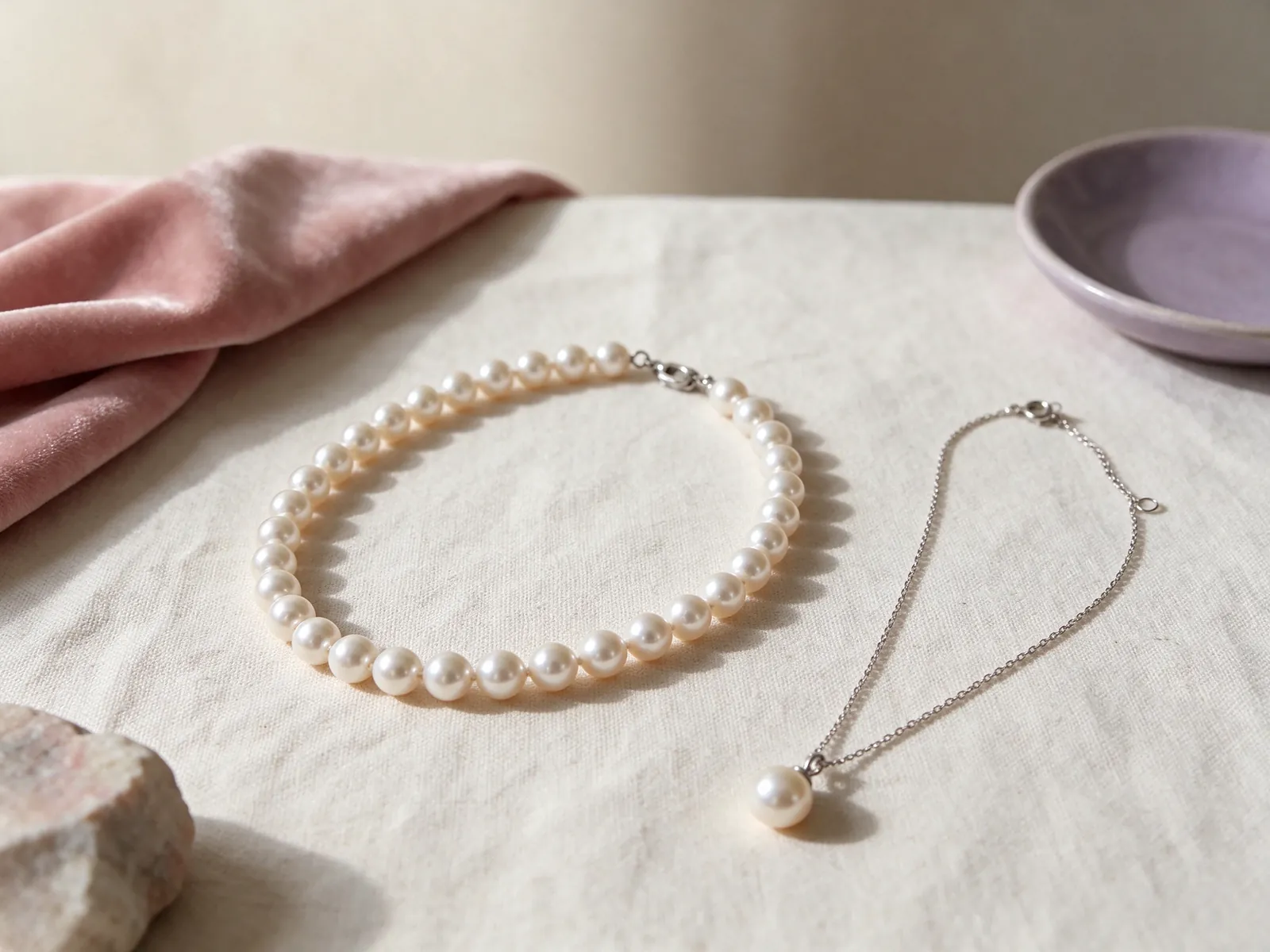
An existing chain is a practical starting point only if the pendant's structure allows it. Find out whether the piece is integrated with its chain or removable. With a removable pendant, compare the bail opening with the chain end and clasp, not just the narrow chain body. With an integrated necklace, evaluate the supplied arrangement as a whole rather than assuming you can replace the chain. Also think about how comfortably you operate the fastening yourself.
For metal color, take cues from your watch, earrings or the hardware on favorite clothes. The five material directions for discussion are 18K 750 white gold, 18K 750 yellow gold, 18K 750 rose gold, PT950 platinum and PT900 platinum. This list does not establish availability of any individual Akoya design. Matching every accessory is optional; a deliberate focal point and comfortable placement can tie an outfit together without making all its metal colors identical.
Consider how the pendant moves against fabric
Side and back views provide information missing from a straight-on image. Notice how far the setting projects and whether any details could catch a knit top. When worn against a smooth shirt, does the pendant turn or drift sideways? If you like layered necklaces, consider where the pendants meet and whether their clasps contact each other. These observations concern the combined wearing experience, not just the appeal of each component viewed separately on a screen.

Create a quieter or more noticeable look without a size rule
For a restrained everyday look, give the pendant room among shirt collars, jacket lapels and other accessories. Decide which element leads: noticeable earrings can pair with a quieter pendant, while a plain top and small earrings allow the necklace to lead. Check the crop used for video calls if that is part of your day. A necklace that looks balanced in a full-length mirror may read differently when only your shoulders and neckline are visible.
For dinner or a gathering, changing the surrounding outline may matter more than looking for a larger pearl. A halo pearl pendant helps you consider a framed center, while a pearl and diamond pendant explores how pearl luster and diamond reflections share attention. Which arrangement works with the neckline and pattern of your chosen outfit? Decoration is a design choice, not an automatic measure of formality or a guarantee that the piece works for every occasion.
Change the background before adding another accessory
Try the same necklace against a solid top and a patterned top. The chain's curve may become clear against a solid background and almost disappear into a detailed print. Open necklines show more of the chain; higher necklines make the pendant a shape on fabric. Photograph combinations you would actually wear and note which ones stay in position with little adjustment. Ease during ordinary movement is a useful part of choosing a style, not simply a compromise.

Make a gift choice personal rather than category-led
Consider the recipient's favorite necklace before deciding on a gift direction. Does she wear it close to her neck or over clothing? Are uniforms, high necklines or frequent layering part of her routine? Does she prefer a clasp she can easily handle? These questions offer more practical guidance than assigning a pearl size or grade by age. If possible, discuss which existing piece feels comfortable and what she enjoys about its position and outline.
A recipient who enjoys a darker focal point may find the Tahitian black pearl pendant topic useful for comparing visual contrast. The white South Sea pearl pendant topic offers another descriptive and design direction for someone who prefers white accents. In either case, return to the actual piece's outline and description. A category name alone does not establish size, price or which gift is more suitable, and it should not replace knowledge of the person's clothes.
Tell the recipient what inspired the choice
A specific gift message can mention a favorite neckline, an understated wardrobe or the accessories that inspired the choice. That is more meaningful than claiming the pendant suits everyone. If a much-loved chain is part of the recipient's routine, discuss whether keeping its familiar position matters before selecting a removable pendant arrangement. Include a short note about gentle wiping and separate storage if helpful, without attaching promises about waterproofness, permanent appearance or lifetime durability.

Use pearl-specific care for a necklace with metal components
GIA lists pearl at 2.5 on the Mohs hardness scale. For a pendant, avoiding friction against harder jewelry is a practical reason to store it separately in a soft space. Lay out the chain so it does not knot around other pieces. After wearing, use a very soft, clean cloth for gentle wiping. Keep perfume, hair spray and acidic substances away from the pearl, and avoid excessive heat rather than assuming the metal setting protects it from every exposure.
Pearls should never be cleaned in ultrasonic or steam cleaners, according to GIA. A cleaning technique that might be used for a metal component should not automatically be applied to the complete necklace. If the pearl becomes loose, a link changes shape or the clasp seems insecure, stop wearing it and ask a jewelry professional to examine the structure. Do not twist the pearl or use household glue. Cleaning a surface does not resolve a connection problem.
Keep the wearing routine simple and observant
Before wearing, check that the clasp is closed, the chain is free of knots and the pendant has not changed its usual position. Avoid forceful pulling as a test. Remove the necklace before using sprays or cleansing products at home, wipe it gently and store it with its chain arranged smoothly. During travel, keep it from repeatedly knocking against other pieces inside a bag. These are care habits, not a claim that it is suitable for swimming or every activity. To discuss Akoya pearl pendant placement, chain proportions or a thoughtful gift pairing, share your styling preferences on WhatsApp at +85260106207.
| Decision | What to look at | Wearing context | Useful action | Unhelpful shortcut |
|---|---|---|---|---|
| Placement | The gap around the neckline edge | Crew necks, shirts and layered outfits | Look while standing and seated | Treating a model's fit as universal |
| Visual quality | Reflections, surface and complete outline | A single focal point on a solid top | Compare angles and normal-distance views | Ranking pearls by image brightness |
| Identity wording | Pearl origin versus design or making location | Choosing and explaining a gift | Read each statement for its subject | Inferring origin from white color |
| Chain arrangement | Bail, chain end and clasp compatibility | Using a favorite existing chain | Determine whether the pendant is removable | Judging fit by chain body alone |
| Care | The pearl and its connection points | Home storage and travel | Use gentle wiping and separate storage | Applying all-metal cleaning methods |
Pearl knowledge and authoritative references
GIA identifies seven pearl value factors: size, shape, color, luster, surface quality, nacre quality and matching. For a single-pearl pendant, focus on the first six; matching matters when comparing multiple pearls. One bright highlight does not establish overall quality.
Read the reference for this factFrequently asked questions
Does Japanese-inspired styling prove a pearl's Japanese origin?
No. Design language, the location of jewelry making and the origin of an individual pearl are different information. Read what each statement refers to; color and shape do not establish origin.
How can I wear a pendant with a crew-neck top?
Decide whether the pendant should be fully above the fabric or fully visible on it. A position exactly at the edge can shift in and out of view. Check the result while moving and with your usual outer layer.
Do I need a larger pearl to create an evening focal point?
Not necessarily. A neckline change, a clearer background or the setting's outline can alter the emphasis. Compare the entire arrangement rather than treating size as a rule for formality.
What should I check before layering an Akoya pendant necklace?
Look at where the pendants meet, whether the clasps contact one another and whether either chain catches the other setting. Test comfortable movement instead of judging the combination only from a still photograph.
What if the pendant's pearl starts to feel loose?
Stop wearing the piece and have a jewelry professional examine the connection. Avoid twisting it or attempting a household-glue fix. A structural problem requires a different response from routine gentle surface wiping.
Updated: