

pearl blemishes explained: assessing pearl surface quality through the size and position of pearl growth marks
A useful surface comparison begins with the whole pearl, not a tally of dots on an enlarged photograph. A small mark near the edge and a conspicuous depression in the centre can affect the view differently. WSP’s surface discussion likewise considers the position and size of marks, and their balance with lustre, alongside the count. Note the relative extent and whether marks are clustered, then return to the overall appearance to decide which details actually draw your attention.
Lustre belongs in this comparison because brightness and reflections influence the way surface detail is seen. The guide to how to judge pearl lustre helps you assess that separate quality alongside marks. A lively reflection does not establish a flawless surface, while a smooth-looking pearl does not necessarily have the strongest lustre. Neither observation should stand in for the other.
pearl blemishes explained: why consider pearl growth marks alongside lustre when judging pearl surface quality?
Rotate each candidate in the same light and notice whether your eye follows the reflection or repeatedly returns to a particular mark. This gives you a practical sense of the balance between detail and overall appearance. It is not a rule that good lustre cancels every surface concern: suspected cracks, chips or peeling call for a separate explanation of condition.

Describe what you see without guessing its origin
Use straightforward descriptions such as a depression, a raised area, a line or an uneven patch. Ask whether the feature is isolated or extends across the visible face. This is more informative than calling the entire pearl defective. It also gives the person showing the piece a clear location to demonstrate, rather than leaving both parties to interpret a general word such as blemish.
Growth marks are surface observations, not proof that a pearl is natural rather than cultured. Nor can a line in one photograph reliably establish when or how it formed. If identity or treatment information matters to your purchase, how to read a pearl certificate explains why the document's scope must be distinguished from an ordinary photograph. Check that the report corresponds to the pearl or piece being discussed and read which examinations it records. Identification does not automatically amount to a complete quality assessment, a valuation or a service guarantee.
Keep possible residue separate from a condition question
An unclear dark spot is a reason to request a better view, not to scrape the pearl with a nail or test it with a solvent. Ask for a softly lit close-up of the area and its surroundings. If the feature looks like a chip, crack or peeling surface, request an explanation rather than assuming it is harmless growth texture. A photograph alone may leave the distinction unresolved.
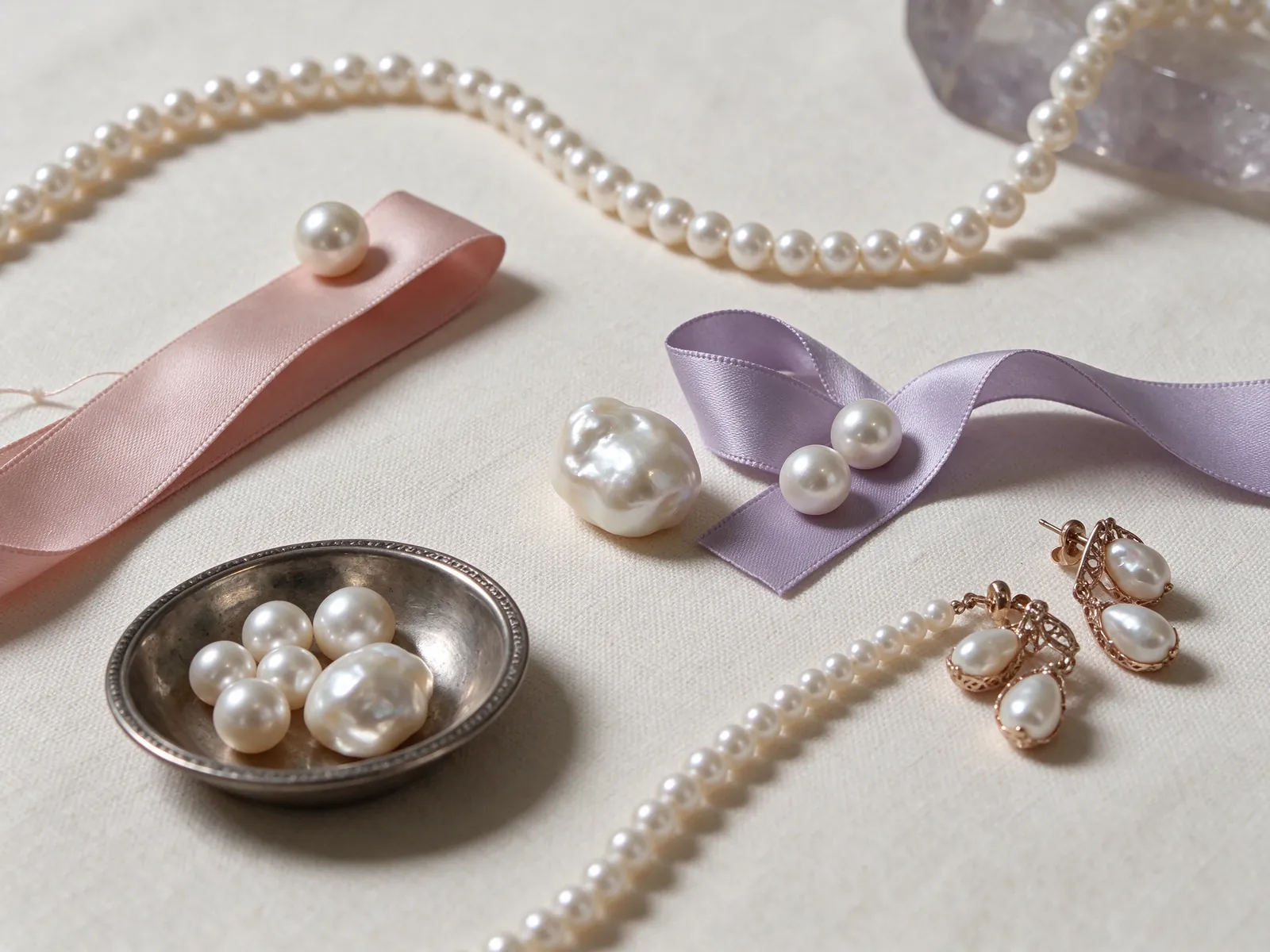
Build a fair comparison with lighting and scale
Photographs taken against different backgrounds or with different exposure are not an even contest. A strong spotlight may produce a brilliant highlight while leaving other areas in shadow. Start with consistent, gentle illumination and a similar presentation for both pearls. Follow this with changing angles so that a mark concealed by a reflection in one view can be understood in another.
Use close-ups to locate detail and a wearing view to judge its practical importance. Keep the enlargement comparable when looking at two candidates; a larger image can make modest surface features seem disproportionately prominent. The pearl size guide is useful for jewellery proportions, but an on-screen image is not a measurement of diameter and cannot establish the physical extent of a mark.
Request a sequence rather than one flattering angle
For an online discussion, ask to see the front, sides and back of the same pearl, with a short rotation video where useful. Confirm which face is intended to point outwards in the finished piece. A continuous sequence helps connect a particular mark across views; a single bright frontal image cannot explain the entire surface or the areas hidden by the setting.
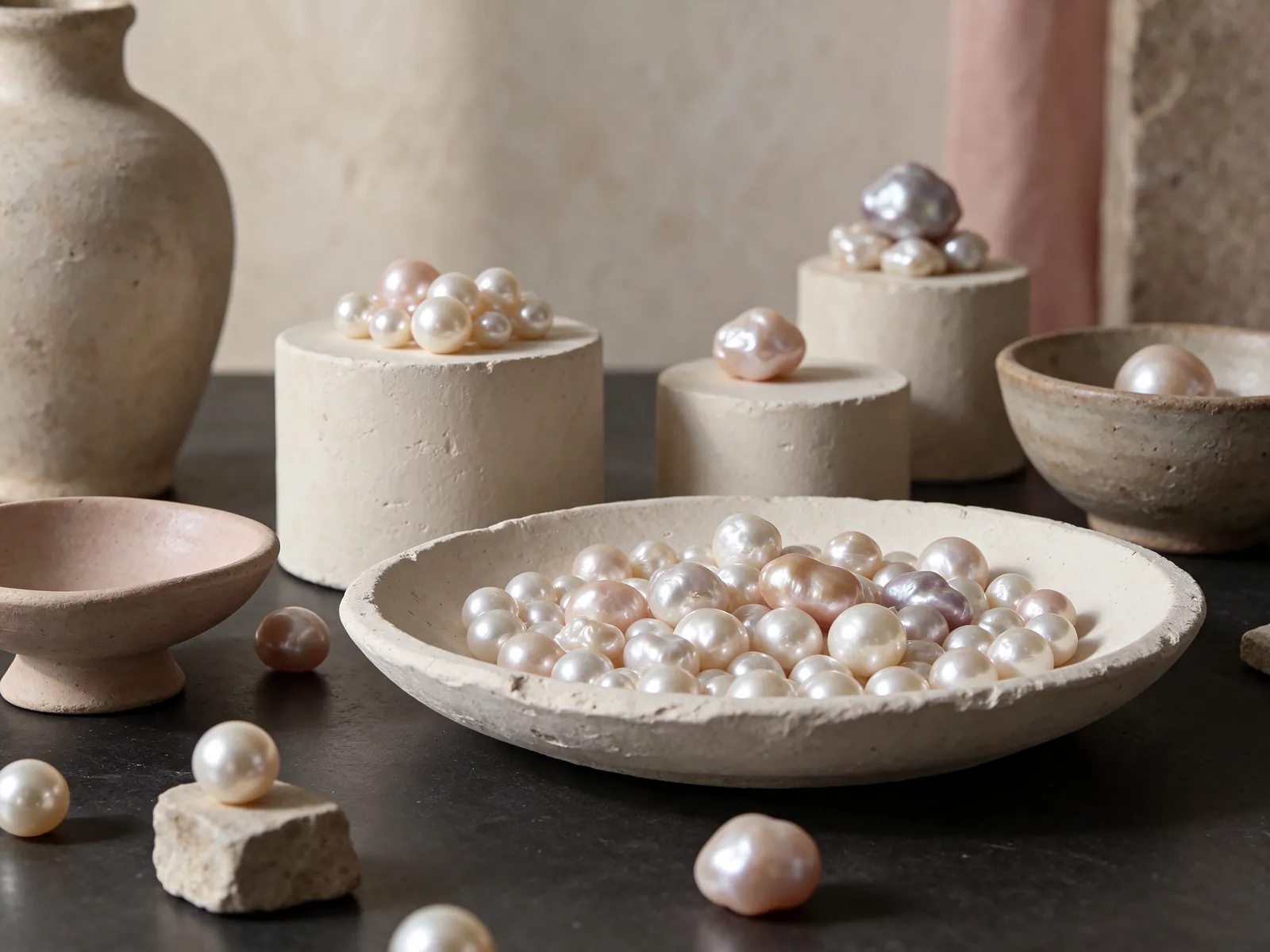
Evaluate the face that will actually be worn
A pendant has a main viewing face, but it may turn as it moves against clothing. An earring's outward face depends on its fitted orientation, not simply on the cleanest side chosen for a photograph. Ask for the piece to be shown as worn. Consider how the pearl, its setting and the direction of the jewellery combine to make a particular mark more or less noticeable.
The back is therefore an aesthetic consideration, not a place where condition stops mattering. Around a visible drill opening or setting edge, request a clear view of any apparent missing material or irregularity. Parts concealed by metal cannot be assessed directly from that view. A setting that reduces the visibility of a mark does not, by itself, demonstrate that an underlying condition issue has been resolved.
Ask what changes when the piece moves
Imagine the pendant turning, the earring being viewed from the side or the ring moving with your hand. Would the mark move into the principal view? This question is more useful than accepting a simple statement that nobody will see it. Once you understand the likely orientation, you can make a personal choice about appearance without confusing concealment with a guarantee of sound condition.
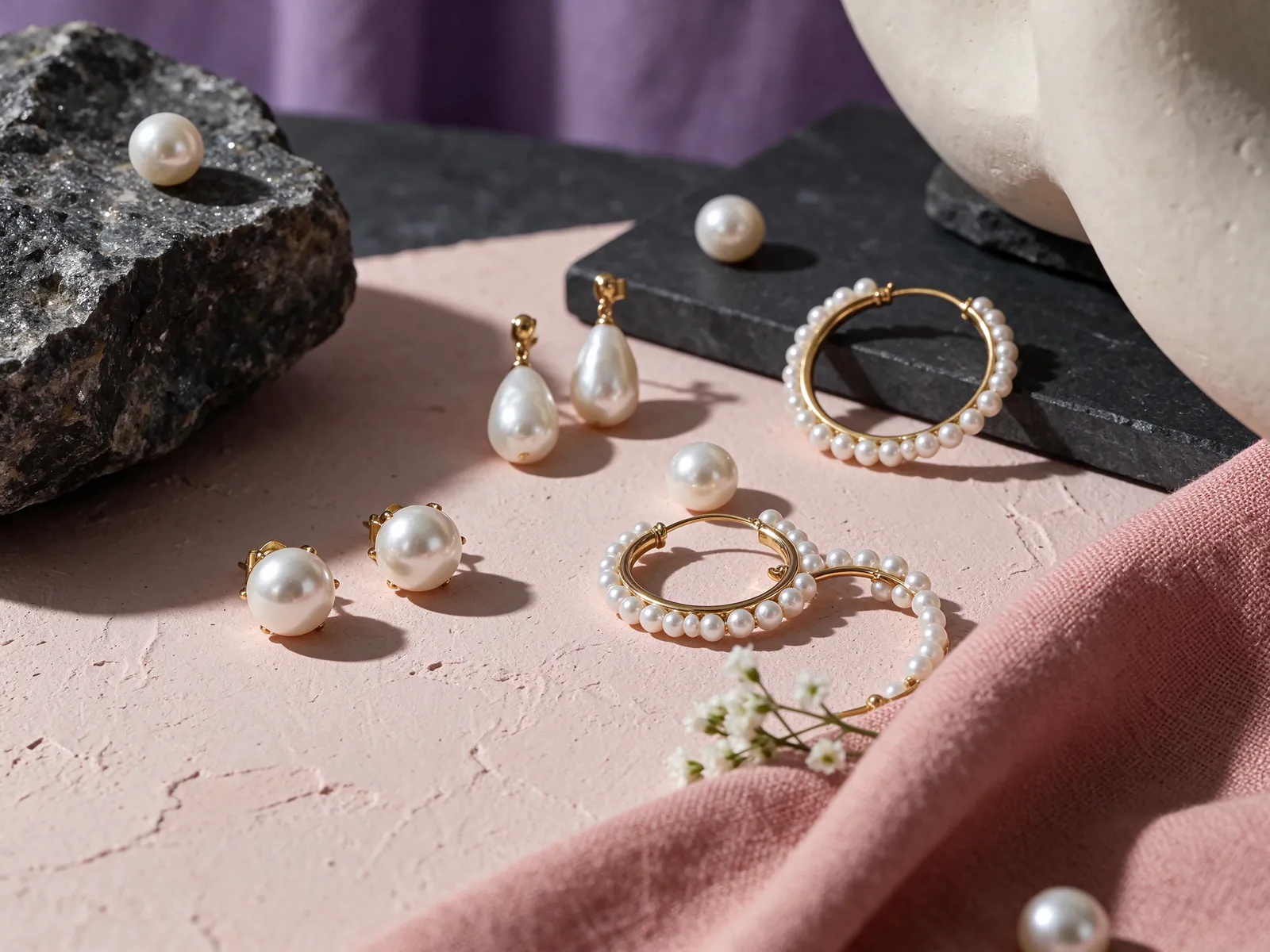
Change your priorities for earrings, strands and rings
For earrings, place both pearls together and compare their outward-facing appearance. A difference in brightness or shape can disrupt the pair even when each pearl looks relatively clean on its own. The discussion of pearl matching quality adds this group perspective: choosing the least-marked individual pearl is not necessarily the same task as choosing a visually balanced pair.
For a strand, look at the entire line before inspecting individual pearls. Pay attention to the visible front section as well as the transition towards the clasp. A ring receives changing views whenever the hand moves, so a side mark may be more relevant than it would be on a consistently oriented pendant. Styling priorities should reflect these differences rather than applying one fixed surface preference to every jewellery type.
Choose the viewing context that matters to you
Someone wearing pearls chiefly for everyday conversation may prioritise overall lustre and coordination, while someone who often looks closely at a ring may be more sensitive to local detail. Both preferences are reasonable. Explain whether a clean central face or harmonious pair matters most, and use the intended clothing and orientation to test the view. Personal tolerance changes the selection, not the underlying facts about condition.

Put surface quality within the wider value picture
GIA describes seven pearl value factors: size, shape, colour, lustre, surface quality, nacre quality and matching. Matching is relevant when a piece contains two or more pearls, such as earrings or a strand. Surface is one part of an assessment, not its total. Use the pearl grading guide to organise observations across those factors. A few visible marks do not answer every quality question, and a smooth photograph does not establish that all the other factors are exceptional.
Do not convert smoothness into an assumed nacre measurement. The topic of pearl nacre thickness is a separate subject requiring appropriate information; counting pits or judging reflection in a photograph cannot supply a thickness figure. Similarly, what determines pearl value is broader than a blemish count. Compare the whole set of stated characteristics rather than expecting a simple price formula based on the number of marks.
Ask what a descriptive grade actually covers
When a description says nearly flawless or uses a seller’s AAA or AAAA label, ask whether it refers to unaided appearance, the principal face or the complete surface. Establish the observation conditions and request the corresponding views. Such commercial labels have no worldwide numerical equivalence and should not be treated as GIA grades. A label cannot replace a demonstration of the pearl, and attractive terminology does not independently identify origin, natural-versus-cultured status or treatments.

Make a deliberate choice and protect the surface afterwards
Before choosing, separate three questions: which visible detail you dislike, whether it remains prominent when worn, and whether any possible damage still needs explanation. A specific request such as showing a line while the pendant turns is more useful than asking for perfection. You may reasonably accept minor detail that does not distract you, or decline a piece whose main face continually draws your eye to a mark.
Care is intended to protect the pearl, not to erase its growth texture. GIA lists pearl at 2.5 on the Mohs hardness scale and says never to use ultrasonic or steam cleaners. After wearing, use a very soft clean cloth and avoid acids, perfume, hair spray and excessive heat. Abrasive attempts to flatten a mark can create a new surface problem instead of addressing your original concern.
Treat a newly noticed mark as a question to investigate
Record the area under similar lighting if you notice a new-looking line or chip, and avoid wear that rubs that spot while seeking an appropriate assessment. Do not repeatedly clean an uncertain feature in the hope that it will disappear. Before any water cleaning, consider the string, adhesive and setting of the whole piece; general pearl-care advice is not permission to soak every construction, and prolonged immersion should be avoided. If the string becomes wet, GIA advises allowing it to dry completely before wearing. Do not use high heat to hurry drying. Routine cleaning cannot promise to remove texture or repair damage.
| Observation | How to compare | Wearing relevance | Useful question |
|---|---|---|---|
| Position of a mark | View the front, sides and back | Movement may bring another face into view | Which face points outwards when worn? |
| Relative extent | Use comparable lighting and enlargement | A concentrated central feature can draw the eye | Can I see both the whole pearl and this area? |
| Lustre balance | Rotate the pearl and follow the reflection | Overall brightness and local detail work together | Can it be shown without a strong spotlight? |
| Pair or strand consistency | See the earrings together or the complete strand | Coordination matters beyond individual surfaces | Can the pieces be compared in their wearing orientation? |
| Possible damage | Request a clear view of a chip, crack or peeling area | A hidden position does not settle a condition concern | What is known about this particular feature? |
Pearl knowledge and authoritative references
GIA identifies seven pearl value factors: size, shape, colour, lustre, surface quality, nacre quality and matching. Matching is considered for jewellery with two or more pearls; surface quality alone is not the complete assessment.
Read the reference for this factFrequently asked questions
Does a growth mark establish that a pearl is natural?
No. Growth marks describe surface features and do not establish natural rather than cultured identity. Where identity matters, confirm that the relevant report corresponds to the pearl or piece, then read its identification results and scope instead of treating texture as proof.
Should I reject a pendant with a mark on its back?
Not automatically. First establish how the pendant sits and whether it turns, then separate your appearance preference from any question about damage. A less visible position can be acceptable to you without proving anything about condition.
Why does a mark disappear in one photograph?
Lighting, reflection and viewing angle affect visibility. Request another angle and a consistent presentation before concluding that the mark has disappeared or that the surface is uniformly clean.
Can two lightly marked pearls make a better-looking pair than cleaner individual pearls?
They can suit your preference better if their outward appearance is more coordinated. Compare brightness, shape and visible surface detail together; matching is not determined solely by choosing the fewest marks.
Will normal cleaning remove an existing growth line?
Normal care is not a method for erasing growth texture. Use a very soft clean cloth as GIA recommends, avoid abrasive experiments, and do not use ultrasonic or steam cleaners. An unclear feature warrants assessment rather than repeated attempts to polish it away.
Updated: