
Diamond 4C Buying Guide: Industry Secrets for Smart Purchasing
Want to buy a diamond without overpaying? This guide reveals industry secrets about the 4Cs — Cut, Colour, Clarity, Carat — and how to maximise value. Book a free consultation with Flint Jewellery!
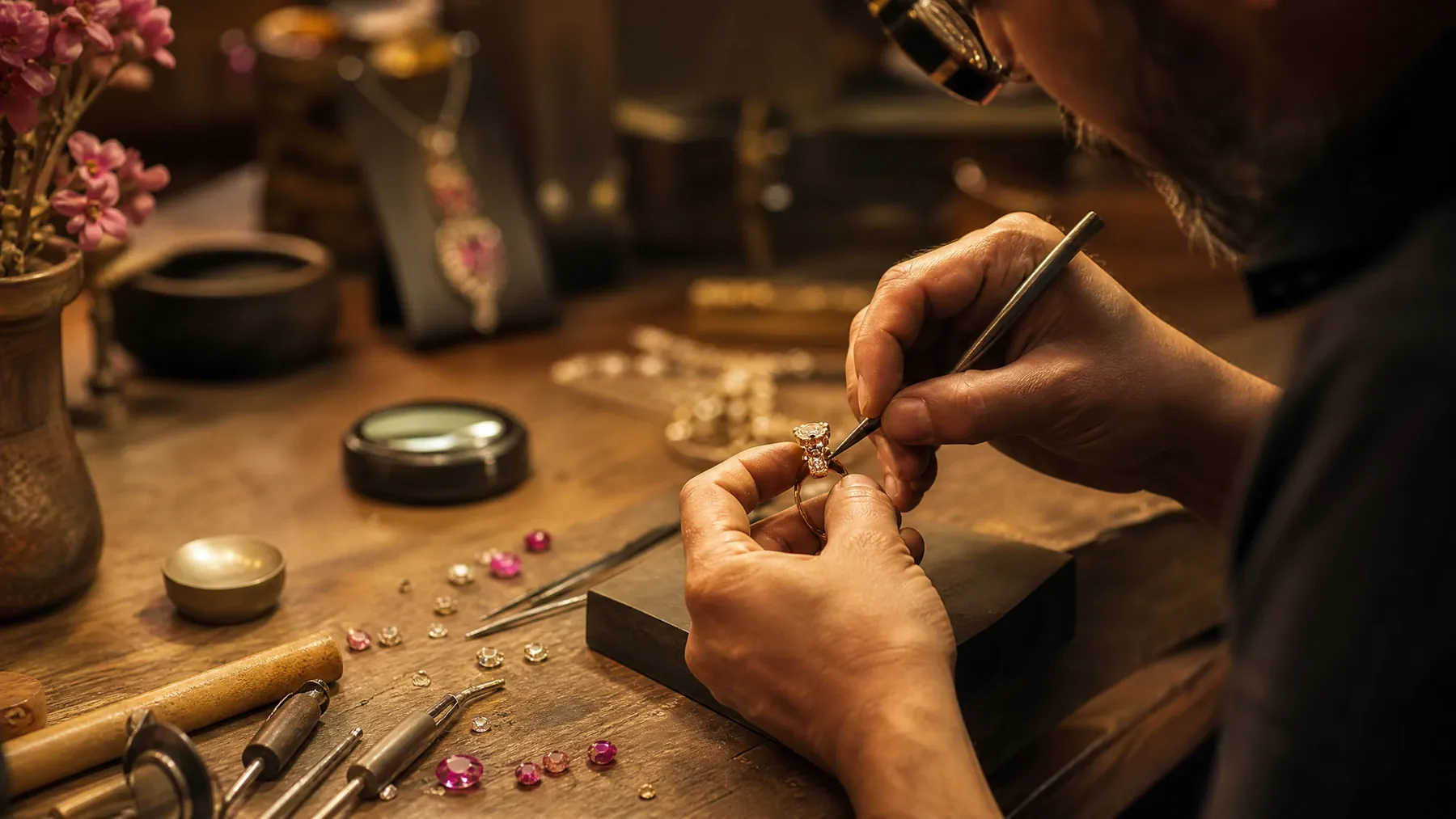
Walking into a jewellery store, faced with a dazzling array of diamonds and densely packed grading certificates, do you feel overwhelmed? Many couples choosing engagement rings often find themselves dizzy from the huge price differences and complex professional jargon. According to our years of industry data, over 70% of first-time diamond buyers end up spending unnecessary money on specifications that are indistinguishable to the naked eye, simply because they don't understand the true market conditions.
As a senior jeweller at Flint Jewellery, I have seen too many clients struggle between budget and quality. In fact, as long as you grasp the core logic of the Diamond 4Cs, you can completely avoid consumer traps. This article will deeply deconstruct the secrets of buying diamonds based on the 4Cs, teaching you how to spend every penny wisely like an insider, and select the most cost-effective, brilliant, and perfect diamond.
What are the Diamond 4Cs? A Jeweller's Professional Interpretation and Market Reality
Before delving into purchasing strategies, we must first establish a correct understanding of the basic concepts. The so-called Diamond 4Cs is a globally recognised diamond grading standard created by the Gemological Institute of America (GIA) in the mid-20th century. These four Cs stand for: Cut, Colour, Clarity, and Carat Weight. Together, these four dimensions determine the rarity of a diamond, which directly affects its market price.
When many clients come to our studio for custom diamonds, the first question they usually ask is: "Which of these four Cs is the most important?" Actually, this is not a multiple-choice question, but a comprehensive consideration of budget allocation. Every diamond is a miracle of nature, but human processing techniques and market pricing mechanisms endow them with different commercial values.
Over the past decade or so, I have personally appraised tens of thousands of loose diamonds. I've noticed a very interesting phenomenon: most consumers will do crazy amounts of research online before buying, pursuing so-called "top-tier parameters". But when they actually compare two diamonds with different parameters but vastly different prices under natural light, they are often surprised to find that they can't see any difference with the naked eye. This is why we need to deeply understand the true meaning of the Diamond 4Cs, rather than blindly pursuing the highest grades on a certificate.
Why do the Diamond 4Cs have such a huge impact on price?
The pricing mechanism for diamonds is a very rigorous mathematical model. In the Rapaport Diamond Report, the price is cross-referenced based on three dimensions: carat weight, colour, and clarity, while the cut will generate a premium or discount based on this foundation.
To give a specific example, a top-tier diamond that is 1 carat, D colour, and IF clarity (Internally Flawless) might cost twice or even three times as much as another diamond that is also 1 carat, H colour, and VS2 clarity. However, at a normal social distance for daily wear, the visual difference between these two diamonds is minuscule.
This huge price gap stems precisely from the extreme scarcity of top-tier parameters in nature. Therefore, understanding the Diamond 4Cs is essentially understanding how to find the balance that suits you best in this game of "scarcity versus visual effect".
Diamond 4C Buying Secret 1: Cut Determines How Brilliant the Diamond Is
If I had to rank the Diamond 4Cs, I would unhesitatingly put "Cut" in first place. Cut is the only factor entirely determined by human skill, and it directly gives a diamond its soul. The reason a diamond can be dazzlingly brilliant is entirely due to precise facet proportions that perfectly refract the light entering the diamond.
The GIA divides cut into five grades: Excellent, Very Good, Good, Fair, and Poor. During the process of customising diamond rings for our clients, I always stick to one principle: no matter how tight the budget is, the cut grade must never be compromised; you must choose Excellent.
"Cut is the soul of a diamond. No matter how high the colour and clarity of a diamond are, if the cut is poor, light will leak from the bottom, and it will just look like a dull stone, completely losing the fire and vitality a diamond should have."
How to choose the most perfect diamond cut?
Besides the overall Cut Grade, we also need to pay attention to Polish and Symmetry. If all three of these indicators reach Excellent, we call it "3EX" in the industry. A diamond with a 3EX cut can display the ultimate Brilliance, Fire, and Scintillation.
Furthermore, if you are pursuing an even more extreme visual effect, you can also pay attention to the diamond's Fluorescence. Generally speaking, we recommend choosing diamonds with None or Faint fluorescence.
Strong fluorescence might make a diamond look somewhat milky under natural light, affecting its transparency. However, in certain specific situations, moderate fluorescence can actually make a yellowish diamond look whiter, which requires a professional jeweller to check for you.
Diamond 4C Buying Secret 2: The Cost-Effectiveness Balance of Colour and Clarity
Colour and clarity are the two dimensions consumers struggle with the most. The GIA's colour grading extends from D (colourless) all the way to Z (light yellow). D, E, and F belong to the colourless range, while G, H, I, and J belong to the near-colourless range.
From a cost-effectiveness perspective, I strongly recommend focusing on G or H colour. Why? Because once set in a ring, especially if you choose a rose gold or yellow gold setting, G and H colour diamonds look almost indistinguishable from D colour to the naked eye, but you can save 20% to 30% on the price.
In recent years, with the advancement of technology, more and more young people pursuing high cost-effectiveness have started choosing custom lab-grown diamonds. Lab-grown diamonds are completely identical to natural diamonds in their physical and chemical properties, but with the same budget, you can easily buy top specifications like D colour and VVS clarity, making it a very modern choice worth considering.
When the budget is limited, how should you choose between colour and clarity?
Clarity refers to the degree of internal Inclusions and external Blemishes in a diamond. It ranges from Flawless (FL/IF) to Very Very Slightly Included (VVS1/VVS2), then to Very Slightly Included (VS1/VS2) and Slightly Included (SI1/SI2).
My professional advice is: just aim for "Eye-clean". The inclusions in VS1 and VS2 grade diamonds require a professional appraiser to see under a 10x loupe, and they have absolutely no impact on daily wear. If your budget is limited, you can even choose a clean SI1 diamond and invest the money saved into a larger carat size.
To help everyone intuitively understand the differences between various configurations, I have compiled the following comparison table:
| Diamond Configuration Strategy | Colour Grade | Clarity Grade | Visual Effect | Price Index | Suitable For |
|---|---|---|---|---|---|
| Top-tier Collector | D - E | IF - VVS1 | Extremely pure, flawless | ⭐⭐⭐⭐⭐ | Ample budget, pursuing ultimate perfection, needs investment value |
| High Cost-Effectiveness | G - H | VS1 - VS2 | Eye-clean, excellent for daily wear | ⭐⭐⭐ | Pursuing pragmatism, smart buyers hoping to balance size and quality |
| Budget Limit | I - J | SI1 (needs careful selection) | Slightly warm tone, need to avoid obvious black spots | ⭐⭐ | Limited budget, but hoping to buy the largest possible carat size |
Diamond 4C Buying Secret 3: The Visual Illusion of Carat Size
Carat is the unit of weight for a diamond, with 1 carat equalling 0.2 grams. Many clients mistakenly believe that carat is the diameter size of the diamond, which is actually a common misconception. A 1-carat diamond cut too deep might look smaller face-up than a well-cut 0.9-carat diamond.
When choosing carat weight, there is a phenomenon known to insiders as the "carat premium". The price of diamonds jumps significantly at whole number marks (like 0.5 carats, 1.0 carats, 1.5 carats). Therefore, if you want to save money smartly, you can look for those "critical weight" diamonds weighing between 0.90-0.99 carats, or 1.40-1.49 carats.
Visually, they are almost indistinguishable from whole-carat diamonds, but the price can be 10% to 15% cheaper. If you have an old diamond and feel the style is outdated or it looks too small, you actually don't need to buy a new one. Through professional diamond redesign services, we can redesign the setting for you, using visual illusions to give the diamond a new lease of life.
How to make a diamond look bigger than its actual carat weight?
Besides choosing a critical weight, the design of the setting has a decisive impact on the visual size of the diamond. Here are a few magnifying secrets commonly used by jewellers:
- Halo Setting: Setting a circle of tiny melee diamonds around the centre stone. This not only increases the overall brilliance but also visually makes the centre stone look 0.3 to 0.5 carats larger.
- Six-Prong Setting: Compared to a four-prong setting, a six-prong setting can make a round diamond look rounder and fuller, thereby creating an illusion of enlargement.
- Tapered Band Design: Making the band thinner near the centre stone, using the contrast effect to highlight the volume of the centre stone.
Jeweller's Private Collection: Diamond 4C Configuration Advice for Different Budgets and Subsequent Care
After understanding the various dimensions of the Diamond 4Cs, the most crucial part is how to apply this knowledge to actual purchasing. As a jeweller who solves difficult problems for clients every day, I have summarised three of the most practical configuration plans:
Plan 1: Budget between 20,000 and 30,000 HKD. I recommend choosing a centre stone of 0.5 to 0.7 carats, colour set at G-H, clarity VS2, and the cut must be 3EX. This configuration ensures the diamond is brilliant enough and no flaws can be seen with the naked eye, making it very suitable for daily wear.
Plan 2: Budget between 50,000 and 80,000 HKD. This is a budget range where you can aim for 1 carat. To ensure the visual impact of 1 carat, it is recommended to choose 1.01-1.05 carats (to avoid the risk of wear right on the 1-carat edge), H colour, SI1 clarity (must be checked by a professional to ensure inclusions are not right in the centre of the table), and 3EX cut.
Plan 3: Budget over 100,000 HKD. You can easily choose a high-quality diamond of 1.2 to 1.5 carats, or opt for a top-tier 1-carat D colour VVS diamond.
No matter which configuration you choose, the brilliance of a diamond requires careful daily maintenance. After wearing it for a long time, hand cream, oils, and dust will adhere to the surface of the diamond, causing it to lose its lustre. We strongly recommend clients bring their rings back to the studio every six months for professional cleaning. If you notice loose or deformed prongs, timely diamond ring repair is a necessary measure to protect this precious token.
Conclusion: Flexibly Apply the Diamond 4Cs to Create Your Perfect Custom Diamond Ring
Choosing a diamond is never a blind comparison of data, but an artistic journey to find the perfect balance. Reviewing the Diamond 4C buying secrets we shared today: first, always put Cut first, as this is the soul of a diamond's brilliance; second, learn to compromise on Colour and Clarity, aiming for the highly cost-effective eye-clean range; finally, cleverly use the critical weight of Carats and setting design to maximise the value of your budget.
As a jewellery professional, I always believe that the most perfect diamond is not the one with top grades in every indicator on the certificate, but the one that best fits your budget and best represents your feelings. Behind every custom diamond ring lies a unique love story, and our mission is to use our professional knowledge to escort this love.
If you are planning a proposal, or have any further questions about choosing a diamond, don't struggle alone. Feel free to contact the professional team at Flint Jewellery via WhatsApp at any time. We offer a free initial consultation service, let me personally analyse your budget and select that brilliant diamond exclusively for you!
About the Author: Master Chan is a GIA-certified diamond appraiser and senior designer at Flint Jewellery with over 15 years of fine jewellery experience. He specialises in diamond selection and custom design, helping clients find the perfect stone within their budget.